Buy Telegram Subscribers: Start With the Free Counters
Four Counters, Two of Them Free to Move
Telegram gives an owner four numbers to worry about: members on the channel or group, views under each post, reactions beside them, and comments if a discussion group is attached. Two of them can be moved without paying anyone, and the honest ranking is that free views are the cheapest and least convincing, free reactions are the most convincing and the most dangerous to fake, and the member count is the only one a stranger reads before deciding whether to join.
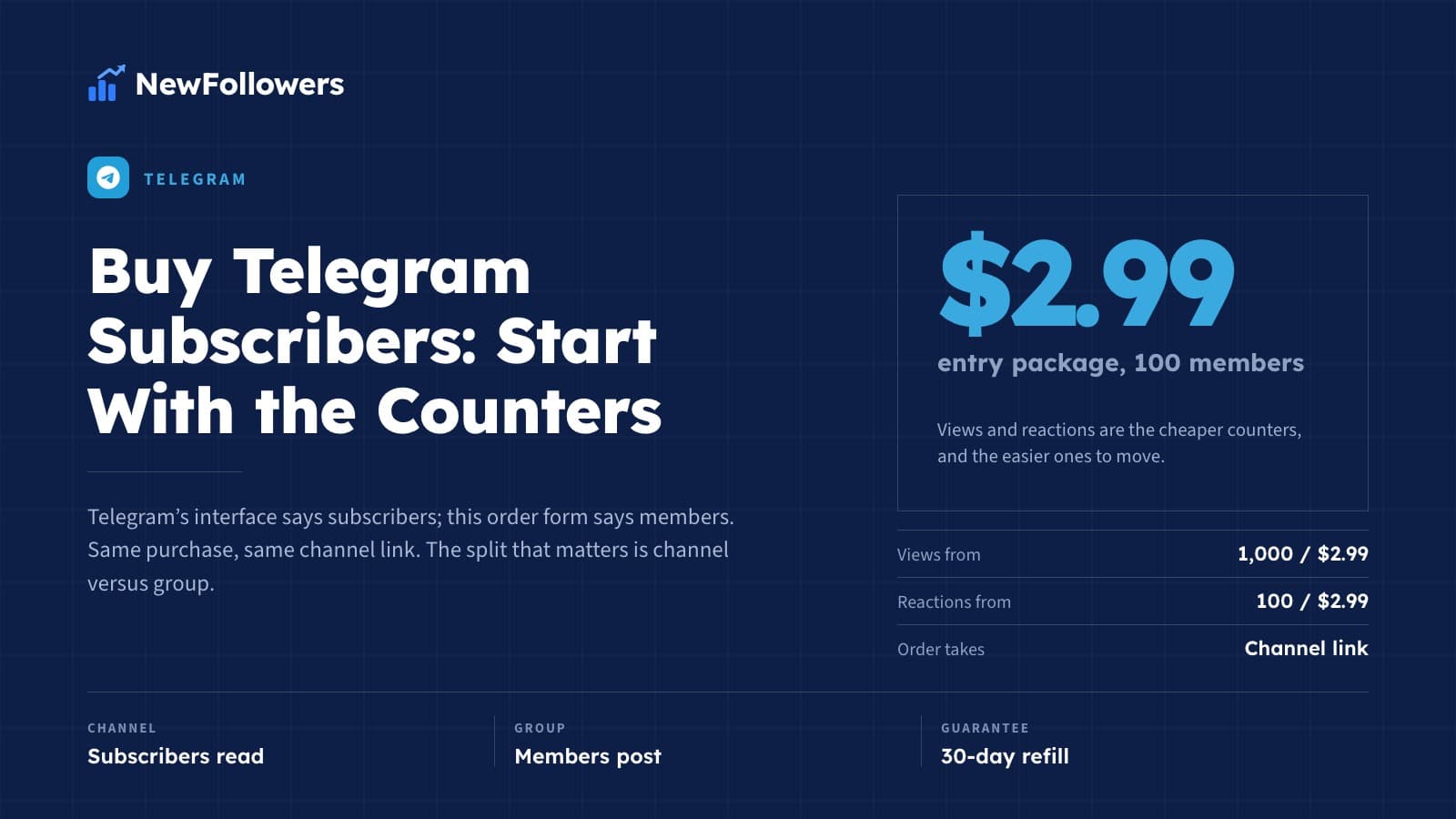
The naming trips people up first, so take it off the table. Telegram's app labels a channel audience subscribers. Order forms here call that same number members and ask for a Channel Link to deliver it. One purchase, one link, two labels, and nothing below turns on which of the two words you typed into a search box.
What does change everything is the surface. A channel broadcasts to people who cannot reply. A group is a room where members post. Telegram's channels FAQ says channels "can have an unlimited number of subscribers", while its main FAQ caps a group at 200,000 members. The counters look identical and mean different things, and that is the distinction most writing on this subject skips.
The free counters come first below, deliberately: they are the part an owner can act on this afternoon, and the part where the mechanics are least understood.
Free Telegram Views Are Approximate by Telegram's Own Description
The view counter under a channel post is the loosest number Telegram publishes, and loose in ways the platform documents rather than hides.
Views from forwarded copies are counted. Forward a post into three other channels and the reads it collects there are added to the total on your copy, which Telegram presents as a measure of how far a message spread rather than of how many people your channel reached. The count is imprecise on purpose too: Telegram says the numbers "are approximate", and after roughly four days it forgets a given person has seen a post and counts them again if they navigate back. In a private channel with one member, that alone produces several views on a post nobody else opened.
Two things follow for anyone chasing free views. The number you would be inflating is already generous by design, so an exchange adding a few thousand is a smaller achievement than it looks. And the only figure a reader can measure a view count against is the member count a line above it. Nine hundred members and eleven thousand views is a claim about forwarding, and it invites a question the channel has to answer.
The price of a free view exchange is the part worth pausing on. Most want an account, an app authorisation or a session, so they can register views on other people's posts using yours. That trade, where the currency is followers rather than views, is the subject of the free followers guide, and the same economics run through the batch sibling on free Discord members, where the unit exchanged is a server bump.
Free Telegram Reactions Are the Best Signal You Own
Reactions differ from views in one way that outweighs everything else. A reaction is a deliberate act by a person; a view is a post arriving in somebody's chat list while they scroll past to a conversation they actually care about.
That makes reactions the most useful number on your own channel. Forty reactions on one post and four on the next tell you something real about what the room wants, which view counts flattened by forwarding never will. It also makes them the worst counter to inflate, for a reason unrelated to detection systems: the person best placed to notice a fake pattern is the owner, who has read every post in the channel.
The tell is uniformity rather than volume. Real reactions arrive in a lopsided spread across the emoji, cluster on some posts and vanish on others, and stop turning up when a post is dull. Exchange reactions arrive evenly, on everything, in similar quantity, because the exchange fills a quota rather than responding to anything you wrote. The Facebook reactions guide covers the same shape where the spread across reaction types is the giveaway, and the batch sibling on LinkedIn likes reaches it from a feed where every reaction carries a job title.
Free Telegram Members Are the Expensive Free Option
Member exchanges draw more searches than views or reactions, and have worse mechanics than either.
The trade is membership for membership. You join channels to earn credits, credits buy you members, and everyone in the pool is there for credits, not for anything you publish. On a channel that produces a number attached to accounts that never open a message, which is survivable if the invite screen was all you wanted. In a group it produces something worse, because those accounts sit inside a room where they can post, and a fraction of them will.
There is a churn cost here that paid delivery does not carry. Credits are earned by joining, so the accounts arriving are also leaving continuously to earn credits elsewhere, and the count moves in both directions without settling. No delivery method makes a count permanent, since accounts get removed and people leave; an exchange is the one method with the leaving designed in. The batch sibling on Spotify monthly listeners is the sharpest version of that argument, since there the decay is written into the metric's definition.
The lever you keep either way is the invite link. Telegram's FAQ says a revoked link "will stop working immediately", the practical way to shut off a link you handed an exchange and then thought better of.
Channel or Group Decides What the Count Is Worth
A channel broadcasts. You post, and every subscriber receives the message signed with the channel name rather than yours. There is no ranking algorithm choosing who sees it and no reply box underneath. Comments exist only if you attach a discussion group to the channel, which is a separate object with its own membership.
A group talks. Members post, and the conversation is the whole of the value. Admins get granular permissions, up to restricting members from sending messages at all, which is why the surfaces blur: a locked-down group is a channel with a worse invite screen.
A member count on a channel
A member count on a group
Channels survive a bought number better than groups do. The same argument runs through the Facebook group members post and the batch sibling on Discord members, where an invite preview is the only surface a stranger sees.
What an Order Needs, and What It Must Never Ask For
An order needs a link. For the member product that is the channel link, public information printed on the invite itself. Expect the form to say members rather than subscribers, here and at most providers: the field asking for a Channel Link and the number Telegram shows as subscribers describe one purchase, with no separate channel-subscriber product behind the other word.
No Telegram login is involved. No phone number, no code from the app, no session string. A provider asking for any of those is asking for full account access, a different transaction from the one you thought you were making, and the one concession here that cannot be walked back. A link can be revoked; an account somebody else has logged into cannot.
Post-level services attach to one message rather than to the channel, so they take that post's link. On this site that covers views, reactions, comments and shares. Comments deserve a second thought: a channel has no comment box unless a discussion group is attached, so the comment lands in that group, in front of the people who are there to talk.
The First 200 Are Yours, Then the Channel Is on Its Own
This constraint is why a Telegram purchase market exists at all.
Telegram's channels FAQ sets a hard ceiling on manual invitations. The owner "may invite the first 200 subscribers", and after that, in Telegram's own words, "the channel is on its own". There is no way to add person 201 by hand. They have to arrive through a link.
Nor is there a discovery surface to lean on. Public channels appear in Telegram search, private ones appear nowhere, and neither gets recommended into anybody's feed, because there is no feed. A channel grows by being linked from somewhere that already has an audience.
Telegram also discourages the obvious workaround. The same FAQ asks users not to send channel links to strangers, warning that if they report it, "you may be banned from contacting other people, however good your intentions". That is one of only two enforcement threats Telegram aims at a growth tactic, and it targets unsolicited messaging, not purchases.
What Telegram's Rules Actually Say
Less than you would expect, and it is worth being precise instead of implying more.
The Terms of Service run to four bullet points: do not send spam or scam users, do not promote violence on publicly viewable channels, do not post illegal pornographic content on them, and do not engage in activities recognised as illegal in the majority of countries. Members, subscribers, views and reactions appear nowhere in them.
The nearest written rule is narrower than it is usually reported. Channels that mislead users into joining through giveaways later refunded with a third party, a bank for instance, "may be terminated or assigned a scam label and removed from Telegram search", and subscribers gained that way may be removed from the sponsoring channel and its associated channels. That is a rule about one giveaway scam, not an engagement-authenticity policy of the kind Meta, YouTube and Discord publish.
What the same page does say, in the termination clause of its subscription terms, is that failing to comply "may result in a temporary or a permanent ban from Telegram". The absence of a clause about buying is silence, not consent, and silence can be filled in later.
Telegram's silence stops at Telegram, though: a subscriber count quoted to an advertiser is a claim about an audience before it is a number on an invite screen, and the American guidance that reaches a claim like that gets worked through on the LinkedIn connections page.
What This Site Sells on Telegram
Start with the order form, because its narrowness is the actual claim. Members are ordered against a channel link, this site's word for the number Telegram's app prints as subscribers; views, reactions, comments and shares are ordered against one post's link. Every input is public information you could copy from a browser without opening Telegram, and a form that only ever accepts a public link cannot turn into account access later, whatever a follow-up message asks for. Sizes and prices sit on the Telegram page.
Pacing comes next, and earns its place for an unusual reason. There is no feed to convince, so the only audience for an overnight jump is the members already watching: it is a courtesy to the room rather than a defence against a ranking system. And with no ranking layer, every member receives every post, which leaves the gap between member count and view count as arithmetic anyone can do.
Then what the listing does not promise, since every other platform page here does. No refill is attached to anything Telegram. The four claims made for it are a channel or post link, no password, every member receiving every post, and delivery spread over time.
The ceiling goes last because it outranks everything above it. Nothing sold on this site makes a channel worth subscribing to, and on Telegram that limit bites harder than on a feed platform: there is no algorithm to persuade with a bigger number, so a channel of 20,000 posting once a month is a bigger channel posting once a month. Members change the invite screen, and that screen is the whole of the effect.
The Order I Would Actually Do This In
Where This Leaves a Channel Owner
The two counters worth working on first are the two nobody charges for, and both are softer than they look: views are approximate by Telegram's own admission and inflated by forwarding, reactions honest enough to be useful and so honest enough to expose an exchange. Understanding both turns the third question, about members, into a decision rather than a reflex.
When it does arrive, it is a decision about the surface. To buy Telegram subscribers for a channel is to buy an invite screen that no longer says nobody is here, on a surface where nobody is expected to speak. To buy the same number for a group is to buy silence in a room whose only product is conversation. Telegram will not settle that for you: its Terms never mention engagement, and its warnings target unsolicited messages and refunded giveaways, not purchases.
What raises a channel is being linked from somewhere that already has an audience, then posting often enough that the people who arrive have a reason to stay. The first 200 are yours to invite; after that the channel is on its own, and so is the writing. The same free tail runs where there is no invite link at all: free Snapchat followers, gated behind a public profile most accounts never switch on. see also.
Frequently Asked Questions
Are Telegram view counts accurate?
Telegram says the numbers are approximate, and explains why. Views from forwarded copies are added to the total on your post, so the figure measures how far a message spread rather than how many of your own members read it. After around four days Telegram forgets that you have seen a post and counts you again if you navigate back to it, which is why a private channel with a single member can show several views.
Do free Telegram view exchanges work?
They move the counter. What most of them want in return is an account, an app authorisation or a session, so they can register views on other people's posts using yours, and that is a larger concession than a soft counter is worth. The number being inflated is already generous by design, since reads collected by forwarded copies are counted in it.
Will anyone notice free Telegram reactions?
The owner will, before any stranger does. A reaction is a deliberate act rather than a post landing in a chat list, so the spread across the emoji says something, and exchange reactions arrive evenly on every post because the exchange is filling a quota. The tell is uniformity rather than volume, and the person who has read every post in the channel is the person best placed to see it.
Telegram subscribers or members: is that one count or two?
One count, under two labels. Telegram's interface calls a channel audience subscribers, while order forms, including the one on this site, call that same channel number members and take a Channel Link to deliver it. What is real is the surface. A channel broadcasts: every subscriber receives every post and nobody can reply inside it. A group is a room where members can post. Telegram's FAQ says channels can have an unlimited number of subscribers, while a group is capped at 200,000 members.
Are free Telegram member exchanges worth it?
They are the most expensive of the free options. Credits are earned by joining other channels, so everyone in the pool is there for credits, and the accounts you receive are joining and leaving continuously, which means the count never settles. On a channel that is survivable. In a group those same accounts are inside a room where they can post.
Does Telegram have a rule against buying subscribers?
No published one. Telegram's Terms of Service are four bullet points covering spam and scams, promoting violence, illegal pornography, and activity illegal in most countries. None of them mentions engagement, members or views. The nearest written rule concerns channels that mislead users into joining through giveaways later refunded with a third party, which may be terminated or assigned a scam label and removed from Telegram search. That is a rule about one giveaway scam rather than an engagement-authenticity policy, and the silence around buying is not permission: Telegram states elsewhere that failing to comply with its terms may result in a temporary or a permanent ban.
Is buying members worse for a group than for a channel?
Yes, and it is the distinction that matters most. On a channel a silent member costs you a diluted read rate on a counter nobody outside can check. In a group a silent member occupies a room whose entire value is the conversation, so the count and the emptiness show up on the same screen.
What does an order actually need?
A link. Members are delivered against the channel link, which is public information already printed on the invite. Views, reactions, comments and shares apply to one message, so those take the link to that post. No Telegram login, phone code or session is required, and a request for one is a request for full account access, which is the single concession here that cannot be reversed afterwards.
Why can I only add 200 people to my own channel?
Because Telegram sets that limit. Its channels FAQ says the owner may invite the first 200 subscribers, and once the subscriber count reaches 200 the channel is on its own. After that people have to arrive through a link, since Telegram has no feed or recommendation surface for a channel to be discovered in.
What actually grows a Telegram channel?
Being linked from somewhere that already has an audience, because there is no discovery feed to be found in. After that it is posting frequency and a reason to stay subscribed, since every member receives every message and an unopened channel is one tap away from being muted or left.
Ready to Grow Your Social Media?
Real followers, instant delivery, 30-day refill guarantee. Pick your platform: