Instagram Shadowban: What Instagram Documents, and What the Word Gets Used For
Instagram Shadowban
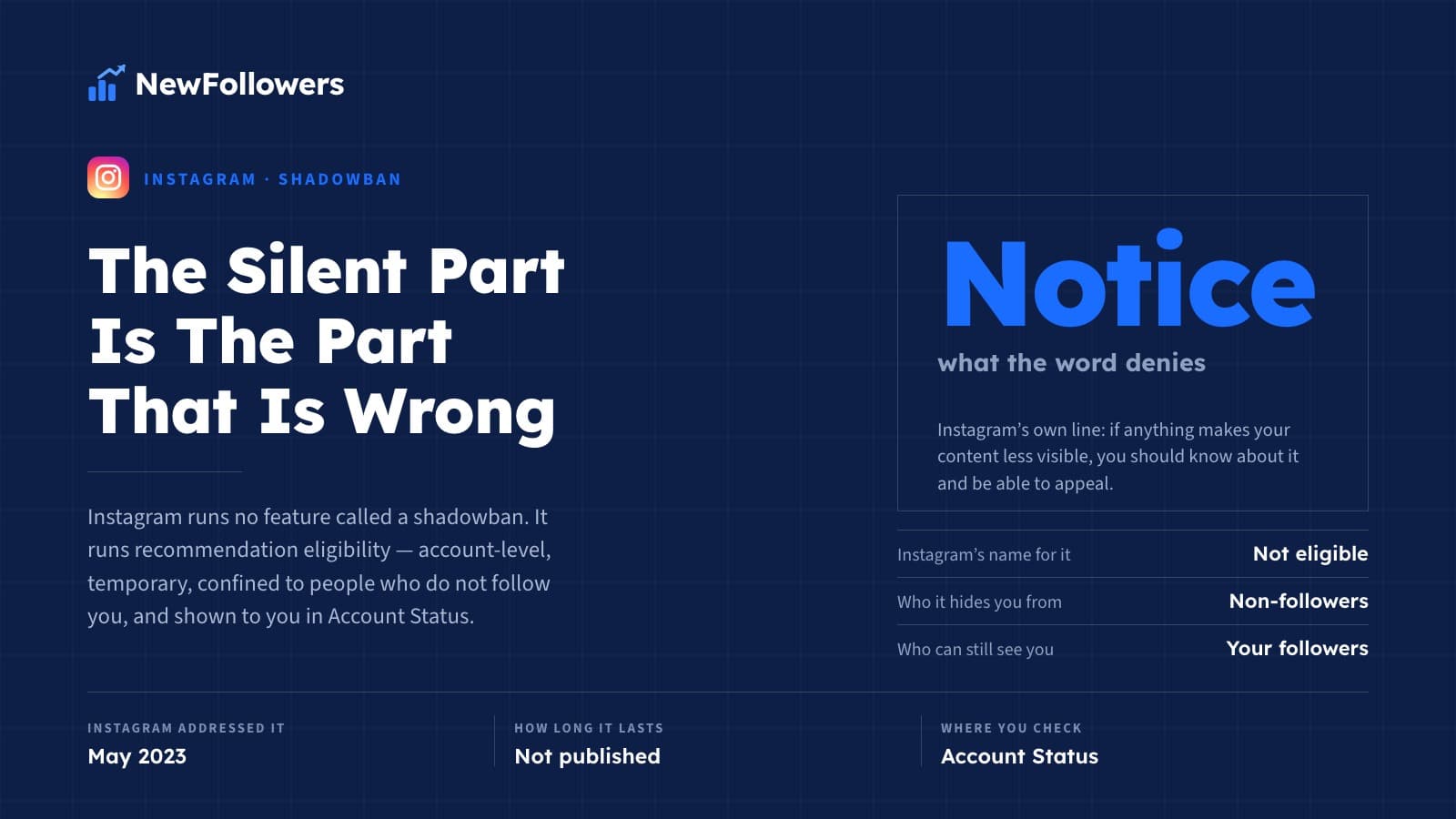
Instagram has no feature called a shadowban, and it has addressed the word in writing. What it does have is recommendation eligibility, and an account that loses it is no longer put in front of anyone who has not chosen to follow it — on Explore, on Reels, in Search and in suggested posts — for a period.
The uncomfortable part is the next sentence. That state is not silent. Instagram built a screen called Account Status to say when your content is in it, and to let you appeal. So the word carries a premise its own documentation contradicts.
Which leaves a third position: not restricted, and not told anything, because nothing was done to you. That is where a great many uses of the word land, and the gap between what the term promises and what the platform documents is what this page is about.
What Instagram Has Written About the Word Itself
The one place Instagram engages with the term in its own documentation is the closing section of Instagram Ranking Explained, by Adam Mosseri, dated 31 May 2023. It is headed "Addressing 'Shadowbanning'" and it concedes more than it denies.
It opens by admitting the word has no fixed meaning: "Though there isn't one shared definition, we know some people use the term to imply that a user's account or content is limited or hidden without a clear explanation or justification. When we rank content across Instagram, that's not our intention."
That is a statement about intent, not about outcome. It does not say nothing limits your content. It says that when something does, leaving you to guess is not the aim — and the same section commits to the opposite: "If anything makes your content less visible, you should know about it and be able to appeal."
A denial of a motive is not a denial of a mechanism, and the mechanism is written out three paragraphs earlier on the same page.
The Mechanism Instagram Does Document
The documented state has a name, and the name is doing the work: not being eligible to be recommended.
Instagram runs a second, stricter rulebook on top of its Community Standards, the Recommendations Guidelines, because "there should be stricter standards when showing people content from accounts they haven't chosen to follow". Content that falls under them stays on Instagram. It stops being eligible for the places where strangers meet it.
The consequence, in Instagram's own sentence: "If an account repeatedly posts content that goes against our Recommendation Guidelines or Community Standards, none of their posts will be eligible for recommendation for a period of time."
Four qualifications travel with that, and between them they account for most of what people describe.
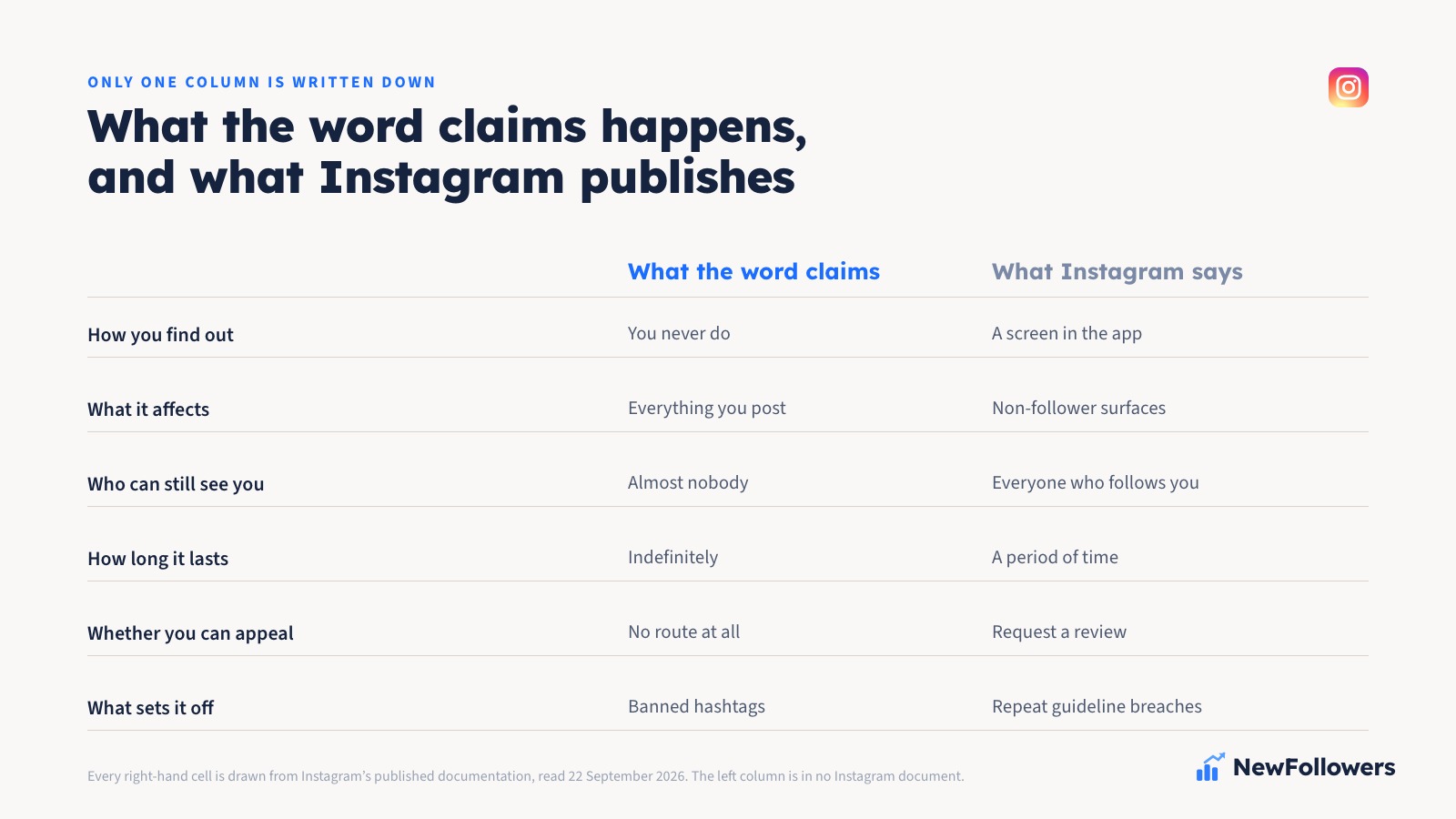
The Four Different Things People Call It
Nearly every use of the word is one of these four. They have different documentation and different exits, and calling them all by one name is why the advice attached to the word so rarely helps.
Recommendation ineligibility. The state above: account-level or post-level, confined to surfaces that reach non-followers, temporary in Instagram's wording, visible in Account Status and appealable.
A removal, or a feature you can no longer use. A different rulebook, and a much louder one. From the ranking page: "If you post something that goes against our Community Standards and we find it, we take it down. If this happens repeatedly, we may prevent you from using certain sharing features, such as streaming on Instagram Live, and eventually we might suspend your account." Account Status lists removed content and unusable features as separate sections, each with a route to request a review. Nobody here is guessing.
A hashtag that stopped working. Real, documented, and misattributed constantly, because it is a property of the tag rather than of you. Instagram's page on it says: "Hashtags on Instagram may not be searchable if the text or the content associated with the hashtag consistently do not follow our Terms of Use or Community Standards", and it says it reviews them periodically. A tag other people ruined is not a mark against your account. Separately, Instagram says several factors set the order of hashtag search results and that they "may include" when the post was shared, how others engage with it, and whether the content meets the Recommendation Guidelines — so a post can be missing from a busy tag with nothing having been decided about it.
Nothing at all. The one with no document behind it, because no action was taken — and the only one of the four that leaves Account Status blank. Instagram publishes no follower count and no reach figure at which anything changes, and the surfaces that reach strangers predict what one viewer will do with one post. A quiet fortnight and then a loud one is what that looks like with nothing decided either way.
The Premise the Word Gets Wrong
"Shadow" is the load-bearing half, and it is the half the documentation will not support.
Account Status exists because of this complaint, and Mosseri's page says so: the community's concerns about the term "have made it clear that there is more we can do to increase transparency", which is why "we've built features like Account Status".
So the check is dull and short. On Instagram it is More, then Settings, then Account Status under "More info and support". Instagram moves these labels around between releases, so look for account health if that path is gone. What you are reading it for is a statement about eligibility, and it is the only authoritative one in existence. Instagram scopes that particular view to professional accounts, which is worth knowing before you go hunting for it on a personal one. Instagram exposes no flag for this outside the app, which is why nothing can scan for it, and why a site that offers to is reading a public profile and inferring, or is about to ask you to log in.
If that screen is clear and the drop is real, the question has changed. The free shadowban checker walks the ambiguous case through the checks that separate a restriction from a decline, none of which needs a login.
What Instagram Does Not Publish
The absences are worth listing, because they are where every confident number on this subject came from.
One published exception is narrow enough to be useful. Instagram says it aims "to make certain reels less visible" for "low-resolution or watermarked reels, reels that are muted or contain borders, reels that are majority text, or reels that have already been posted on Instagram", and that it is "experimenting with new notifications to help creators understand when the reach of their reel may be limited due to a watermark". That is a list about how a video was made, not about how an account behaves — and a reposted clip carrying another app's watermark is the one item on it you can fix in an export setting.
Where Buying Fits, and the Line That Is Against Us
NewFollowers sells Instagram followers, so read this as interested and check it against the documents rather than against us.
The Recommendations Guidelines do not only describe content. They describe accounts, and the list of accounts Instagram says it tries not to recommend contains this item, verbatim: "Repeatedly engaged in misleading practices to build followings, such as purchasing 'likes'." That sentence sits inside the document that decides recommendation eligibility. Meta's spam standard puts it from the other end, listing "attempting to or successfully selling, buying, or exchanging for engagement, such as likes, shares, views, follows, clicks" among what it does not allow. What is not published is any detection rate or any figure for how often that line is acted on, and a shop inventing one would be inventing the kind of number the rest of this page refuses.
What a purchase does is change a number on a profile, and the number is not what the guidelines turn on: they turn on content, profile and conduct, and Instagram publishes no follower count that clears eligibility or trips it. The conduct is a different matter, and the sentence above is where Instagram names it. A purchase cannot lift a restriction already applied either. And it does nothing for reach, because an account paid to follow predicts nothing about what any viewer will do with any post. Selling a follower package as the fix for a reach problem is selling a cause the platform has never described.
What it is for is the one thing a person does with the number, and that price is printed: 1,000 Instagram followers are $9.99, the ladder is on the Instagram page, that rung has a page of its own, and prices are in US dollars with tax possibly added at checkout depending on the country you buy from. Two neighbouring pages take the rest: can you buy Instagram followers walks an order through end to end, and can you buy real followers asks how much of a claim the adjective "real" actually is.
If Your Reach Collapsed This Week
Open Account Status before anything else. It is the only screen with any authority on this question, and it turns the whole argument into one of two outcomes: a named guideline with a review button, or a blank.
If it names something, the post is identified, the guideline is identified, you can edit or delete it and you can ask for the decision to be looked at again. That is a better position than the word implies.
If it is blank, then what you have is not what the word means, and the remedies attached to it address a state you are not in. What is left is the duller question of whether a run of posts was interesting to people who had never heard of you.
And be careful with the word from here. It has become the name for every disappointing week, which is exactly why it stopped being useful — a term covering a documented restriction, a hashtag strangers ruined, a watermark and a quiet fortnight is not describing anything.
Frequently Asked Questions
What is an Instagram shadowban?
It is an informal word rather than the name of anything Instagram operates. Instagram's own ranking explainer notes that there is not one shared definition, and that people use the term to imply an account or its content is limited or hidden without a clear explanation. The documented state closest to what people mean is not being eligible to be recommended. While it lasts, none of that account's posts are eligible to be recommended on Explore, Reels, Search or suggested accounts, which are the surfaces that reach people who have not chosen to follow it. Its existing followers can still see its posts.
Does Instagram admit that shadowbanning exists?
It addresses the word directly and answers in two halves. On the term itself, Adam Mosseri wrote in May 2023 that limiting or hiding an account without a clear explanation is not Instagram's intention when it ranks content, and that it does not suppress content to push people towards buying ads. On the mechanism, the same page states that an account repeatedly posting content that goes against the Recommendation Guidelines or Community Standards will have none of its posts eligible for recommendation for a period of time. So the reduced-distribution part is documented; the silent part is what Instagram disputes, and Account Status is the feature it built to make the point.
Where does Instagram tell you if your account is not eligible to be recommended?
Account Status, inside the app, on a professional account -- Instagram scopes the eligibility view to those. Its help pages say it shows whether your content may be eligible to be recommended to people who do not follow you, whether something in your profile photo or bio goes against the Recommendations Guidelines, a sample of the content responsible and which guideline applies to it, alongside anything removed under Community Standards and any features you can no longer use. The path Instagram publishes is More, then Settings, then Account Status below More info and support. No site outside Instagram can query this, because no such flag is exposed to third parties.
How long does recommendation ineligibility last on Instagram?
Instagram publishes no duration. Its wording is that none of the account's posts will be eligible for recommendation for a period of time, and that is the entire published extent of it. There is no official 24-hour, 14-day or two-week figure anywhere in Instagram's documentation, so every specific recovery window in circulation was inferred from anecdotes. What is published instead is a route rather than a clock: where content goes against the Recommendations Guidelines you may be eligible to request a review, and you can edit or remove the content involved.
Do banned hashtags get your account shadowbanned?
Not in the way the folklore describes, because a restricted hashtag is a property of the tag, not a mark against you. Instagram states that hashtags may not be searchable if the text or the content associated with them consistently does not follow its Terms of Use or Community Standards, and that it reviews them periodically and may make one searchable again if that changes. It publishes no list of them, so the downloadable banned-hashtag lists in circulation are third-party spot checks. Separately, Instagram says several factors set the order of hashtag search results and that these may include when the post was shared, how others engage with it, and whether the content meets the Recommendation Guidelines.
Can buying followers or likes make an Instagram account ineligible for recommendation?
Instagram's Recommendations Guidelines list, among the accounts it tries not to recommend, those that have repeatedly engaged in misleading practices to build followings, such as purchasing likes. That sentence sits in the same document that governs recommendation eligibility. Meta's spam policy separately prohibits selling, buying or exchanging engagement, and names likes, shares, views, follows and clicks. What is not published is any detection rate, any threshold or any figure for how often the line is acted on, so nobody, sellers included, can honestly quote a risk number. What can be said is that the practice is named in the guidelines above, that Instagram publishes no follower count at which eligibility changes, and that a purchase cannot lift a restriction that has already been applied.
My reach dropped but Account Status is clear. What happened?
Most likely nothing was done to you. Instagram publishes no follower count and no reach figure at which anything changes, and the surfaces that reach non-followers work by predicting what one viewer will do with one post, so a quiet run and a loud one can follow each other with no decision behind either. There is one published exception worth ruling out on reels specifically: Instagram says it aims to make certain reels less visible when they are low-resolution or watermarked, muted, bordered, majority text, or already posted to Instagram. A reposted clip carrying another app's watermark is the one item on that list that is fixable in an export setting.
Ready to Grow Your Social Media?
Real followers, instant delivery, 30-day refill guarantee. Pick your platform: