How Many Followers to Get Verified on Instagram? No Number, and Two Different Badges
How Many Followers to Get Verified on Instagram?
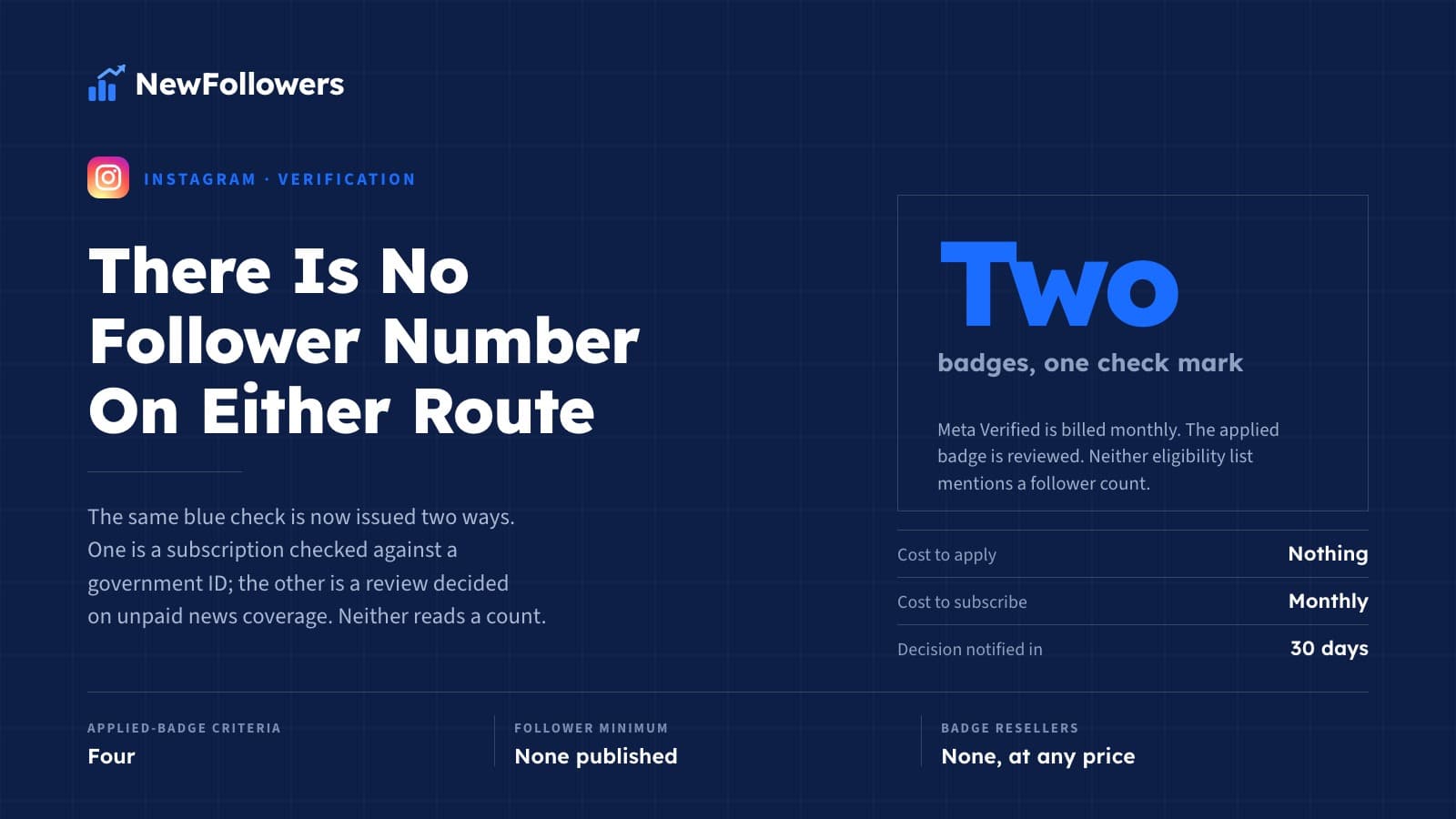
None. Instagram publishes no follower minimum for a blue check, and no follower count appears on either eligibility page. There are two of those pages, because there are now two ways to get the same check mark, tested on entirely different things.
That is why the number keeps getting invented. A question with two correct answers and no figure in either of them is an awkward thing to write a listicle about, so the industry supplies one anyway and attributes it to nobody.
Everything below about what Meta requires is taken from a Meta page, dated to the day it was read — 22 September 2026 — with the link sitting beside it. This subject is revised often enough that the source is worth more than any summary of it, this one included.
Two Badges, One Check Mark
On a profile they are identical. Behind them, almost nothing is.
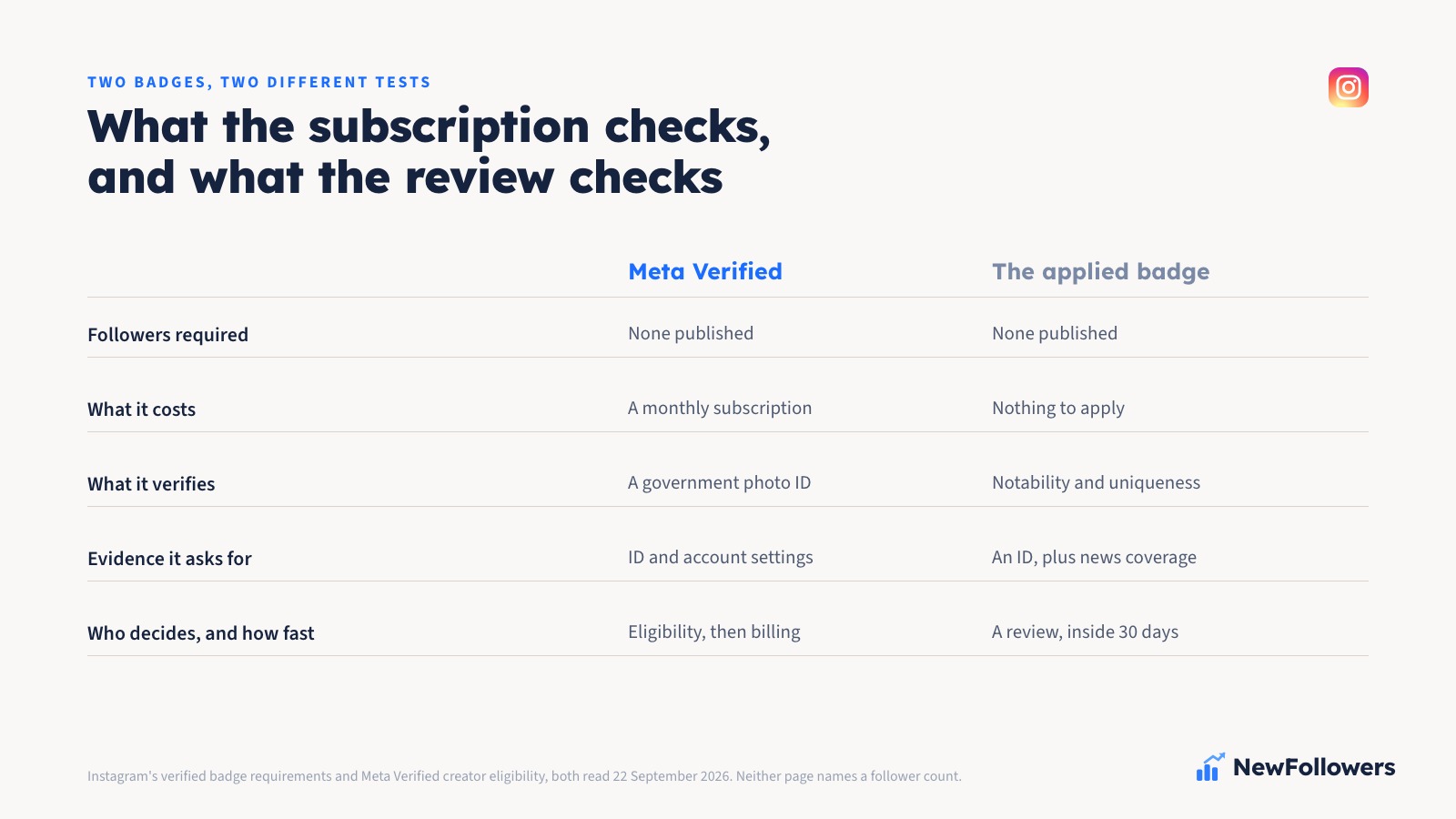
Meta Verified is a subscription. You pay monthly, you confirm who you are with a government photo ID, and the badge comes with the plan. Meta describes it as a profile verified based on your activity across its technologies, or on information and documents you provided.
The applied badge is the older one. You submit a request in the app, Instagram reviews it, and Instagram decides. There is no fee and no way to hurry it along.
A visitor cannot tell which one you hold. Neither can a brand, a journalist or anybody else looking at the profile — which is worth knowing before you decide what either is worth to you.
What Meta Verified Checks, and What It Does Not
Meta's eligibility page for creator subscriptions lists what you need in order to subscribe: be at least 18, or the age of majority where you live; be in a country where Meta Verified is available; hold an eligible Instagram or Facebook account; have a government-issued photo ID; not have exceeded the number of account changes allowed in a set period before applying — profile name, profile picture, username, location or account type are the examples Meta gives; and agree to the terms.
The Instagram account itself has to be a personal or creator account — which Meta says may also need a profile picture and name meeting its naming standards — have Advanced Protection turned on, meet minimum activity requirements, sit in a country where the subscription is offered, and follow the Terms of Use and Community Standards.
Notice what is not in it. No follower number. No engagement rate, no post count, no audience size in any form. The only quantity-shaped phrase on the whole page is "minimum activity requirements", and Meta does not say what those are — so anybody quoting you a figure for them is quoting themselves.
The requirement that actually catches people is the one nobody expects. Rename yourself, change your username, swap your profile photo and flip your account type in the same fortnight and you can make yourself temporarily ineligible for a subscription you are otherwise entitled to buy. That is a scheduling problem, not a growth problem.
What the Applied Badge Checks
Instagram's requirements page names four things your account has to be, on top of following the Terms of Use and Community Standards.
Three of those four are an afternoon. Notable is not, and notable is where the applications stop.
What settles it is an editor's unpaid choice to publish something about you, somewhere Instagram is prepared to count. No audience size produces that. A large account with no coverage has nothing to put against that criterion, while a small one a newspaper wrote about last month has already cleared the hardest part of it.
One more line on that page is worth reading before you apply rather than after: once verified, you may not change the username on your account. Settle the handle first.
Meta's Own Two Pages Do Not Agree
The requirements page lists Unique and Notable as current criteria. But Instagram's verified badges page, read the same afternoon, says the badge now means Instagram has confirmed the account is the authentic presence for that person or brand, and that previously the badge also required the person or brand to be notable and unique. It adds that you may still see accounts carrying badges issued under the previous requirements.
So one Meta page treats notability as a live requirement and another treats it as a former one, and both were live on 22 September 2026. This article is not going to tell you which one wins, because Meta has not. What you can do is open both links before applying and see which version is standing that week.
The same page is unusually direct about the thing people actually want. A verified badge, it says, is not a symbol of importance, authority or subject-matter expertise, and Meta does not use it to endorse or recognise anyone. That sentence does more work than the four criteria above it.
Why Everybody Expects a Number
Because Instagram publishes follower numbers everywhere else.
Starting a live broadcast needs a public account and 1,000 followers or more, and Instagram states it plainly on its own Live help page. Several other features carry thresholds of their own. A creator who has learned that this platform gates things at a count reasonably assumes the badge is gated at one too — and then finds an article willing to supply the missing figure.
Verification is the exception, and the reason is structural. A size gate and an identity check do not work alike. A size gate opens the moment the number is reached, for anybody; an identity check can be failed at any size and passed at almost none. Nothing you do to the count moves an identity check, because the count is not one of the things being identified. The thresholds that genuinely exist, with the pages they come from, are in how to go live on Instagram.
What a Follower Count Does on Either Route
There is a version of this paragraph a seller would rather write, and this is not it: on both routes, a follower count does nothing.
The subscription does not read a follower count. Its eligibility list is age, country, account type, ID, security settings and recent changes. The review does not read one either. Its criteria are identity, uniqueness, completeness and press coverage. There is no line on either form where a bigger number produces a better outcome, which means there is no gap for a purchase to close.
Buying your way there is worse than neutral. Meta's spam policy prohibits attempting to or successfully selling, buying or exchanging for engagement, and names follows among its examples. Instagram's page on what happens after you apply lists attempting to verify your account through a third party — and advertising, transferring or selling a badge — among the things that cost people their badge or their account.
What a follower package does buy is narrower and duller than any of that. The count on the profile goes up. That is worth something to a brand contact or a prospective client working out whether you are established, and it is the entire transaction. Instagram followers are sold here for that and nothing else; the prices sit on a page of their own, what a seller's "real" actually asserts is another, and what actually arrives after an order is a third. None of the three brings a check mark any closer.
What the Badge Costs, and Who Cannot Sell You One
Meta publishes its creator pricing openly: $14.99 per month per profile for Standard, $49.99 for Plus, $149.99 for Premium and $499.99 for Max, renewing automatically. Meta adds that plans, benefits and availability vary by region, by app and by account, and that Standard costs less signed up on the web than in the app, so take the figure shown at your own checkout over the one printed here. Businesses subscribe through a separate product with its own eligibility page, not covered here.
Applying for the other badge costs nothing at all.
Which leaves the people offering to get you verified for a fee. Instagram answers them structurally rather than with a warning label: attempting to verify your account through a third party is on its own list of reasons a badge gets taken away. Nobody outside Meta has a check mark to issue — there are exactly two places one comes from, and both of them are Meta.
Applying, and What Happens Next
The request lives in the app: Instagram's page on requesting the badge says the feature is not available on computers at all, and lists what the form asks for — your full name and a required form of identification, meaning a government-issued photo ID or official business documents. Both routes want to see an ID. Only one of them charges for the privilege.
Instagram says you will get a notification in Activity up to 30 days after applying, telling you whether the account was verified, and that if the request is denied you can submit a new one 30 days later.
One thing worth knowing before impatience sets in: applying again before a decision arrives cancels the application. The instinct to resubmit is the easiest way there is to throw away the month you have already spent waiting.
And if you provide false or misleading information during the process, Instagram says it will remove the badge and may disable the account — which is the quiet reason the third-party route is a bad idea even when it appears to work.
If You Came Here For a Number
There isn't one, so the useful question is the one sitting underneath it: what did you want the check mark to do?
If the answer is "stop people passing themselves off as me", that is the job the subscription is sold to do: impersonation protection sits beside the badge itself in the benefits Meta lists, and account size has no bearing on eligibility for either.
If the answer is "make people take this account seriously", read Meta's own sentence once more. The badge is not a symbol of importance, authority or subject-matter expertise, and Meta does not use it to endorse anybody. It asserts one fact — this account is who it says it is — and since $14.99 a month now asserts that fact for anyone eligible, it has stopped being able to assert the second one.
If the answer is "get written about", then the badge was never the mechanism. On the one route that still weighs notability, it arrives after the coverage, not before it.
What is genuinely good news is the thing this page has been repeating throughout. Nobody is stuck a few hundred short. There is no shortfall, because there is no line — and whatever you decide to do about any of the three answers above, it was never going to be arithmetic.
Frequently Asked Questions
How many followers do you need to get verified on Instagram?
None that Meta publishes. There is no follower minimum on either route to a blue check, and no follower count appears on either eligibility page. The Meta Verified subscription checks your age, your country, your account type, a government photo ID, your security settings and how recently you changed your profile details. The applied badge is reviewed on four things — authentic, unique, complete and notable — of which notability, meaning coverage in multiple news sources, is the one that decides most applications. Any article quoting you a specific figure is quoting a number Meta has not published.
What are the two ways to get verified on Instagram?
Instagram's own requirements page states there are two. You can subscribe to Meta Verified, a paid monthly subscription that includes the verified badge and requires a government-issued photo ID, or you can apply for the verified badge and be reviewed against Instagram's account criteria. They produce the same check mark on the profile, and a visitor cannot tell which one an account holds. What they test is almost entirely different: one confirms your identity documents and your account settings, the other weighs whether you are notable enough to be written about by news publications.
How much does Meta Verified cost on Instagram?
Meta publishes four creator plans on its own Meta Verified page: $14.99 per month per profile for Standard, $49.99 for Plus, $149.99 for Premium and $499.99 for Max, each renewing automatically. Meta notes that plans, benefits and availability vary by region, by app and by account, and that signing up for Standard on the web costs less than signing up in the app. Check the figure shown at checkout rather than any figure printed elsewhere, since that is the amount charged. Applying for the non-subscription badge costs nothing.
Does buying followers help you get verified on Instagram?
No. Neither eligibility list reads a follower count, so there is no threshold for a purchase to close. Meta's spam policy separately prohibits attempting to or successfully selling, buying or exchanging for engagement and names follows among its examples, and Instagram's page on what happens after you apply lists attempting to verify your account through a third party among the reasons a badge is removed or an account disabled. What a follower purchase changes is the count on the profile, which is something a human visitor reads. On a verification decision it changes nothing.
Can you buy an Instagram verification badge from a service?
No. There are two places a blue check comes from and both of them are Meta: a Meta Verified subscription, billed by Meta, or an application reviewed by Instagram. Instagram lists attempting to verify your account through a third party, and advertising, transferring or selling a verified badge, among the reasons it takes badges away and may disable accounts. It also says that providing false or misleading information during the verification process means the badge is removed and the account may be disabled — the risk you take when somebody else fills in the form on your behalf.
What counts as notable for Instagram verification?
Instagram says a notable account represents a well-known, highly searched-for person, brand or entity, and that it reviews accounts featured in multiple news sources. It also states that it does not consider paid or sponsored media content as a source for review. So the deciding evidence is somebody else's unpaid decision to write about you in a publication Instagram is willing to count — not an audience size, not a posting streak, and not anything you can commission.
How long does Instagram verification take?
Instagram says you will receive a notification in Activity up to 30 days after applying, letting you know whether the account has been verified. If the request is denied you can submit a new request 30 days later. One warning on that same page is worth repeating: applying for a verified badge multiple times before receiving a decision cancels the application, so resubmitting out of impatience costs you the wait you have already served.
Is Instagram verification still based on being notable?
Meta's own documentation is inconsistent about this, and that is worth knowing rather than resolving. Instagram's requirements page lists notable and unique among the criteria it applies to accounts not subscribed to Meta Verified. Instagram's verified badges page says the badge now means the account has been confirmed as the authentic presence for that person or brand, and that previously it also required the person or brand to be notable and unique. Both pages were live on 22 September 2026. The practical advice is to open both before applying, because the applied route appears to be mid-revision.
Ready to Grow Your Social Media?
Real followers, instant delivery, 30-day refill guarantee. Pick your platform: