Buy Facebook Group Members: Why Almost Nobody Should
Quick Answer
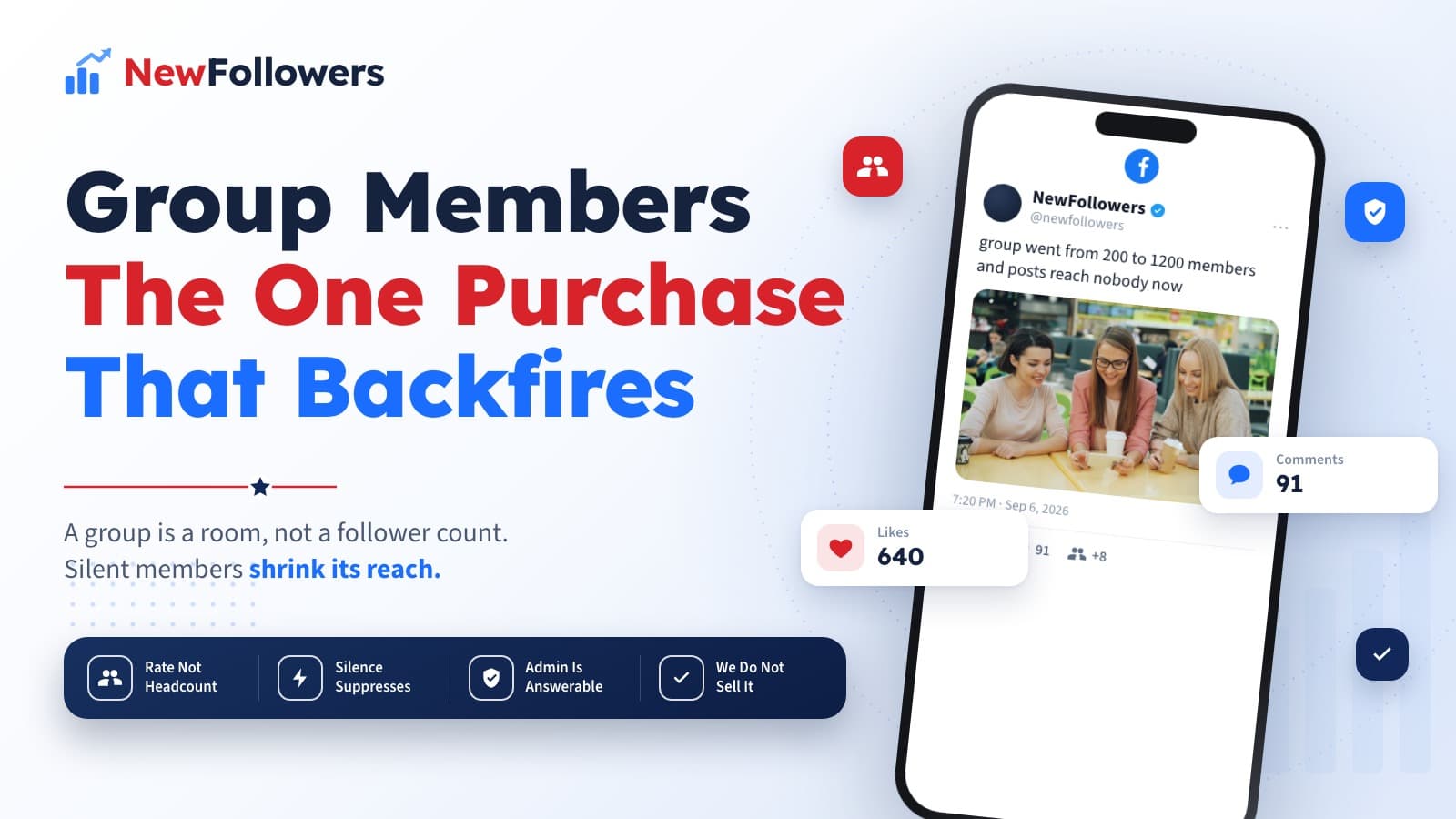
Buying Facebook group members means paying for accounts to join a group you run. It behaves worse than any other purchased metric because a group is not a display surface, it is a room: Facebook decides what to show members based on whether members post, comment and react, so a thousand silent joins actively suppress the group's reach in everyone's feed. Meta's Spam standard prohibits buying, selling and exchanging engagement, and group admins carry additional exposure because Facebook holds groups accountable for member behavior. NewFollowers does not sell group members, and this page exists to explain what does work instead.
This is a page about a product this site does not sell, which is worth saying at the top rather than at the bottom.
The decision to buy Facebook group members comes up often enough to be worth a straight answer, and the straight answer is that it is the single worst purchase in this category. Not on ethical grounds, on mechanical ones.
A Group Is Not a Follower Count
The distinction the whole topic turns on.
A Facebook page is a broadcast surface. The follower count sits in the header, visitors read it, and it functions largely as display. Whether those followers ever interact affects reach at the margin, but the number itself is doing a job just by being visible.
A group is a room. Facebook decides how prominently to show a group's posts in members' feeds based on whether the group is active: are people posting, commenting, reacting, returning. The membership number is an input to that judgment, not the output.
Add a thousand accounts that will never post and the arithmetic moves against you. The numerator stays where it was. The denominator jumps.
What a group's distribution actually responds to:
Purchased members contribute to none of these, and dilute all of them.
The Suppression Effect
Why this purchase does not merely fail to help, but does harm.
A group with 200 members and 40 active ones has a participation rate that Facebook reads as healthy. The same group with 1,200 members, 1,000 of them purchased, has the same 40 active people and a rate five times worse.
The visible consequence is that posts reach fewer of the real members. The people who were participating see less response to their posts, so they post less, and the rate falls again. The group is larger in the header and quieter everywhere that matters.
This is the opposite of how a purchased page follower count behaves, where the worst case is usually that nothing happens.
A Bigger Room or a Busier One
The two things that get confused here.
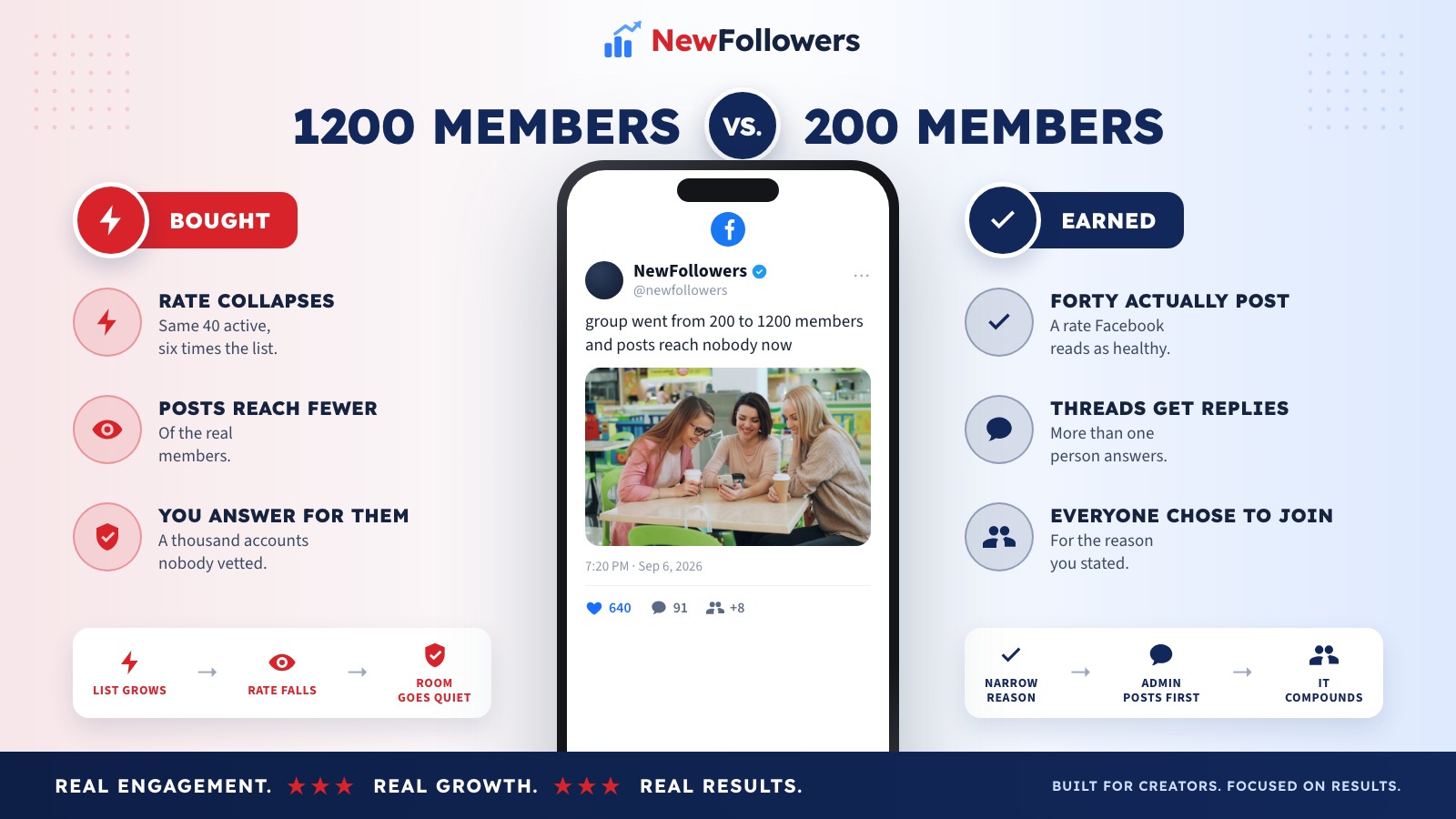
1,200 members, 1,000 purchased
200 members, 40 active
The right-hand group is smaller on paper and larger in every respect that produces an outcome.
What Meta's Rules Say
The Spam standard, which covers Facebook and Instagram, prohibits attempting or completing the sale, purchase and exchange of engagement including likes, shares, views and follows. Buying membership is a purchase of engagement in the plainest sense.
Groups add a second layer. Facebook holds group admins responsible for activity within their group, and moderation obligations scale with membership. A thousand accounts you did not vet are a thousand accounts whose behavior lands on you.
Every major platform words the same prohibition differently: TikTok prohibits trading in services that inflate metrics, YouTube prohibits artificially increasing any metric, X prohibits inauthentic use of engagement features, and Twitch prohibits viewership tampering.
The Business Case Is Worse, Not Better
Counterintuitive, since group size is often bought for commercial reasons.
A group's membership number presented to an advertiser, a partner or a client is a claim about audience. When most of that audience cannot see the posts, the claim is inaccurate in a way that a page follower count is not, because a page's followers at least receive the content.
For a US business, misrepresenting audience size to a commercial partner is the territory the FTC's rule on fake indicators of social media influence addresses. The exposure is not theoretical for anyone selling group access, sponsored posts within a group, or a community as part of a package.
Why This Site Says No
NewFollowers sells followers, likes, views, comments, shares and reactions across six platforms, Facebook included. It does not sell group members.
The reason is the mechanism described above rather than a policy position. Every other product on the list adds a number to a surface where a number is doing display work. Group membership is the one place where the number is an input to distribution, so inflating it makes the group perform worse. Selling something that reliably makes the customer's situation worse is a bad product regardless of margin.
If the underlying goal is a Facebook presence that looks established, the Facebook page products are where that argument holds, and the site states plainly on those pages that buying engagement violates Meta's Spam standard.
Where the Members Would Come From
Worth knowing, because the supply side explains the outcome.
Group joins cannot be delivered the way a follower can. Following a public profile is a single action against a public surface; joining a group means passing whatever the admin set up, which for most groups is at least an approval and often three questions.
That leaves providers two options. Either they supply accounts to groups with no questions and open approval, which is why the offer usually comes with a requirement to disable your own filters, or they use accounts already logged in through an app with permission to join groups on the holder's behalf.
Both routes select for exactly the accounts you would reject if you saw them. The first works only if you dismantle the filter that was protecting the group; the second means every joining account belongs to somebody who handed their credentials to a service.
What Actually Fills a Group
The route that works, which is slower and narrower than most people want.
Give it one reason to exist
"Photographers" is not a reason. "Photographers who shoot weddings in the Midwest and want to compare pricing" is. Narrow groups fill faster because the reason to join is obvious.
Post first, for longer than feels reasonable
A group where only the admin posts for the first two months is normal. A group where the admin waits for members to start is dead.
Ask questions only that group can answer
The fastest activation is a question a member knows the answer to and nobody outside the group would.
Approve, do not accumulate
Membership questions filter for the reason people joined. Three questions cost you volume and buy you a participation rate.
Reply to every post for the first hundred members
The first hundred set the norm. If posts get responses, posting continues.
Common Mistakes
Treating members like followers
A page count is display. A group count is an input to how much Facebook shows the group.
Buying members before the group has a reason
An empty room with a thousand people in it is still an empty room.
Skipping membership questions to grow faster
They are the cheapest filter available and the only one applied before someone joins.
Presenting group size as reach
Most of the membership cannot see the posts. That gap is the problem for a business claim.
Buying an existing group
The membership joined for the previous topic. Meta's terms also prohibit the sale of accounts and assets like this.
Waiting for members to post first
They will not. Groups are seeded by admins, always.
Final Thoughts
Choosing to buy Facebook group members is the one purchase in this category that reliably makes things worse rather than merely failing to help. A group's distribution depends on the share of members who participate, so adding silent accounts lowers the number that decides how many people see anything.
Meta's Spam standard prohibits buying engagement, and group admins carry a second layer of exposure because Facebook holds them accountable for what happens in the group.
NewFollowers does not sell group members and this page is not going to work around that. If the goal is a Facebook presence that reads as established, the page likes guide covers the surface where that argument actually applies. If the goal is a community, the only thing that fills one is a narrow reason to be there and an admin who posts first.
Frequently Asked Questions
Can you buy Facebook group members?
Services offering it exist. Meta's Spam standard prohibits buying, selling and exchanging engagement, and a group is the worst possible place to spend money this way because silent members reduce the group's distribution rather than increasing it.
Why are group members worse than page followers?
A page is a broadcast surface where the follower count is mostly display. A group is a room, and Facebook decides how much to show it based on whether members participate. Members who never post or comment lower the participation rate that decides everyone's reach.
Does NewFollowers sell group members?
No. It sells followers, likes, views, comments, shares and reactions across six platforms, and Facebook page products among them. Group members are not offered, which is why this page recommends against the purchase rather than around it.
What happens to a group full of silent members?
Posts reach a smaller share of the membership, the members who do participate see less response, and they participate less. The group looks larger in the header and gets quieter in the feed at the same time.
Do admins carry extra risk?
Yes. Facebook holds group admins responsible for what happens in their group, and moderation load scales with membership. A thousand accounts you did not vet are a thousand you are answerable for.
Can I remove purchased members later?
You can remove members individually or in bulk from the member list, but the damage to participation rate happens while they are there, and rebuilding distribution is slower than losing it.
Is buying group members illegal?
Not criminal for a private individual, but it violates Meta's terms. For a business, a group's size presented to advertisers or partners as reach is a claim about audience, which is where consumer protection law starts to apply.
What about groups sold outright?
Buying an existing group transfers a membership that joined for a different reason. Engagement typically collapses when the topic changes, and Meta's terms prohibit the sale of accounts and assets like this.
How do real groups grow?
A narrow reason to exist, a question that only that group can answer, and admins who post first. Groups grow from participation outward, not from headcount inward.
What should I buy instead, if anything?
If the goal is a Facebook presence that looks established, page followers are the surface where that argument makes sense, because a page count is display and does not gate distribution the way group participation does. It still violates Meta's Spam standard, which this site states on every page that sells it.
Ready to Grow Your Social Media?
Real followers, instant delivery, 30-day refill guarantee. Pick your platform: