Buy LinkedIn Connections: The One Metric Nobody Can Sell You
Nobody Can Sell You a Connection
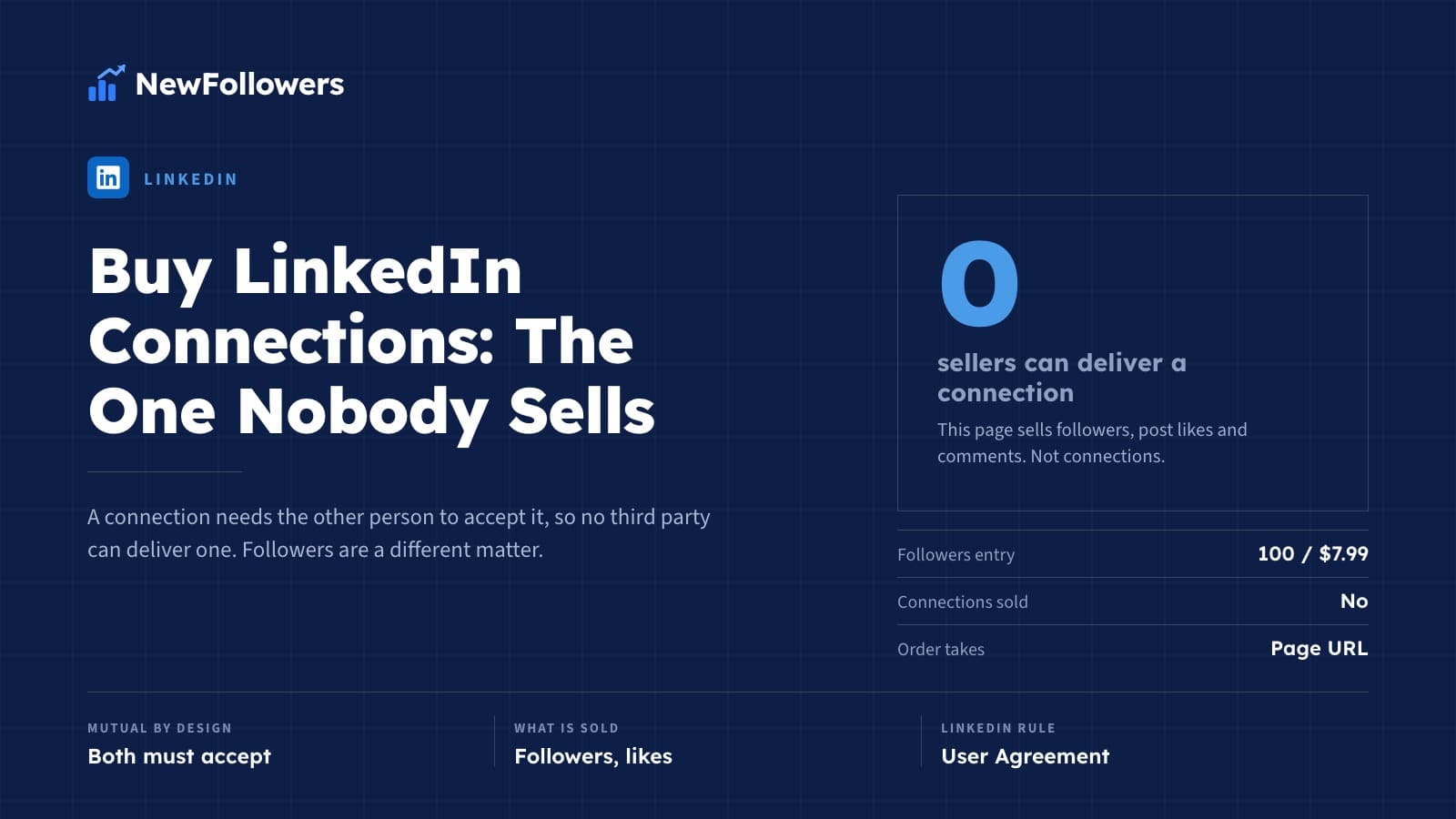
You cannot buy LinkedIn connections. Not here, not anywhere, and the reason is mechanical rather than moral: a connection only exists after the other person opens your invitation and taps Accept. No third party can press that button. To manufacture one they would have to send invitations as you, from inside your account, with your login — which is the precise activity LinkedIn restricts and suspends accounts over.
Followers are a different object entirely. A follow is one-sided, it needs nobody's approval, and it can be added to a public page or post without anyone touching your credentials. That is the half of a LinkedIn audience an outsider can actually supply, and it is the half sold on the LinkedIn page here.
So this article does two jobs. It explains why the thing in the search box does not exist as a product, and then it covers what does: how connections are actually earned, and where followers fit around them.
Connections and Followers Are Not the Same Number
LinkedIn draws the line itself. Its Follow and connect help page states that "Connections are members you know and trust", and that when you connect "you both become first-degree connections" — a two-way link, with direct messaging and mutual feed visibility attached to it.
Following is described in the same article as a way to see someone's public posts "without sending a connection invitation". One direction, no approval, no relationship implied.
That difference decides everything else on this page:
The last line is the one that settles what any provider can honestly sell, and it is why every site advertising connections is either selling you followers under the wrong label or asking for your password.
Why No Provider Can Deliver a Connection
Walk through what fulfilment would actually require.
A connection begins with an invitation, and an invitation can only be sent by the account holder. There is no public endpoint, no post URL, no username field that lets an outside party generate one. So a seller has exactly two options, and both are bad.
The first is to take your login and send invitations as you. That hands a stranger your inbox, your contacts and your professional identity, on a platform where your name is the product. Revoking access afterwards does not un-send anything.
The second is to run automation against your account. LinkedIn addresses this directly on its invitation restrictions page, which warns that where an excessive number of invitations suggests an automation tool, "we may suspend or restrict your account". The same page notes that repeated suspensions can end in a permanent restriction.
There is also a sentence on that page that reads as though it was written for this exact search. LinkedIn says plainly that you cannot "buy or acquire more invitations" — restricted or otherwise. Invitations are not a commodity the platform lets anyone trade in.
And even if invitations could be sent at volume, they would sit unanswered. LinkedIn lists ignored, pending and spam-marked invitations as a reason accounts get restricted in the first place. Buying connections would mean buying the exact behaviour that gets the ability to connect taken away.
The Ceiling Most People Never Hear About
Connections are capped. Followers are not.
LinkedIn's network size limit page sets the maximum at 30,000 first-degree connections per member, and states that the number of people who can follow you is unlimited. Hit the cap and Follow becomes the default button on your profile; you cannot accept or send another invitation until you remove someone.
Read that arrangement carefully, because it tells you what LinkedIn thinks each number is for. Connections are a bounded, curated list the platform expects you to keep clean — its own recommendation is to connect with people you know personally and trust professionally. Followers are the unbounded audience layer bolted on for reach.
Anyone whose real goal is "more people see my posts" is chasing the follower number and calling it connections. Anyone whose real goal is "more people I can message" needs the invitations, and those cannot be outsourced.
Connections vs Followers, Side by Side
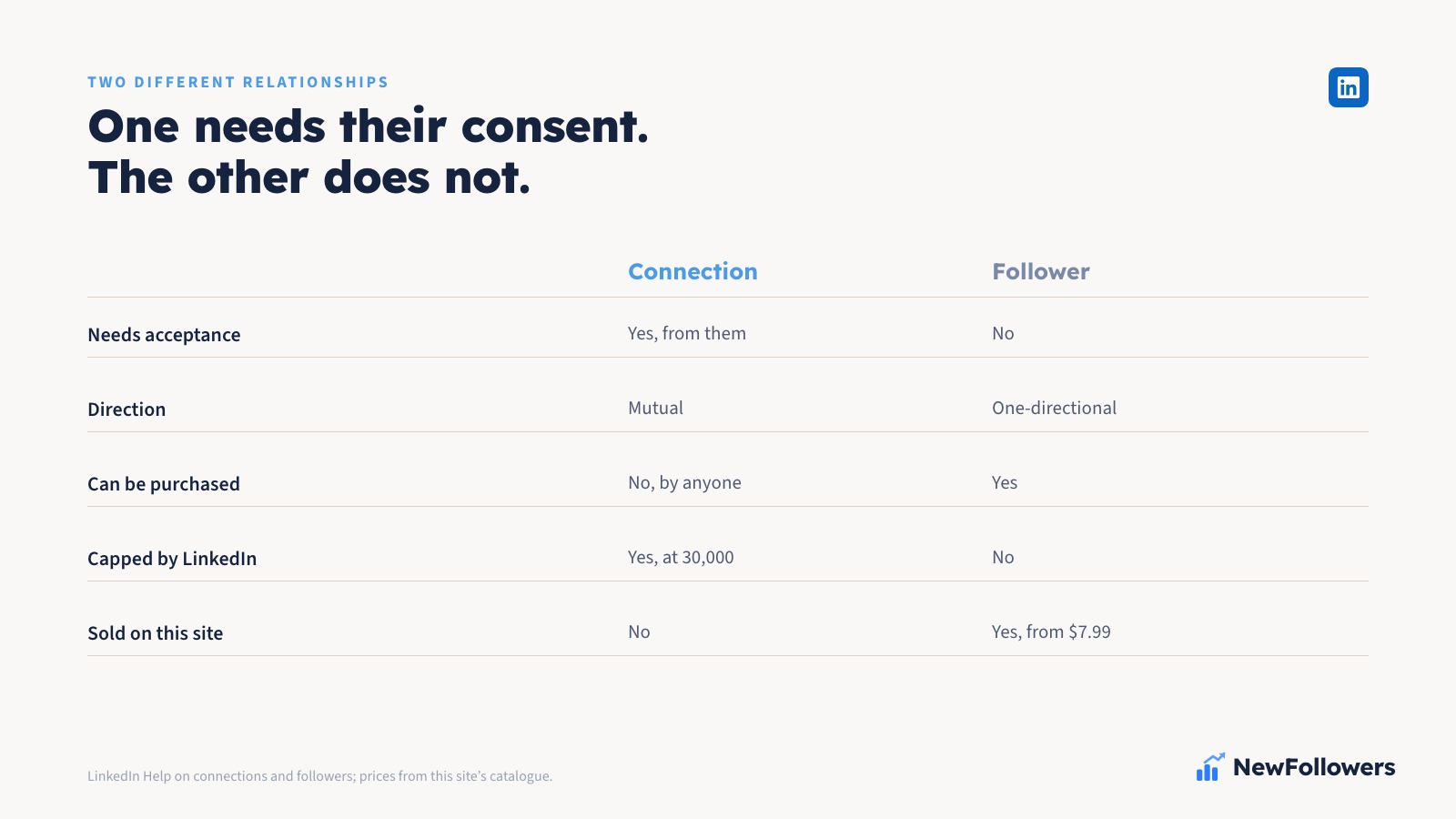
A connection
A follower
Two columns, one buyable. That is the entire commercial reality of this topic, and any page that blurs it is doing so on purpose.
How to Actually Get More Connections
The real methods, none of which are for sale.
Invite people who already know your name
Colleagues, former colleagues, clients, classmates, people from the conference badge in your drawer. LinkedIn's own guidance on the follow-and-connect page is to "only send invitations to people you know and trust". Acceptance rate is the metric that keeps your account healthy, and familiarity is the only reliable input to it.
Put the context in the note
An invitation with no note asks a stranger to reconstruct why you exist. One line naming where you met, or what you read of theirs, converts far better than a bare request — and a pending invitation that nobody remembers is one of the things LinkedIn counts against you.
Comment before you invite
Three thoughtful comments under someone's posts over a fortnight makes your name familiar before the invitation lands. This is slower than a tool and it is the difference between an accept and a spam report.
Post something worth accepting
Most people check the profile before answering an invitation. An empty feed makes the decision easy in the wrong direction. One useful post a week is enough to make the profile look inhabited.
Withdraw stale invitations, carefully
Old pending invitations drag on your acceptance rate. LinkedIn notes that once you withdraw an invitation, you cannot resend to that person for up to three weeks, so clear out the ones you have genuinely given up on rather than the ones you are still hoping for.
Watch the ratio, not the total
Invitations sent against invitations accepted is the number that predicts a restriction. A person who sends ten a week and gets eight is in a stronger position than one who sends two hundred and gets thirty.
How to Get More LinkedIn Followers
The other number, and the one that behaves like every other platform sold here.
Organically, followers come from posts that travel beyond your own network — comments on other people's posts, a company page linked from your site and your email signature, and employees who reshare rather than a founder posting alone. A LinkedIn company page is often the first thing a buyer, a candidate or an investor opens after your website, which is what gives the count on it a job to do.
Followers are also the part a provider can genuinely deliver, because a follow needs no approval and no login. Post likes and comments are deliverable too, but they carry a complication a follower count does not: LinkedIn publishes the name, photograph and job title of every person who reacts, so a purchase on a post is inspected rather than counted. That mechanism is its own subject, and buy LinkedIn likes is where it gets taken apart — worth reading before you order on a post rather than on a page. What nobody sells, here or anywhere, is connections.
If you are weighing the purchased route generally, the buy followers guide covers what the transaction does and does not do on any platform, and free followers covers the versions that cost nothing but your login. The second is worth reading before you type your LinkedIn password into anything. For the unpaid side, most of how to get followers fast transfers here, with one adjustment: on LinkedIn the audience is at work, so posting cadence matters less than whether the post is worth a colleague's forward.
What the Rules Say
Two rulebooks apply here and they are not the same document. LinkedIn's own is written about posts rather than invitations, so this blog reads it clause by clause in buy LinkedIn likes instead of twice over. The second has a regulator behind it, applies to businesses rather than individuals, and belongs on this page, because this is the page about what can and cannot honestly be sold.
The United States Federal Trade Commission takes on bought engagement in its Endorsement Guides FAQ, and the first thing to get right is what the answer is actually about. It is written about paid "likes" — not about engagement in general, not about followers, and not about connections — and that subject noun is worth holding on to rather than quietly swapping it for whichever number a page happens to be selling.
On likes, then. Where they come from non-existent people, or from people with no experience of the product or service, the FTC says "they are clearly deceptive", and it names "both the purchaser and the seller" of the fake ones as parties who "could face enforcement action".
Two things in that carry past likes to every other bought signal, which is why this is the paragraph the rest of the blog points at rather than rewriting. The first is that the deception the FTC describes is a claim made to somebody: nothing turns on a number sitting on a profile until it is put in front of a buyer, a recruiter, a client or a partner as evidence of something. The second is that the purchaser is named alongside the seller, which removes the usual defence that the panel did it. Both land harder on LinkedIn than on a consumer platform, because here the buyer is usually a business and the profile is usually being read as a credential.
Connections sit outside all of it, for the reason the rest of this page has already given. There is no purchase to regulate, because there is no product.
What Is Actually on Sale Here
A shopping note more than a pitch, and the shortest section on this page.
Begin with the gap in the catalogue. The LinkedIn page on this site lists three things: followers, post likes and post comments. Connections are absent, and they will stay absent, because the sections above rule them out as a product rather than as a policy preference. Treat that absence as the shopping test for this entire search — a storefront that does list connections has either relabelled a follower package or is waiting to ask for your password.
Two limits belong in the same breath as the offer. LinkedIn permits none of it, whoever supplies it. And of the three items listed, comments are the one an ordinary reader notices without going looking.
Followers open at $7.99 for 100, with the price shown before checkout and a 30-day window to refill drops.
The input goes last, because on this platform it is the argument rather than a specification. An order takes a company page URL or a post URL. No password field appears on it and no app-authorisation step, and the reason is the same one the whole page turns on: an account that can send invitations is an account that can read your inbox.
How This Search Usually Ends
Five endings, in rough order of how often they turn up.
Where That Leaves the Search
"Buy LinkedIn connections" has an answer, and the answer is that the product does not exist. A connection is a mutual link that the other person creates by accepting an invitation, invitations can only be sent from inside your own account, and LinkedIn states outright that they cannot be bought or acquired. Anything sold under that name is either a follower package wearing a costume or a request for your password.
What is left is more useful than it sounds. Connections are earned in small, unglamorous ways — invite people who know you, say where you met, comment before you ask, keep your acceptance rate high — and the ceiling at 30,000 means they were never going to be the scalable half of the number anyway. Followers are uncapped, need nobody's permission, and are the only part of a LinkedIn audience an outside provider can honestly deliver, which is exactly what the LinkedIn page offers and all it offers. see also.
Frequently Asked Questions
Can you buy LinkedIn connections?
No. A connection only exists once the other person accepts your invitation, and invitations can only be sent from inside your own account. No third party can create one for you without your login. LinkedIn's invitation restrictions page also states that you cannot buy or acquire more invitations, restricted or otherwise.
What is the difference between a LinkedIn connection and a follower?
LinkedIn's own help page puts it simply: connections are members you know and trust, and when you connect you both become first-degree connections with messaging in both directions. Following lets someone see your public posts without sending a connection invitation. Connections are mutual; follows are one-sided.
Then what are sites selling when they advertise connections?
Usually followers under the wrong label. The follower count moves, the connection count does not, and the buyer only notices afterwards. The other possibility is that the service expects your login so it can send invitations as you, which is worse.
Is there a limit on LinkedIn connections?
Yes. LinkedIn's network size limit page sets a maximum of 30,000 first-degree connections per member. Once you reach it, Follow becomes the default action on your profile and you cannot accept or send new invitations until you remove someone. Followers are not capped.
Can I buy LinkedIn followers instead?
Followers are deliverable because a follow needs no approval from anybody. NewFollowers sells LinkedIn followers, post likes and post comments from a page or post URL, starting at $7.99 for 100 followers. Connections are not on that list and cannot be.
Will mass-sending invitations get my account restricted?
It can. LinkedIn restricts invitation sending when many invitations go out in a short period, when a lot of them are ignored, left pending or marked as spam, and when the volume suggests an automation tool. The page notes that most restrictions lift within about a week, but repeated suspensions can become permanent.
Does LinkedIn allow buying engagement?
No. Its Professional Community Policies rule out inflating the response your own posts get, and treat fake accounts as a separate violation on top of that. For connections the question hardly arises, since nobody can create one on your behalf. The policy wording itself is read clause by clause in the buy LinkedIn likes guide on this blog.
How do I actually get more connections?
Invite people who already recognise your name, add a note saying where you met, comment on their posts before you invite them, and keep a profile worth accepting. LinkedIn's guidance is to send invitations only to people you know and trust, and acceptance rate is the number that protects your account.
Should I withdraw old pending invitations?
Pending invitations that nobody answers count against you, so clearing genuinely dead ones helps. Be selective, because LinkedIn notes that after you withdraw an invitation you cannot resend to that person for up to three weeks.
Is buying LinkedIn engagement a legal problem for a business?
It can be, separately from the platform rules. The Federal Trade Commission's Endorsement Guides FAQ is written about paid "likes", and on those it says that ones from non-existent people, or from people with no experience of the product or service, "are clearly deceptive", naming "both the purchaser and the seller" of the fake ones as parties who could face enforcement action. It bites once a count is offered to somebody as evidence, which on LinkedIn is the normal case rather than the exception. Connections fall outside it only because there is nothing to buy in the first place.
Ready to Grow Your Social Media?
Real followers, instant delivery, 30-day refill guarantee. Pick your platform: