Free Discord Members: What a Bump Actually Sends You
There Is No Free Member Button on Discord
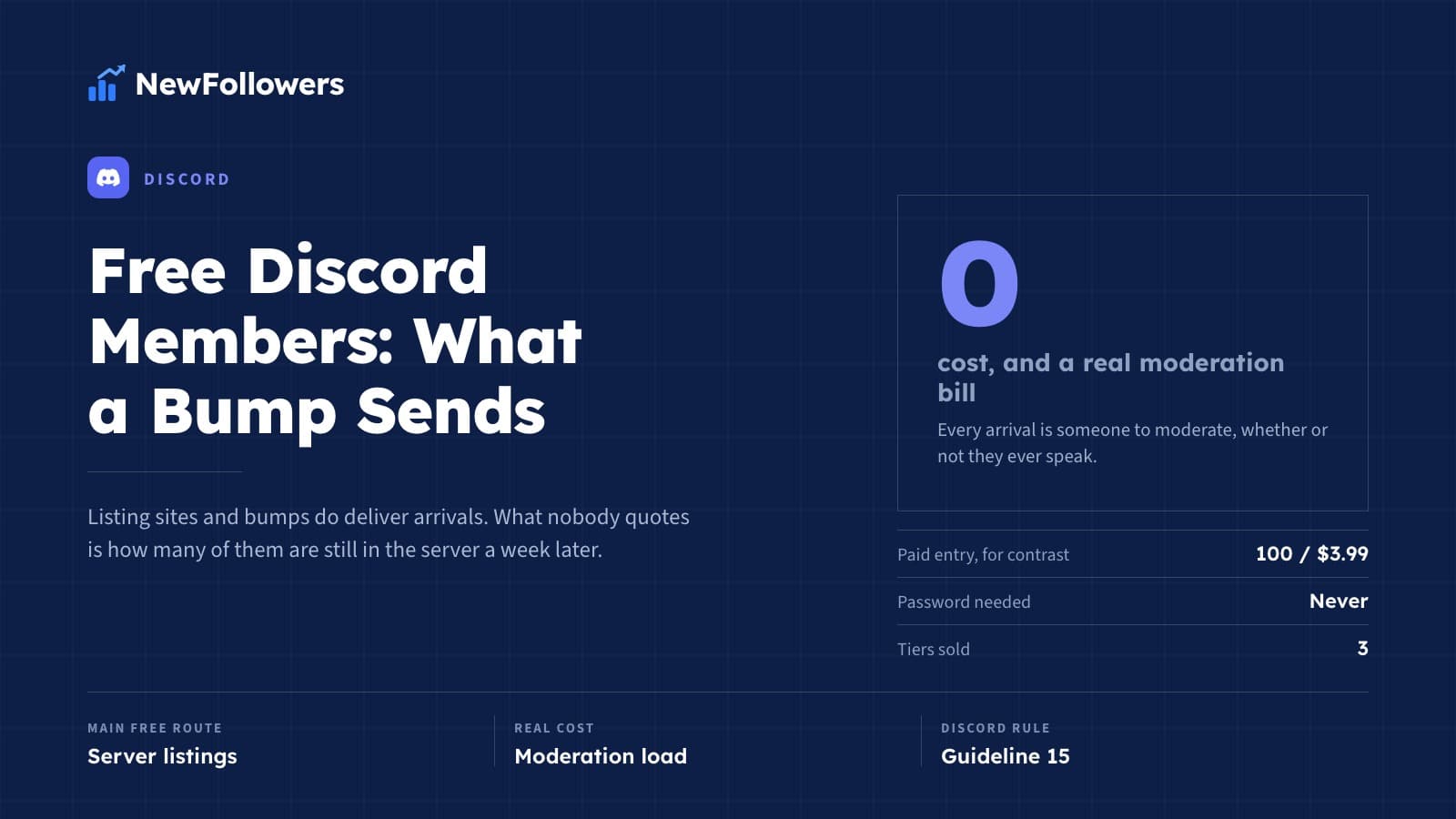
The three routes that actually send people are older than the phrase. Server listing sites such as Disboard and Discadia, where the tag pages are ordered by how recently a server bumped. Partnerships, where two servers trade a permanent invite in each other's channels. And Discord's own public directory. All three work in the narrow sense that arrivals appear. What none of them publish is the exit rate, because a directory click comes from somebody shopping for a server rather than looking for yours. Every arrival is also a moderation event, and that is the cost the word free is hiding. A fourth tier — generators, member bots and token exchanges — is not a distribution channel at all.
Searching for free Discord members turns up two very different things wearing the same label: real distribution channels that cost time and attention instead of money, and a tier of generators and exchanges that cost an account token. This page is about both, mostly the first, because the honest problems with the free routes are the ones nobody writes down.
The Four Things People Mean by "Free Discord Members"
Server listing sites
Disboard, Discadia, top.gg and the rest are directories. You submit an invite, tag the server, write a description, and then bump on a cooldown the site's own bot enforces and displays.
The bump, not the listing, is what you are actually using. The tag pages are ordered by recency, so a bump is a short lease on the top of the page rather than a position you hold. You slide down as every other server in your tags bumps behind you.
Partnerships and shoutout swaps
Two servers agree to advertise each other. In practice that means a partner channel in each server holding the other's invite, sometimes an announcement ping, sometimes a one-off cross-post.
No money moves, which is why it reads as free. It is a trade, and the section below is about what you are actually trading.
Discord's own directory
Discord runs a public server directory and points owners at its own support documentation on getting a community ready for it. It is the only listing surface here that Discord controls, and the only one where appearing carries any implication about the server itself.
Generators, token sites and member exchanges
The fourth tier is what the search term usually surfaces first: a page promising a free member package in exchange for a login, an app authorization, or a pasted token.
This is not a distribution channel. It is either a credential harvest or a delivery of accounts, and a token hands over the whole account, which is a categorically bigger concession than a password.
A Bump Is a Lease, Not a Rank
The mechanism is simple enough to reason about precisely, which is unusual in this category. A listing site ranks its tag pages by most recently bumped. When you bump, you return to the top of every tag you are listed under. From that second onward you are being pushed down by everyone else who bumps. So the value of a bump is not measured in the day it happened. It is measured in the window before you slide off the visible part of the page.
That has three consequences worth planning around.
The arrivals cluster. Almost everyone who clicks does so inside that window. A bump does not produce a trickle across the afternoon; it produces a burst and then nothing.
The intent is generic. A person browsing a directory is looking for a server, not for your server. They arrived at a list, filtered by a tag, and clicked something near the top. Your description did some work. Your actual community did none, because they have not seen it yet.
The window moves with the competition. A quiet tag holds you near the top far longer than a saturated one, so two servers with identical bump schedules get completely different results purely from tag choice. Any figure quoted for "members per bump" is meaningless without the tag list it came from.
How to measure your own bump, properly
Discord already gives you the instrument. In Server Settings, the invites list shows each invite code and how many times it has been used.
Create a separate invite code for every channel: one for Disboard, one for Discadia, one for each partner, one for anywhere else you post the link. The number next to each code is then that channel's real contribution, permanently, with no guessing. Do that before spending another month bumping on faith.
The Join-Then-Leave Rate Nobody Quotes
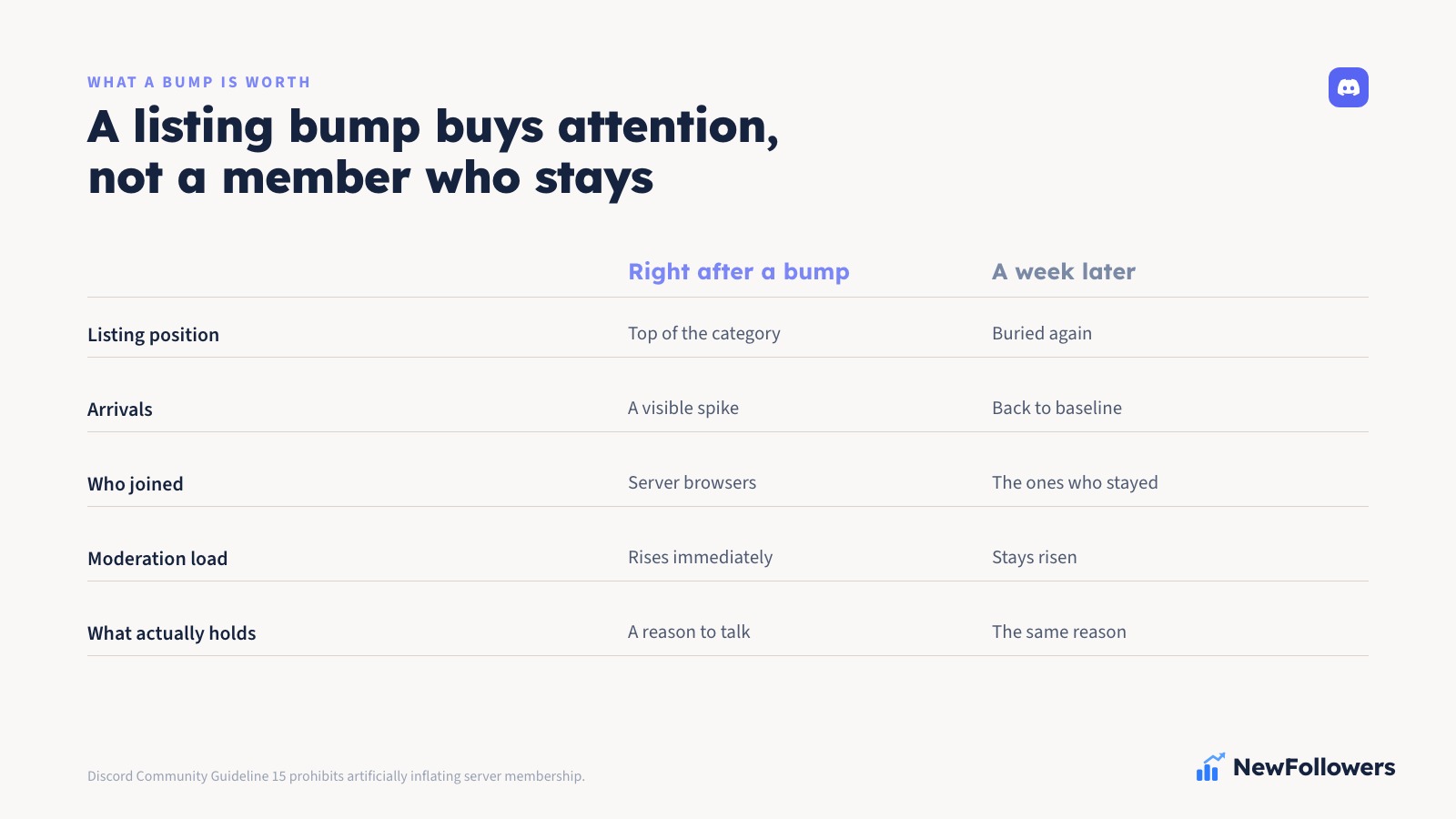
Every listing site advertises joins. None advertises the other half of the number, and it is not a conspiracy: they cannot see it. Only you can.
Here is the arithmetic, and it takes about a minute per bump. Write down the member count immediately before you bump. Bump. Write it down again once the burst has stopped, then again twenty-four hours later, and once more a week on. Alongside those, note the uses on the invite code you gave that listing site.
Gross joins come from the invite counter. Net growth comes from the member count. The difference is your leavers, and on directory traffic it is the larger of the two numbers far more often than anyone selling you a bump schedule will say.
There is a second figure worth more than either of them: how many of those arrivals ever post. You can approximate it from a welcome channel, an onboarding reaction, or simply by reading the first-message trail in your busiest channel the following day.
Nobody quotes a percentage here because the honest answer is that it depends on your tags, your description, your onboarding and your topic, and any single figure would be invented. Measure yours. It is the only one that applies to you.
What Free Discord Members Cost in Moderation
This is the part that makes the free channels expensive.
A bump publishes a live invite to an audience you have not screened, at a moment you chose. Everything that follows is a consequence of that sentence.
The burst is unsupervised unless you plan for it
If you bump and go to bed, the window in which almost all of your arrivals land is the window with nobody watching. Raid attempts, scam links and advertisement drops all favour exactly that hour. Bumping on a schedule you are awake for is not a nicety; it is the whole safety model.
Your member list becomes a mailing list
Anyone who joins can see who else is in the room. Scam and advertisement operations join servers specifically to direct-message the members, and DM spam is the one form of abuse your members feel and you never see. It reaches you as people quietly leaving.
The gates cost setup, then attention forever
Verification level, a rules screening step, slowmode on the first channel a newcomer can post in, link restrictions for accounts below a role, an automod ruleset. Each one is a small job to configure and a permanent obligation to maintain and tune.
Every gate you add lowers the join-to-first-message rate
This is the trade at the centre of the whole topic. The gates that protect you from directory traffic are the same gates that make a curious visitor close the tab. You cannot open the door wide and screen everyone who walks through it.
Partner channels are load too
An inherited audience is an audience whose habits you did not set. A partner server that turns into a scam hub, gets abandoned, or simply attracts a different kind of member sends all of that through a channel you put in your own server.
Partnerships Are a Trade, Not a Gift
Worth separating from listing sites, because they behave differently and fail differently.
What you actually exchange is not exposure but endorsement. Their invite sits in your server under your name, and members read that as vetting whether or not you did any.
Reciprocal partnership networks also circulate the same population. Someone who joins through a partner channel was, by definition, browsing a partner channel — which usually means they were another server's directory arrival. The same names turn up across dozens of servers, posting in none of them.
The partnerships that are worth having are the ones where the audiences overlap on a topic rather than on the habit of joining servers. Those are rare, they come from knowing the other owner, and they are almost never arranged in a channel called partner-requests.
The Line Discord Draws
One distinction carries all of this. Listing your server on a directory and partnering with another server are ordinary uses of Discord; inflating the count is the thing the Community Guidelines prohibit by name, listing "artificially inflating server membership" among the examples of engaging with the service in an inauthentic way.
That is why a bump schedule sits on one side of the line and the generator tier sits on the other. The full policy treatment — the guideline text, the assets clause that covers trading accounts and servers, the enforcement wording and the US endorsement-disclosure angle — is quoted in full on the buying guide, and not repeated here.
Free Members vs Paid Discord Members
The same outcome from two directions, since the honest comparison is not free against paid but slow-and-noisy against fast-and-silent.
A listing-site or partnership member
A purchased member
Neither column is a community. The left one can turn into one; the right one changes the first number a prospective member sees and leaves the rest of the job untouched.
Keeping the Ones a Bump Sends
The leaver problem is not solved upstream of the join. It is solved in the first ninety seconds after it.
Give the first channel one obvious thing to do
A newcomer who lands in a wall of read-only rules and an empty general chat has nothing to respond to. One prompt, one recent conversation, one question they can answer badly without embarrassment.
Pin the reason the server exists
Not a rules list. A short statement of what happens here and when. Most people leave because they cannot tell what the room is for, not because they disagreed with it.
Be present during the burst
If you know arrivals cluster after a bump, greet them then. A single reply from an actual human to an actual newcomer does more than a month of bumping.
Keep the tags honest
A server tagged for everything gets clicks from people who wanted something else, and they leave. Tighter tags produce fewer joins and better ones, which your invite counters will show you within two bumps.
When Paying for Members Makes Sense
There is one case, and it is worth naming precisely rather than waving at.
A bump only works on a server that already looks enterable. The description sells the click; the invite preview decides it, and a preview showing a single-digit member count tells a browsing stranger that nobody has said yes yet. The free channels cannot fix that, because they are the thing being gated by it. That is the narrow case for paying — not growth, not activity, but getting past the number that makes the free routes fail before they start.
Discord does not allow it, and that belongs at the front of this section rather than tucked into the last line of it. The guideline is named a few paragraphs up and quoted properly in the buying guide; a workaround being useful has never made it permitted. The second thing to price in is that the accounts do nothing afterwards. Every measurement in this article returns zero on them, because there is nothing there to measure.
With both of those on the table, the transaction itself is small. NewFollowers sells Discord members for that one job, from $3.99 for 100, with the sizes and what each costs on the Discord page. Fulfilment runs off a server invite link, the same public string a listing site takes, and never a token — that single input is what separates it from the fourth tier described above. Joins land across a period rather than in one spike, and anything that falls away inside thirty days is refilled. Whether a cold-start workaround is worth the trade is a judgement rather than a fact, and it is yours.
If a room worth being in is the goal, this is the smallest task on the list. Buy Facebook group members covers why a community surface reads an inflated number differently from a follower count.
What Wastes a Bump Schedule
A page asking for your token in exchange for members
Nothing legitimate on this list needs one. A listing site never asks, and that is the fastest way to tell the two tiers apart.
No idea which listing site earned the joins
Without a separate invite code per channel you cannot tell which cooldown is worth respecting, so you keep respecting all of them forever.
Gross joins on the whiteboard instead of net members
Joins are the flattering number. The member count a week later is the real one, and the gap between them is the thing you are actually managing.
A partner channel nobody has looked at in months
It is an endorsement in your own server, under your name, pointing at a room whose current state you have not checked.
Tags chosen for reach rather than fit
More clicks, worse fit, a higher leave rate, and no way to see the cause because it is spread across every tag at once.
What to Do Before Your Next Bump
Four things, none of which take an afternoon.
Free Discord members are real; the free part is simply priced in attention rather than money. Listing sites hand you a burst inside a window you do not control, partnerships hand you an endorsement you cannot supervise, and both hand you people you have not screened at a moment you chose. The leavers are the half of the number nobody publishes, and the only figure that applies to your server is the one your own invite counters give you. Every platform charges attention for its free tier; what changes between them is the currency, which is the argument the free followers guide makes across all of them — see also.
Frequently Asked Questions
Are there really free Discord members?
There are free channels, not free members. Server listing sites such as Disboard and Discadia, partnerships with other servers, and Discord's own public directory all send arrivals without charging money. They cost time, a bump schedule and moderation attention instead. Anything offering a free member package in exchange for a login or a token is a different thing entirely.
What does a Disboard bump actually do?
It returns your listing to the top of every tag page you are listed under. Those pages are ordered by how recently a server bumped, so the position is a short lease rather than a rank you hold: you slide down as other servers in your tags bump behind you. The value of a bump is the window before you slide, not the day.
How many members will one bump send me?
No honest number exists, because it depends entirely on how saturated your tags are, how your description reads, and what time you bumped. Two servers on identical schedules get completely different results from tag choice alone. Measure your own instead: give each listing site its own invite code and read the uses counter in Server Settings.
How do I measure my join-then-leave rate?
Note the member count immediately before you bump, again once the arrival burst stops, again twenty-four hours later, and once more a week on. Gross joins come from the invite code's uses counter; net growth comes from the member count. The difference is your leavers. Nobody publishes this figure because only the server owner can see it.
Why do so many directory arrivals leave straight away?
Because a person browsing a directory is looking for a server, not for your server. They filtered by a tag and clicked something near the top, so the only thing that sold them was your description. What keeps them is downstream of the join: one obvious thing to do in the first channel, and a pinned line saying what the room is actually for.
Do Discord server partnerships work?
They send people, but what you exchange is endorsement rather than exposure. Their invite sits in your server under your name, and members read that as vetting. Reciprocal partnership networks also tend to circulate the same nomadic population between servers. The partnerships worth having overlap on a topic, not on the habit of joining servers.
Is listing my server on Disboard allowed?
Yes. Directory listings, bumps and partnerships are ordinary uses of Discord. What its Community Guidelines prohibit by name is "artificially inflating server membership", which is the count rather than the listing. The full policy text, including the clause on trading accounts and servers, is quoted on the buy Discord members guide rather than repeated here.
Are free Discord member generators safe?
No, and the exposure is the credential rather than the members. They ask for a login, an app authorization or a pasted token, and a Discord token hands over the whole account: every direct message, every server, and the ability to post under your name, and it cannot be narrowed to a smaller permission. A listing site never asks for one, which is the fastest way to tell the tiers apart.
What moderation should be in place before I start bumping?
A verification level, a rules screening step, slowmode on the first channel a newcomer can post in, link limits for new accounts, and an automod ruleset. Bump only during hours you are awake, because the arrival burst and the unsupervised hour are otherwise the same hour. Each gate also lowers the share of arrivals who ever post, which is the trade at the centre of the topic.
Is it better to grow free or to buy Discord members?
They solve different problems. Free channels can produce genuine regulars, and cost a bump schedule, a partner obligation and moderation time. Purchased members move the number on the invite preview and do nothing after that, which addresses the cold start and nothing beyond it. Discord's guidelines prohibit the second; nothing about the first is against the rules.
Ready to Grow Your Social Media?
Real followers, instant delivery, 30-day refill guarantee. Pick your platform: