Buy Spotify Streams: Do They Earn Royalties?
Thirty Seconds Decides the Count. Spotify Decides the Money.
Two facts settle whether this purchase is worth anything, and the first is the one buyers most often have backwards.
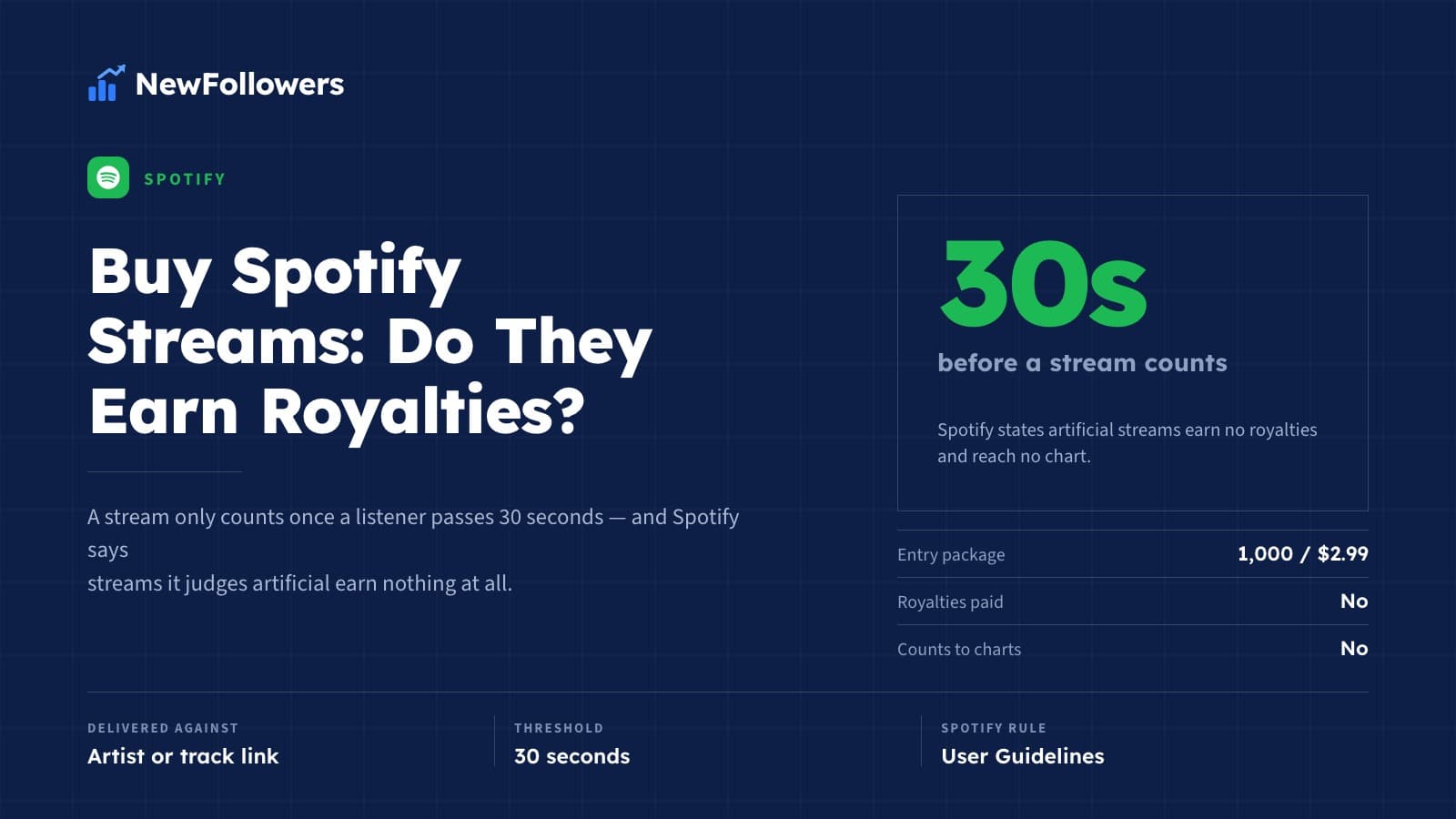
Spotify counts a song stream only once a listener has played it for at least 30 seconds. A skip at twenty-five seconds registers nothing at all, so what a provider sells by the thousand is playback time rather than clicks. The second fact is the one the money rests on: Spotify states that streams it identifies as artificial earn no royalties, do not count toward public stream numbers or charts, and do not positively influence its recommendation algorithms. Its User Guidelines prohibit "artificially increasing play counts or follow counts", including by "providing or accepting any form of compensation (financial or otherwise)". A purchased stream can move a number on a page. It cannot move a payment.
Buy Spotify streams goes into a search box as a marketing problem and comes back out as an accounting one. Nobody enjoys watching a counter rise for its own sake. Streams get bought because they look like money, or because they look like the thing that leads to money — so the payout answer belongs first, ahead of anything about delivery speed or provider choice.
What Spotify Counts as a Stream
Spotify's help article on how your streams are counted leaves no room for interpretation. A song stream is "Counted when a listener plays your song for at least 30 seconds". A music video stream works the same way.
That single threshold explains most of what is strange about the metric.
A stream, in other words, is not a person and not a fan. It is thirty seconds of playback. Thirty seconds of playback is the cheapest unit any music platform sells, which is exactly why it is the one on every provider's menu.
Do Purchased Streams Earn Royalties?
Not when Spotify identifies them, and Spotify says so in one sentence.
Spotify for Artists publishes a page on artificial streaming whose answer is: "Those streams do not earn royalties." The same page adds that they do not count toward public stream numbers or charts, and that they do not positively influence recommendation algorithms.
Pull those apart, because they happen to be the three reasons anyone buys streams in the first place.
Spotify also describes what happens further up the supply chain, and this is the part most buyers never see coming. It says a distributor, once informed of artificial streaming, may issue warnings, "charge a penalty fee", suspend the account or pull the music from the service. Where a track appears to exist mainly as a vehicle for artificial streaming, Spotify describes removing it from the service altogether. And effective 1 April 2024, Spotify began charging labels and distributors per track when flagrant artificial streaming is detected on their content.
That changes the shape of the risk. The penalty does not stop at an adjusted number on a page. It can arrive as a bill from the company you upload through.
The payout threshold is where this actually breaks
There is one more piece, and it catches the specific buyer doing this for money rather than for appearances.
Spotify's track monetization eligibility rules require "at least 1,000 streams in the previous 12 months" before a track enters the recorded music royalty pool calculation. Buying a thousand streams to cross that line is the obvious move, and Spotify closed it in advance: the same page says there is also a minimum number of unique listeners required, and that Spotify does not publish that number, in its words, "to prevent further manipulation by bad actors".
A thousand streams sourced from a small pool of accounts fails the second test even where it passes the first. The threshold was written with this exact purchase in mind.
What Purchased Streams Look Like
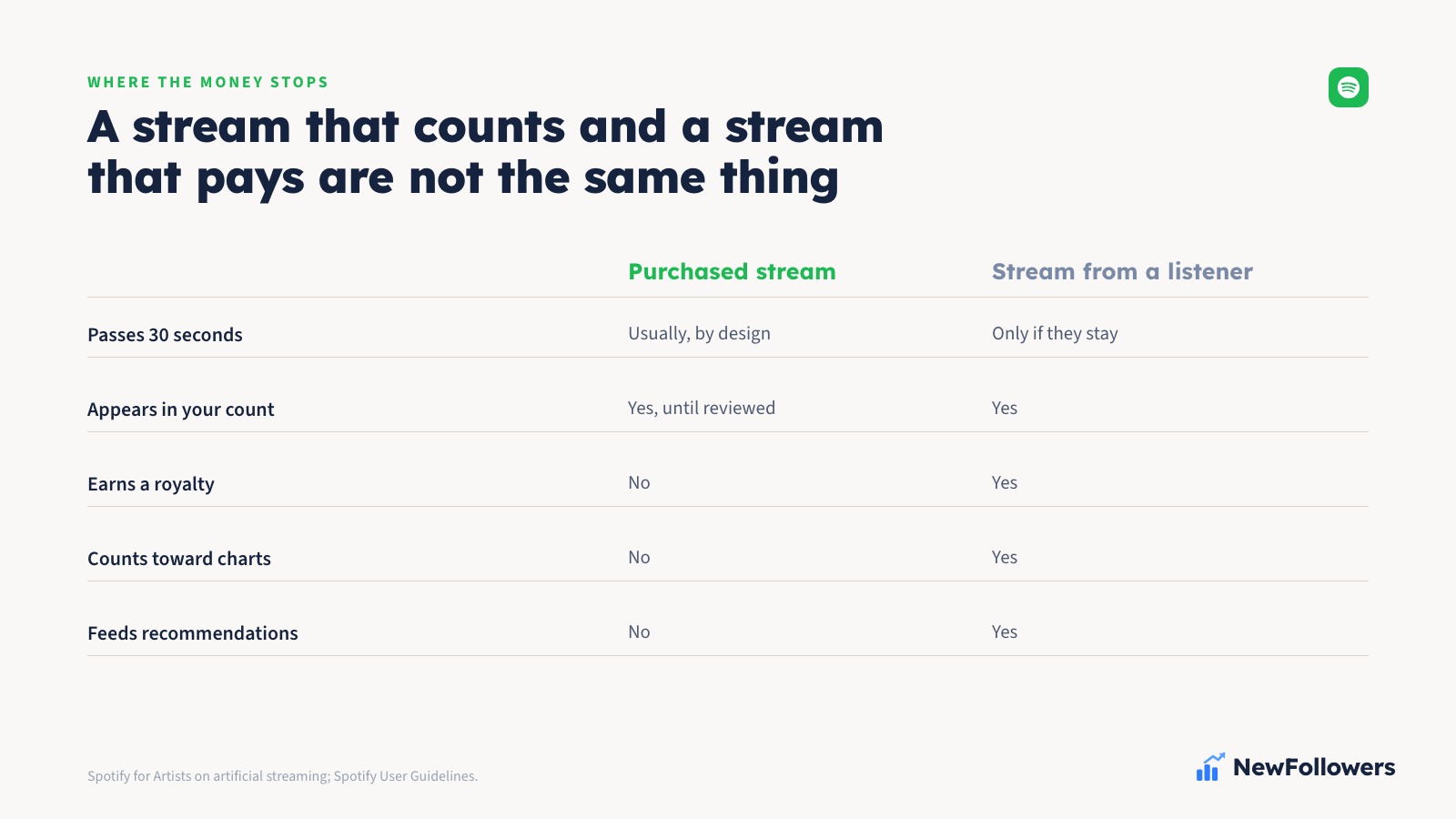
The same release, read from two directions.
A purchased stream count
An earned stream count
Only the second column has a payment attached to it, which on a streaming service is the entire point of the exercise.
The Clause This Whole Series Points At
Three Spotify articles on this site refer to one sentence in the platform's own rules. Here it is in full, because this is the page where the exact wording decides something.
Spotify's User Guidelines list what is not permitted "for any reason whatsoever". The clause reads: "artificially increasing play counts or follow counts, artificially promoting Content, or other manipulation", whether by bot or script, by "providing or accepting any form of compensation (financial or otherwise)", or by any other means. The same document says a violation may lead to removal of contributed content and to suspension or termination of the account, and it separately prohibits giving your password to anyone.
Two details in that sentence do work later. It names play counts and follow counts separately, so no metric on the profile is outside it. And it covers the accepting of compensation as well as the providing, which puts the buyer and the seller in the same clause.
Spotify for Artists is equally direct about the vendors. It says marketing services that target artists with the promise of streams or playlist placements "in return for a fee" are scams and should be avoided, that some claim to get a song streamed, playlisted or prioritised in Spotify's algorithmic recommendations, and that "None of this is true."
One thing that clause does not reach: what the number does once it leaves Spotify. A stream figure inside a pitch deck is a representation made to a business rather than a statistic sitting on a profile, and the American rules for that are worked through in the post on buying LinkedIn connections.
The Other Two Numbers, in Two Sentences
A visitor to an artist profile sees three public figures, and the other two have their own articles in this series rather than a rehearsal here.
Monthly listeners is a rolling 28-day count of unique people, so any spike leaves the figure about four weeks later on its own, before enforcement enters into it — the mechanics of that window, and what it does to a purchase, are the whole subject of the monthly listeners article. Followers is the standing count that does not decay, and the reason the phrase covers two different products, one attached to an artist and one attached to a playlist, is worked out in the Spotify followers article.
Saves sit outside that list entirely. They appear in Spotify for Artists rather than on the public profile, so Spotify saves change what you can see about a release rather than what a visitor sees before pressing play. A save also puts the track in someone's library, where it can be played again without being discovered again. Plays are the output. Saves are the thing that keeps producing them.
Ordering Without Handing Over an Account
Three requests should end a conversation with a vendor, and the third is the one people say yes to.
Delivery to a public track needs the link. Spotify's own Guidelines prohibit providing your password to another person, and no part of this job uses it, so a Spotify login is the first refusal and access to a Spotify for Artists account is the second.
The distributor request is the third, and the worst, and the one people agree to, because it sounds administrative rather than dangerous. That account controls your catalogue and your payouts. It is also, by Spotify's own description, the account that gets warned, charged or suspended when artificial streaming is detected — so handing it over hands over the exact thing the penalty lands on.
A short order of operations:
What Actually Moves a Stream Count
The unpaid route involves less guesswork here than elsewhere, for one reason: Spotify publishes the bar a play has to clear instead of leaving artists to infer it.
Earn the first thirty seconds
The counting rule is a production note as much as a metric. An intro that takes forty seconds to arrive loses streams from listeners who were willing to give the track a chance. Front-loading the hook is the only item on this list that costs nothing and works immediately.
Chase saves before plays
A save is a listener choosing to keep the track. Every later play out of that library is a stream you did not have to win again, which is why saves compound and single plays do not.
Release often enough for followers to matter
Followers are the one number that does not decay, and Spotify pushes new releases toward them. A profile with followers and no releases wastes the asset; a profile with releases and no followers rebuilds its audience from zero every time.
Use the pitch form
Spotify for Artists includes a form for submitting an unreleased track for editorial playlist consideration. It is the placement route the platform itself provides, which is the relevant distinction given what Spotify says about the ones sold for a fee.
Fix the skip point, not the count
If plays are dying at twenty seconds the problem is upstream of any provider. Paying for the shortfall leaves the leak exactly where it was and adds a bill to it.
NewFollowers on the Royalty Question
Start with the refill guarantee, because on this metric it is the promise most likely to be misread. The thirty-day refill attached to orders here replaces delivered units that go missing. It is a warranty on delivery and nothing else. It says not one word about royalties, and no wording anybody could put into it would.
The catalogue behind it is short. Spotify plays, monthly listeners, saves and followers are sold on this site, each tier priced on the Spotify page where the figures can be read and compared while you are still deciding. Orders take an artist, track or playlist link, volume is paced across days rather than arriving in a block, and no step in that sequence has any use for a password or a connected app.
Then the concession this whole article is built on. If the goal is a payout, do not buy this — from us or from anybody. Spotify's own answer is that identified artificial streams earn no royalties, and no delivery method, drip schedule or account-quality claim revises that sentence. A provider who tells you otherwise is describing a platform that does not exist.
What is left on offer is narrow: a figure a visitor reads before pressing play, on a profile where saves and followers are the columns still standing next month. Everything this page has quoted about royalties, charts and recommendations applies to an order placed here exactly as written.
Where Buyers Get the Money Question Wrong
Buying streams to reach the 1,000-stream payout threshold
Spotify pairs that threshold with an undisclosed unique-listener minimum precisely to stop it. This is the single most common version of the purchase and the least likely to work.
Reading the Spotify for Artists dashboard as settled
Spotify notes that artificial streams can still show as spikes in private artist data even after the royalties have been withheld and the public numbers adjusted. A number on the dashboard is not a payment, and the royalty report from a label or distributor is the source of truth.
Ordering plays and nothing else
A play count running far ahead of saves, followers and listeners is the shape people read a profile by. Moving one number in isolation makes the others louder.
Buying for a track with a slow opening
Thirty seconds is the gate. A track that cannot hold attention that long is losing streams that were already free, and paying for the shortfall fixes nothing upstream of the problem.
Paying for playlist placement
Spotify describes services promising placement in exchange for a fee as scams. It is the most expensive way to buy streams and the most likely to be reversed.
The Half-Minute You Already Own
The thirty-second threshold is the part of this metric worth carrying away, and not for the reason it usually gets cited. It is the only component of a stream count an artist controls for free. Make the first half-minute earn the listen and the counter moves on its own, with royalties attached to it and no vendor in the chain.
Everything else in this article points the other way. Streams identified as artificial earn nothing, stay out of public counts and charts, and do not influence recommendations, and since April 2024 the cost of being wrong can also land on a distributor as a per-track charge rather than on the artist profile where it is visible. The number and the money were never the same object; buying the first has never produced the second.
If the goal was the payout, the slow route — saves, followers, consistent releases and the editorial pitch form — is the only one that reaches it. If the goal is a number a visitor reads before pressing play, the Spotify plays page sets out what that costs and what it does not do. And Spotify is one counter among several with a payout number written on it, so if the real question is which of them is worth chasing at all, the other platforms and their thresholds are listed in the monetization thresholds guide. see also.
Frequently Asked Questions
What counts as a stream on Spotify?
A play of at least 30 seconds. Spotify's help article states a song stream is counted when a listener plays your song for at least 30 seconds, and a music video stream works the same way. A skip before that mark contributes nothing to the count.
Do purchased Spotify streams earn royalties?
No. Spotify for Artists states that streams it identifies as artificial do not earn royalties, do not count toward public stream numbers or charts, and do not positively influence recommendation algorithms. If the goal is a payout rather than a number on a page, this is the wrong purchase.
Is buying Spotify streams against Spotify's rules?
Yes. Spotify's User Guidelines list "artificially increasing play counts or follow counts" among the things not permitted for any reason whatsoever, including where it is done by bot or script or by "providing or accepting any form of compensation (financial or otherwise)".
How many streams does a track need before it earns anything?
Spotify's track monetization eligibility rules require at least 1,000 streams in the previous 12 months for a track to enter the recorded music royalty pool calculation. There is also a minimum number of unique listeners, which Spotify deliberately does not publish so the threshold cannot be gamed.
Can buying streams get a track removed from Spotify?
Spotify describes removing a song from Spotify playlists, and removing the track from Spotify altogether where it appears to exist mainly as a vehicle for artificial streaming. It also describes correcting the public stream numbers so the popularity shown is accurate.
Does my distributor get penalised too?
Spotify says that once it informs a distributor of artificial streaming, that distributor can respond with a warning, a penalty fee, a suspended account or the removal of the music. Effective 1 April 2024, Spotify also charges labels and distributors per track where flagrant artificial streaming is detected on their content.
Can a service get my song prioritised in Spotify's recommendations?
No. Spotify for Artists warns about marketing services that promise streams or playlist placements in return for a fee, says some of them claim to get a song streamed, playlisted or prioritised in its algorithmic recommendations, and answers that claim directly: none of it is true.
Do downloaded or offline plays count?
Yes, but not immediately. Spotify counts streams from downloaded music once the listener goes back online, which its help article notes they must do at least once every 30 days.
Does buying Spotify plays require a login?
No. Delivery to a public artist profile, track or playlist needs only the link. Spotify's Guidelines separately prohibit giving your password to another person, and a request for distributor credentials is a larger risk still, since that is the account Spotify describes being warned, charged or suspended when artificial streaming is detected.
What actually raises a stream count?
Saves, followers and the first thirty seconds. A save puts the track in a library where it can be replayed without being rediscovered, followers receive new releases and do not decay, and a track that earns the first half-minute converts listens the counter would otherwise never record.
Ready to Grow Your Social Media?
Real followers, instant delivery, 30-day refill guarantee. Pick your platform: