Buy Spotify Followers: Artist or Playlist?
Which Follower Are You Buying?
Settle one question before spending anything: is the count you want the one printed under an artist profile, or the one on a playlist? Spotify carries both, this phrase covers both, and only the artist-profile one is sold here. The pages competing for the search rarely say which of the two an order will move.
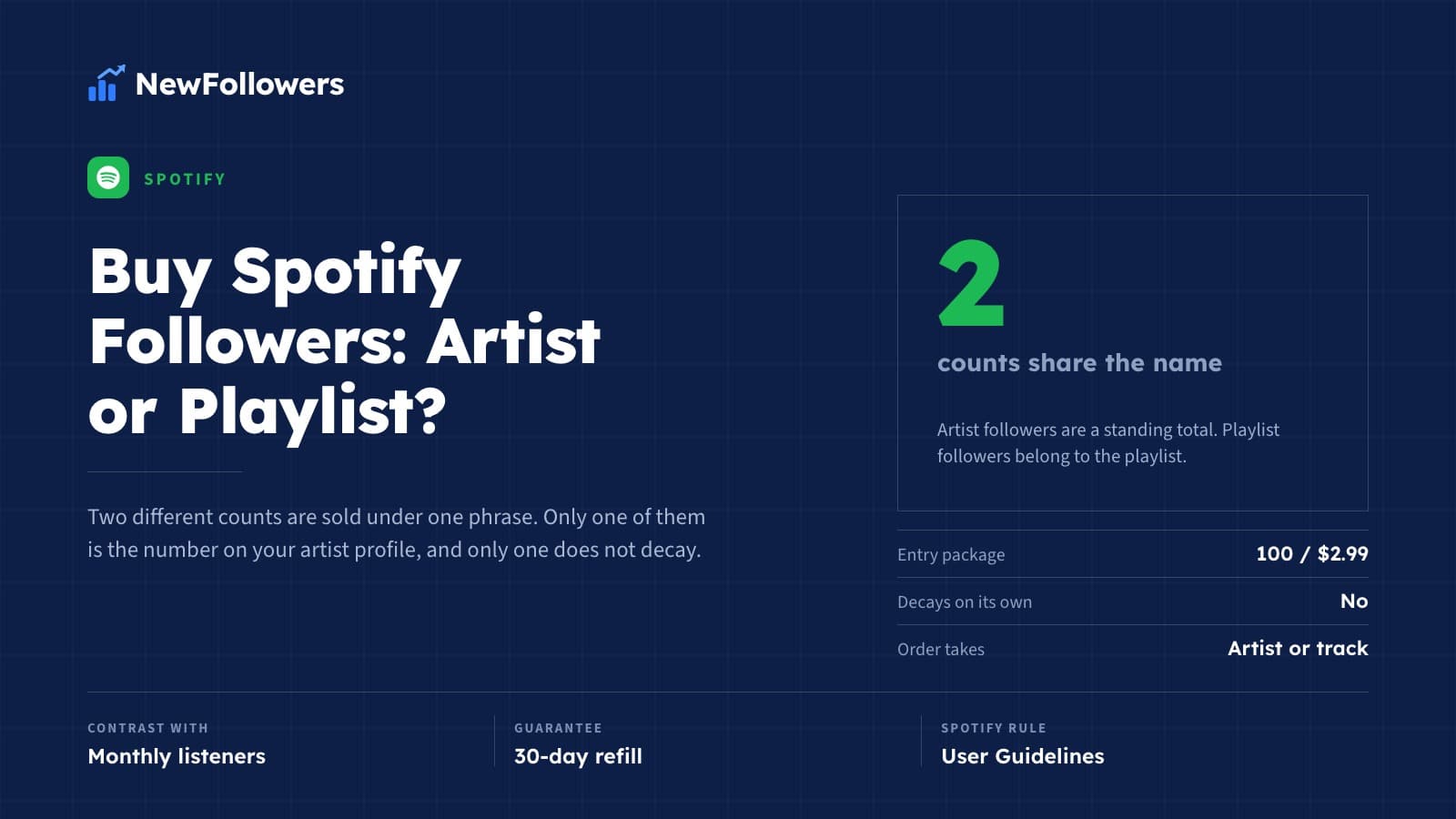
An artist follow attaches to your name. It sits under the artist profile, it is the figure a promoter or a label looks up, and it does not expire. A playlist follow attaches to one playlist you own, is displayed on that playlist, and travels with the playlist rather than with you. Only the first is sold on this site; playlist followers are explained here because the search phrase drags them in, not because they are on offer. Spotify prohibits either purchase — its User Guidelines forbid artificially inflating follow counts, with compensation named among the methods that clause reaches, and the Spotify streams article quotes it in full.
So anyone typing buy Spotify followers is putting one phrase over two different transactions. Sorting that out first matters more on Spotify than on any other platform, because the two counts sit on different pages, get read by different people, and are worth wildly different amounts to each of them.
Three Surfaces, One Search Phrase
Spotify shows a follower count in three places, and the same four words cover all three.
They share a search phrase because the underlying action is identical: someone presses Follow. What differs is where the number lands and who ever sees it.
An artist with 40 followers and a playlist with 40 followers have two completely different problems. The artist has a profile that reads as unreleased. The playlist has a page nobody has any reason to open. Buying the same thing for both is how people spend money on the surface that was not the problem.
What a Follow Does on an Artist Profile
A follow is a standing subscription. Someone has said, once, that they want this artist kept in view, and that statement does not expire on its own.
That is the entire mechanic, and it is why the count behaves the way it does. Nobody has to listen again for it to hold. Nobody has to open the app. The number sits under the artist name until a person actively unfollows.
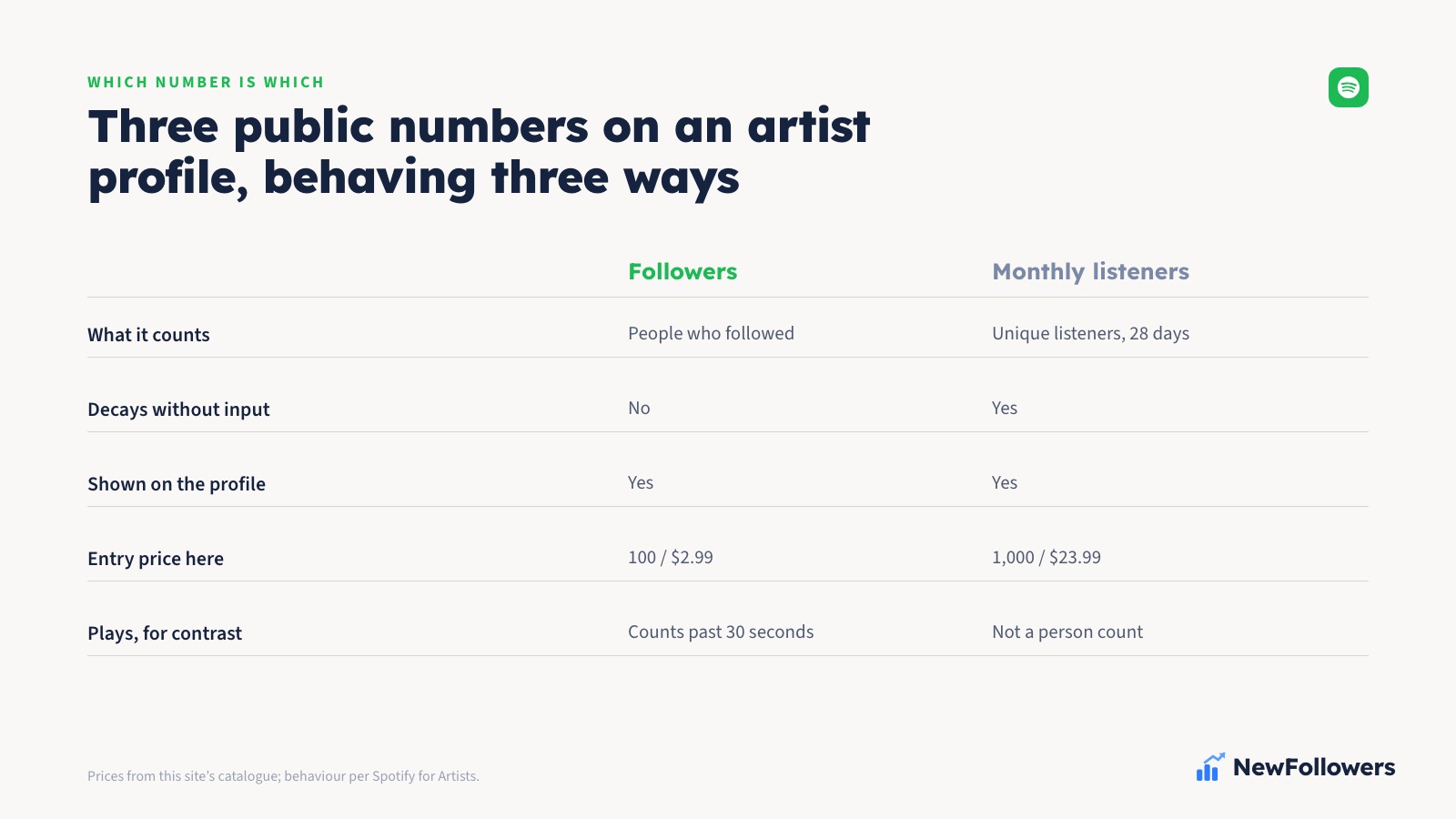
Compare it with what sits directly beside it. The monthly listener figure printed under your name runs on a rolling 28-day window, so it slides back down on its own roughly four weeks after any spike — the monthly listeners article is where that window and everything it does to a purchase get worked out. Play counts move only when someone listens past the thirty-second mark, which is the streams article. The follower count is the only figure on the page that a quiet month does not touch.
That durability is the honest case for buying it, and it is also the reason the number carries less information than people assume. A count that never falls is a count that stops describing the present. An artist who released steadily three years ago and nothing since still shows every follower earned back then, and a promoter who knows that discounts the figure accordingly.
Playlist Followers Are a Different Job
One thing to settle before the rest of this section: this site does not sell them. The Spotify order form here asks for an artist or track link, and the follower packages raise the count on an artist profile. Playlist followers are real, people do buy them, and they are worth understanding before spending anything — but anyone who decides they want them will be buying them somewhere else.
Playlists are discovered flat. A listener finds one through a share, a search or a link, and the only thing on the page suggesting the playlist is maintained rather than abandoned is how many people already follow it. On a playlist the count is the entire first impression, because there is no artist name attached to it carrying reputation of its own.
That is why curators buy the number and artists usually should not. A curator running a genre playlist is selling the playlist; the follower count is the product's only visible credential. An artist is selling the music, and a follower count on their own submission playlist convinces nobody who matters.
There is a second reason to keep the two apart, and it lives in Spotify's rules rather than in tactics. The section below has it.
Artist Versus Playlist, Side by Side
Two counts, the same button, almost nothing else in common.
An artist profile follower
A playlist follower
If the phrase brought you here wanting the right-hand column, the useful thing this page can do is say so plainly rather than sell you the left-hand one.
The Rule That Covers Both
Spotify handles this in a single sentence of its User Guidelines, and it is worth reading the whole sentence rather than the half everyone quotes.
The prohibited-activity clause names artificially increasing play counts and follow counts, and it names both providing and accepting compensation as covered methods, which catches whoever pays as squarely as whoever delivers. The streams article reproduces that wording verbatim, because the royalty question there turns on the exact phrasing. Two things about it matter here. Follow counts are named explicitly rather than swept up by a general anti-manipulation line, and the wording is identical for artist followers and playlist followers, so there is no version of this purchase that the rules treat more kindly. Nobody should go shopping for one.
The same sentence starts somewhere else, though, and that opening half belongs to this page. Immediately before the follow-count language, Spotify prohibits "selling a user account or playlist", and prohibits accepting or offering compensation to influence a playlist's name or "the content included on an account or playlist".
That is paid playlist placement, described in the platform's own words, sitting in the same sentence as the follower purchase. Anyone offering to add your track to a playlist for a fee is describing the practice named there. It is a different transaction from a follower count, and confusing the two is the most expensive mistake available in this topic — which is precisely why the two clauses share a sentence.
The Part That Applies Off Spotify
For an artist who sells anything, there is a second rulebook, and it is the one with a regulator behind it.
That second rulebook belongs to the Federal Trade Commission, and because its argument turns on how a count is used rather than on which platform is holding it, this blog derives it once — in the LinkedIn connections guide — instead of rebuilding it on every platform page.
The trigger is commercial use, not the follow itself. A hobbyist raising a number on a profile is not who the rule is written about. An artist presenting that number to a promoter, a sync agency, a brand or a distributor as evidence of audience size is making a claim about influence, and that is the moment the rule becomes the relevant document rather than Spotify's terms.
It is a narrower risk than the platform one and a heavier one. Spotify can remove a number. A misrepresentation to a commercial partner is a different category of problem, and it does not resolve itself when the count is corrected.
What Actually Raises a Follower Count
The organic route on Spotify is unglamorous and unusually specific.
Ask for the follow off-platform
Almost nobody presses Follow while listening; they press it after deciding they want more. The ask belongs where the decision happens — a show, a video description, a newsletter, a link in a profile — rather than inside the track.
Release on a rhythm people can rely on
A follow is a bet that something else is coming. An artist who releases predictably gives that bet a reason to exist. Long silences do not cost you followers, but they stop new ones arriving.
Send people to the profile, not to a single track
A track link converts a listener into a play. A profile link is the only one that puts the button in front of them. Plenty of artists spend an entire campaign driving traffic to a page with no follow action on it.
Treat the playlist as its own project
If you run a playlist, promote it as a thing with a name and a reason to exist. Playlist followers come from people who wanted that playlist, which is a completely different audience from people who wanted you.
Read followers against the listener figure
The relationship between the two is the useful reading. Listeners far ahead of followers means people are hearing you and not committing, which is a call-to-action problem. Followers far ahead of listeners means an audience you built and then stopped feeding.
What NewFollowers Actually Sells for Spotify
Four tiers, one surface. The Spotify page lists 100 followers at $2.99, 500 at $5.99, 1,000 at $10.99 and 5,000 at $18.99, and each of them raises the count under an artist name.
The order form takes an artist or track link. Nothing else goes into it — no password field, no app authorisation — because a public profile can be followed by anybody holding the link, and the account behind it never enters the transaction.
A thirty-day refill covers delivered followers that vanish afterwards. It is worth knowing what that promise cannot reach: the disappointment on this metric is rarely a number falling, it is a number holding perfectly while saying less and less about the artist under it.
Then the gap, which outranks all of the above for anyone who arrived on the playlist half of the phrase. There is no playlist-follower product here at any price. The artist package will put a number on a profile and nothing whatsoever on a playlist, so a curator is better served leaving this page than substituting.
Permission is the one thing not on offer. Spotify prohibits artificially increasing follow counts, this page has linked the clause and quoted the playlist half of it, and no delivery method alters what that sentence says. What a provider can control is narrow: which surface the number lands on, what the order form asks for, and whether the pricing is honest about it.
A Decision Rule for the Two Products
Everything above collapses into a short sequence. Work down it in order and most of the ways this goes wrong never come up.
What the Count Is Worth
The phrase covers two products and refuses to separate them, so the separation has to happen before the money does. Artist followers sit under your name and stay there, and they are the ones sold here. Playlist followers sit on one playlist and belong to it, and buying those means buying them somewhere else. Mistaking one for the other is the most common way money gets spent on this topic with nothing visible changing.
The durability of the artist count is real and it cuts both ways. It is the one figure on the profile that a quiet month does not erode, which makes it the most flattering number you can raise and the least informative one anybody can read. Everyone who reads Spotify profiles for a living knows that, which is why they read the follower count against the listener count rather than on its own.
Spotify's User Guidelines prohibit artificially increasing follow counts and name compensation directly, so nothing here is an argument that the purchase is permitted. For anyone selling tickets, merch or their own time, the consumer-protection question above is the second one to settle before the number is quoted to a partner. Anyone whose real question is about follower counts rather than about Spotify should be reading the general buying followers guide instead of this one. see also.
Frequently Asked Questions
Are Spotify playlist followers and artist followers the same number?
No, and they sit on different pages. An artist follow attaches to the artist page and shows as the count under your name. A playlist follow attaches to one playlist you own and is displayed on that playlist only. They are sold under the same phrase because the action is the same, but the number lands in a different place and is read by different people. This site sells the artist-profile one only.
Does Spotify permit paying for followers?
It does not. Follow counts are named alongside play counts in the prohibited-activity clause of the User Guidelines, and that clause treats accepting compensation and providing it as covered methods, so whoever pays sits inside the same sentence as whoever delivers. Nothing in the wording separates an artist follower from a playlist follower. The streams guide on this blog carries that clause verbatim.
Do Spotify followers decay?
No. A follower count is a standing total that holds until someone actively unfollows. That is what separates it from the monthly listener figure sitting beside it on the same profile, which is a rolling 28-day count and falls back on its own.
What do Spotify followers cost here?
The tiers on this site are 100 followers at $2.99, 500 at $5.99, 1,000 at $10.99 and 5,000 at $18.99. All four raise the follower count on an artist profile. There is no playlist-follower tier, at any price.
Will buying followers get my music onto playlists?
No. A follower count on your artist profile does not place a track anywhere. Paid placement is a separate transaction, and it is the one Spotify names in the clause about accepting compensation to influence the content included on a playlist.
Should an artist buy playlist followers?
Usually not, and not from here: this site does not sell playlist followers at all. The Spotify order form takes an artist or track link and the packages raise the count on an artist profile. Playlist followers make sense for someone whose product is the playlist, because the count is the only signal on the page that it is still maintained. For an artist the product is the music, and a follower count on their own submission playlist persuades nobody.
Is a Spotify login required to order?
No. The order form asks for an artist or track link and nothing else. Anyone asking for a Spotify password is after the account rather than the follower count, which is a reason to stop rather than to shop around.
Do purchased followers change my stream count?
No. A follow and a stream are separate actions on separate counters, so no volume of follows produces a play, a listener figure or a payout. What does and does not count as a stream is covered in the Spotify streams article.
Is there a rule outside Spotify that covers buying followers?
Yes, for anyone who uses the number commercially. United States consumer-protection guidance treats bought engagement as deceptive once the figure is offered to a promoter, a brand or a sync agency as evidence of an audience, and it does not stop at whoever supplied the accounts. The LinkedIn connections article on this site is where that guidance is quoted and worked through.
What actually raises a Spotify follower count?
Asking off-platform, where the decision is made rather than mid-track, and sending campaign traffic to the artist profile rather than to a single track, because the follow button is only on the profile. Releasing on a predictable rhythm is what makes the follow worth pressing in the first place.
Ready to Grow Your Social Media?
Real followers, instant delivery, 30-day refill guarantee. Pick your platform: