How to Go Viral on TikTok: What Is Not in Your Hands, and What Is
How to Go Viral on TikTok
Nobody can tell you how, and that includes TikTok. Going viral is an outcome that a few thousand strangers decide about one video, and no sequence of steps produces it on demand. What repeats is the input: the opening seconds, how long a video asks for against how much it has to say, whether it gives the feed something to act on, and how many attempts you make.
So there is no numbered formula on this page. A formula would assert that the outcome is yours to arrange, and it is not. Everything below is the part that is.
What TikTok Publishes, and What It Does Not
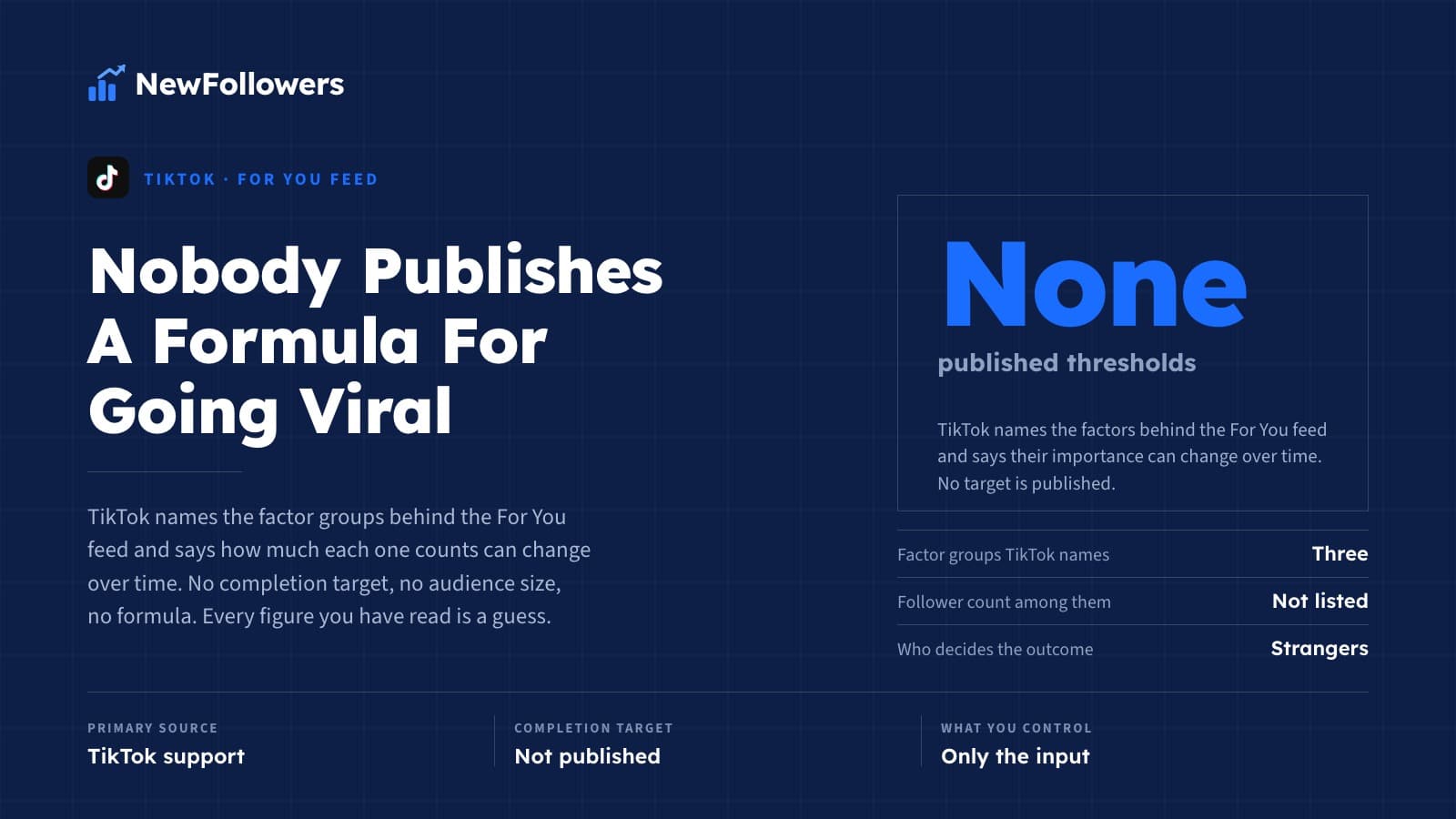
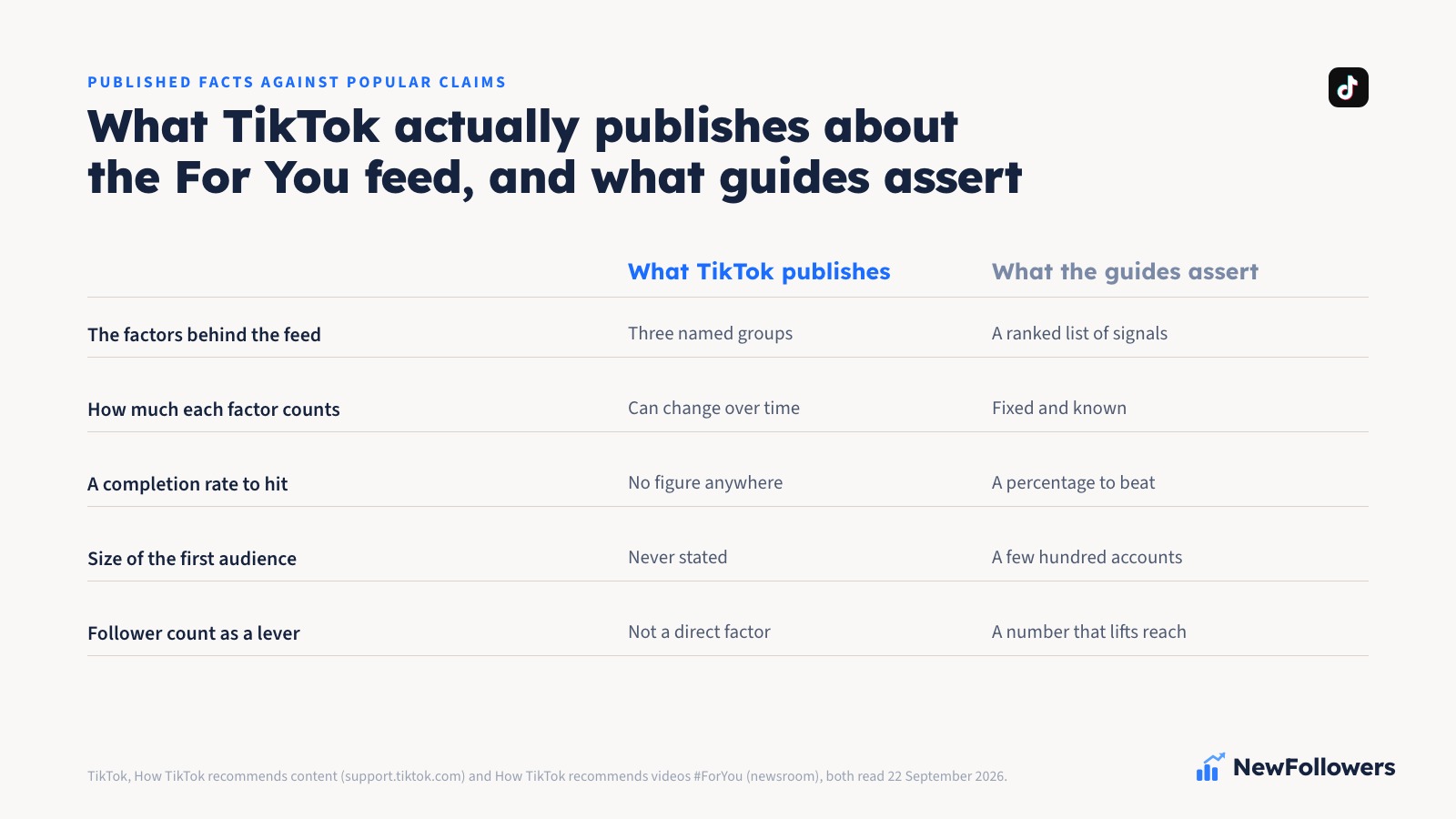
TikTok's support documentation names three groups of factors behind the For You feed. User interactions — content you like, share, comment on, and watch in full or skip. Content information, listed as sounds, hashtags, number of video views, and the country the post was published in. User information: device settings, language preference, location, time zone and day, and device type.
Then it says the thing most pages on this question leave out. Each of those factors "can play a larger or smaller role" in what gets recommended, and how important each one is "can change over time". That page adds one comparative statement and then stops: for most users, user interactions, which may include the time spent watching a video, are generally weighted more heavily than the others.
That is the published mechanism in full. No completion percentage to beat. No stated size for the first audience a video reaches. No ranked list of signals, no points, no score, no threshold. Every figure of that kind you have read on this subject was supplied by whoever wrote it.
TikTok's older explainer, still on its newsroom and dated 2020, adds one comparison worth keeping. A strong indicator of interest, such as a viewer finishing a longer video from beginning to end, carries more weight than a weak one, such as the viewer and the creator being in the same country. Strong beats weak. That is a direction, not a dial, and it is the most specific thing TikTok has ever said about this.
The same explainer also says there is no one For You feed — each person's is assembled for them. Two videos of identical quality meet different people on different days, and that alone is enough to produce very different results from the same work. It is the least discussed fact about this question and probably the most important one.
Follower Count Is Not the Lever, and TikTok Says So
This is the point in a page on this site where you would expect to be sold something, so here is the documented answer instead.
TikTok's newsroom explainer states that while a video is likely to receive more views if posted by an account with more followers, by virtue of that account having built up a larger follower base, neither follower count nor whether the account has had previous high-performing videos are direct factors in the recommendation system. Follower count does not appear anywhere in the three For You factor groups either. It does appear elsewhere in TikTok's own lists — under account recommendations, and in the LIVE feed — which makes the claim narrow rather than absolute, and worth stating precisely rather than as a slogan.
Nothing you can buy changes how a video is distributed. NewFollowers sells TikTok followers and that sentence is still true: what an order moves is a number on a profile. Whether a stranger who lands there behaves differently because of it is a claim about other people's behaviour, and nobody selling it has measured it, this site included. The honest version stops at: they can see it. What a purchase does and does not contain is its own page.
The version you will meet everywhere else — build a base so a viral video converts — does something worse than overstate. It attaches a purchase to an event nobody can schedule. And there is a cost on the other side: TikTok's Community Guidelines rule out trading in services that artificially boost engagement, name buying or selling followers among what is not allowed, and say that where inauthentic metrics are detected the fake likes and followers are removed. The newsroom explainer lists spam content, such as videos seeking to artificially increase traffic, among what may be ineligible for recommendation at all. On a page about reach, that belongs in the same breath as the offer.
The Opening Seconds, Which Are Genuinely Yours
Everything downstream needs a viewer who is still there, and the only part of that you control is what happens before they decide.
The useful instruction is narrower than the usual one. Do not open with what the video is about; open with the video. The establishing shot, the greeting, the name of the account, the slow pan into the subject — each is a promise that something is coming, and a promise is weaker than the thing itself. Start at the moment you would otherwise have cut to.
TikTok's own answer to a creator asking why posts are not getting views is worth knowing, because it is so much smaller than the folklore. That page says to use the analytics dashboard, which covers total views, engagement information and other metrics. It says nothing else. No shadowban, no jail, no ritual. Two things about that dashboard catch people out: analytics are only generated for videos posted after the feature is switched on, and the data can take a day or two to update.
Your own retention figures are the only evidence on this subject that is about your audience rather than somebody else's. They also cannot be argued with, which makes them more useful than any list of hooks.
Completion Is a Ratio, and You Only Control the Denominator
You cannot make anyone watch for longer. You can make the video shorter. That is arithmetic rather than a claim about the algorithm, and it is why cutting is the one edit that reliably moves the number.
But "make everything short" is not TikTok's advice, and it is worth noticing who it did come from. TikTok's own growing your audience page lists four practices — get to know your audience, post high-quality content on a regular basis, use the monetisation tools, collaborate with other creators — and under the second one it says to create content longer than one minute. Short is not a rule. Short is what you do when the idea is short.
The question to ask of a cut is whether the next ten seconds are there because the idea needs them or because the video does. Where the answer is the second one, that is where people leave.
Give the Feed Something to Act On
TikTok lists what counts as an interaction: liking, sharing, commenting, watching in full, skipping. It does not rank them, and anyone telling you a share is worth precisely more than a comment has ordered a list TikTok has not published.
What is observable without that ranking is still useful. A share hands the video to somebody the system had not selected, which is the only interaction that reaches outside the audience it was already being shown to. A rewatch is more watch time on the same upload. A comment that people stop to read is time spent on the post. None of that depends on knowing the weights; it follows from what the actions are.
In practice it means ending somewhere that has somewhere to go — a reply worth writing, a claim worth disputing, a last frame that runs back into the first — rather than ending on "follow for more", which asks for a decision the viewer has not been given a reason to make yet.
Post Enough That Variance Can Work
Because the outcome is settled by an audience you do not pick, each upload is a separate attempt at it. More attempts, more chances. That is the entire argument for posting often, and it is a statement about probability rather than about TikTok.
It is also where the numbers get invented. There is no published posting frequency, and TikTok's own wording is "on a regular basis". Once a day, three a week, five a week — nobody outside TikTok can tell you which the system prefers, and anyone naming a figure is guessing in public. Pick a rate you can hold for three months without the work getting worse, because a rate abandoned in week two is worth less than a slower one you keep.
When something does break out, the honest next move is not to copy its format across the whole account. It is to work out what that video did that the others did not, and to test the answer twice before believing it. One result is not a pattern, and treating it as one is how accounts end up making the same video forty times.
The Word Shadowban Has a Real Name
There is a documented state, and it is not the one the folklore describes. TikTok calls it being ineligible for recommendation. Its support page says an account that repeatedly posts content unsuitable for the For You feed will not appear there and will be harder to find in search — and then adds the part nobody quotes: you are told. The notice arrives in your inbox and appears on your profile, it lists the videos concerned, and there is an appeal.
Which makes the test simple. If you have not had that notice, you do not have that problem, and a run of quiet videos is a result rather than a punishment. TikTok also says it typically does not recommend content people have already seen, and that content can fall short of its For You feed eligibility standards while remaining entirely permitted on the platform. Neither of those is a penalty. Both of them look like one from the inside.
What a Viral Video Actually Leaves You
Traffic, and about a day of it.
A video that travels puts the account in front of people who were not looking for it, and almost all of them keep scrolling, which is not a failure of the video. What happens next is decided on the profile: the pinned post, whether the rest of the account is recognisably the same thing as the clip they just watched, whether there is a reason to come back as opposed to a reason to have watched once.
That is not arrangeable in advance either, and it is where most guides promise that it is. What you can do is make the account worth arriving at before anything arrives, and keep making attempts — because the input is the half of this you own, and it is the only half anybody has ever controlled.
Two related questions have their own pages here. Whether putting FYP in a caption does anything, and what the For You Page actually is, is in what FYP means. And paying TikTok directly to distribute a post, which is the one route to reach that is neither organic nor against the rules, is TikTok Promote.
Frequently Asked Questions
How do you go viral on TikTok?
Nobody can tell you how, and that includes TikTok. Going viral is an outcome that a few thousand strangers decide about one video, and no sequence of steps produces it on demand. TikTok names three groups of factors behind the For You feed and says how important each one is can change over time, which is a direction rather than a procedure. What is genuinely in your hands is the input: the opening seconds, how long the video asks for against how much it has to say, whether it gives the feed something to act on, and how many attempts you make.
How many views do you need to go viral on TikTok?
TikTok publishes no such number, and any figure quoted to you is somebody's opinion rather than a platform threshold. There is no view count at which a video is officially viral, no point at which distribution is guaranteed to widen, and no published size for the audience a new upload is first shown to. The word viral is a description people apply afterwards, not a state the platform announces.
Is there a completion rate you have to hit on TikTok?
Not one that TikTok has published. Its documentation says that for most users, user interactions, which may include the time spent watching a video, are generally weighted more heavily than other factors, and its older explainer says a strong indicator of interest such as finishing a longer video counts for more than a weak one such as sharing a country with the creator. Both are comparative. Neither is a percentage, and the specific targets circulating on this subject were not supplied by TikTok.
Does follower count affect whether a TikTok goes viral?
Not as a direct factor, according to TikTok itself. Its newsroom explainer says that while a video is likely to receive more views if posted by an account with a larger follower base, neither follower count nor whether the account has had previous high-performing videos are direct factors in the recommendation system. Follower count is also absent from the three For You factor groups in its current support documentation, though it does appear in TikTok's lists for account recommendations and for the LIVE feed.
Does buying followers help a video go viral?
No. TikTok says follower count is not a direct factor in the recommendation system, so nothing bought changes how a video is distributed. NewFollowers sells TikTok followers and that answer does not change: what an order moves is a number on a profile. There is a cost on the other side as well, because TikTok's Community Guidelines rule out trading in services that artificially boost engagement, name buying or selling followers among what is not allowed, and say that where inauthentic metrics are detected the fake likes and followers are removed. Its newsroom explainer separately lists spam content such as videos seeking to artificially increase traffic among what may be ineligible for recommendation.
How often should I post to go viral on TikTok?
There is no published frequency. TikTok's own growth page says to post high-quality content on a regular basis and names no number. Since the outcome is settled by an audience you do not pick, each upload is a separate attempt and more attempts mean more chances, which is a statement about probability rather than about TikTok. Choose a rate you can hold for months without the work getting worse, because a rate abandoned after two weeks is worth less than a slower one you keep.
What is the 3 second rule on TikTok?
It is folklore rather than a TikTok rule, and TikTok publishes nothing of the kind. What is true underneath it is that a viewer decides whether to keep watching before you have explained anything, so the opening should be the video rather than an introduction to it. The evidence for your own account is in your analytics, which is what TikTok points creators at when posts are not getting views, and it beats any general rule about seconds.
Am I shadowbanned if my TikTok views dropped?
Probably not, and there is a way to check. TikTok has a documented state called being ineligible for recommendation: an account that repeatedly posts content unsuitable for the For You feed will not appear there and is harder to find in search. The creator is notified, in inbox notifications and on the profile, can review the videos that were flagged and can appeal. If you have had no such notice, that is not what is happening. TikTok also says it typically does not recommend content people have already seen, which can look like a penalty from the inside and is not one.
Ready to Grow Your Social Media?
Real followers, instant delivery, 30-day refill guarantee. Pick your platform: