How to Get Verified on TikTok: The Criteria TikTok Publishes, and the One That Stops Everybody
How to Get Verified on TikTok
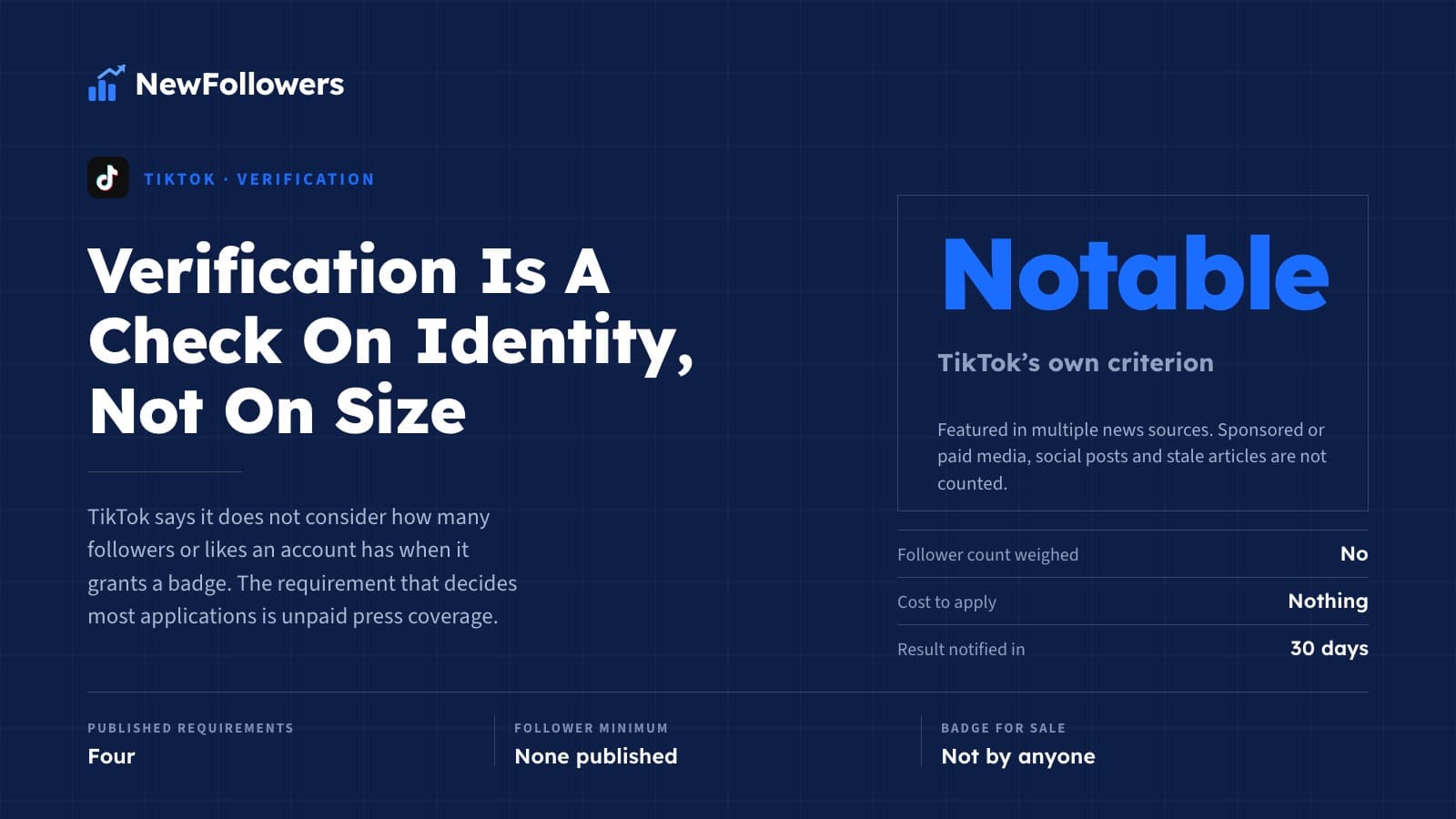
You apply from inside the app, and TikTok decides on identity rather than on size. Its own criteria page says the number of followers or likes on an account is not considered. Most applications fail on a single word, and the word is "notable".
That is the shape of the whole thing. The blue check says TikTok has reviewed who is behind an account. It is not a reward for a follower count, not a mark of quality, and not for sale at any price — including from the people who will happily take your money for it.
Every claim below about what TikTok requires comes from TikTok's own published material, read on 22 September 2026 and linked, so you can check the current version rather than trust a paraphrase.
What the Badge Certifies
TikTok's description is narrower than the one the internet uses. The badge indicates that an account has been reviewed on the information given during the verification process, and that it represents the person, business or brand it is attached to. It is a claim about identity and nothing else. TikTok adds that a verified badge does not imply an endorsement by TikTok.
So the badge answers a question most accounts are never asked. Verification exists so that when fifteen accounts are using a singer's name, a viewer can tell which one is the singer. Impersonation is the problem it solves, and if nobody is pretending to be you, it solves a problem you do not have.
A statute puts it more plainly than any creator guide does. TikTok notes that in the United Kingdom its verification is defined as a notable user labelling scheme under the Online Safety Act. A scheme for labelling notable users is precisely what this is — which tells you what the review measures, and it is not the size of an audience.
The Criteria TikTok Publishes
On its verified accounts page TikTok says it weighs a number of factors, and names four: whether an account is active, authentic, notable and unique. It then lists some of the account requirements it considers, and there are four of those as well:
The two lists do not line up. "Unique" is named as a factor and then defined nowhere; "Recognized" is a requirement with no matching factor. TikTok is describing a review rather than publishing a rubric, and the difference is the point: there is no score to total and no threshold to cross.
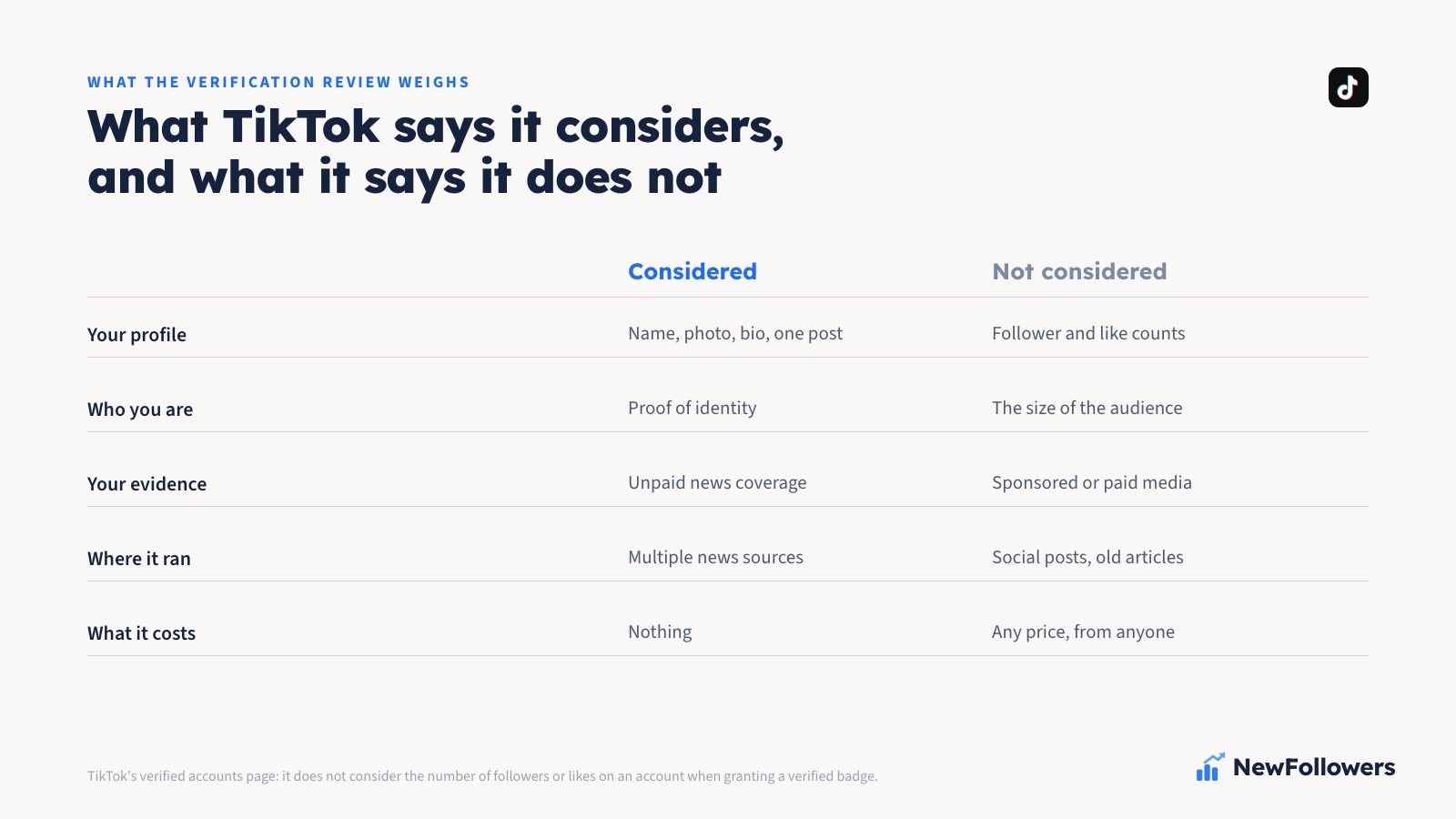
There is also no follower number anywhere on that page, apart from the sentence ruling one out. TikTok states plainly that it does not consider how many followers or likes an account has when it grants a badge.
And the criteria move. In February 2026 the same page carried five requirements. The profile requirement was headed Complete rather than Recognized, and a fifth — Secure — required two-step verification with a verified email. Neither name is on the page today. A rewrite inside seven months of the document deciding who gets a badge is the reason this article links every claim instead of asserting it. TikTok does not date the change, so the two dates here are the dates the two versions were read.
Notable Is the Whole Test
Three of the four requirements are housekeeping: a name, a photo, a bio, one public post, a login inside six months, and paperwork proving you are who you say. Most of that is an afternoon.
Notable is not like that, and it is where nearly every application stops. TikTok wants to see you featured in multiple news sources, and the application itself asks for credible written media coverage such as news articles. The exclusions do more work than the requirement: sponsored or paid media is not counted, social media posts are not counted, outdated or irrelevant articles are not counted.
Read that back slowly. The deciding evidence is somebody else's decision to write about you — unpaid, recent, in a publication TikTok is willing to count. You cannot produce it, schedule it or buy it. It is a by-product of having done something away from TikTok that a journalist thought was worth reporting.
The unflattering answer is also the true one. Verification sits downstream of being notable. It is not a step on the road there, and there is no version of this where the badge arrives first and the reputation catches up later.
What a Follower Count Buys, and What It Does Not
This site sells followers on TikTok, so the sentence is worth making as flatly as possible: buying them moves you no distance at all towards a verified badge.
The verification page says follower and like counts are not considered, so there is no gap there for a purchase to close. The same page reserves TikTok's right to deny or revoke verification where its criteria have been met through artificial or inauthentic activity, which points the opposite way from the one a seller would prefer.
The Community Guidelines are blunter still. Under deceptive behaviour and fake engagement, the not-allowed column covers buying or selling followers or engagement for financial gain, and separately covers trading, marketing or providing access to services that artificially increase engagement — with followers and likes named first among them. Where inauthentic metrics are detected, TikTok says it removes fake likes, followers and other inflated signals.
So what does a purchase buy? One thing: a number that a human being reads. A brand weighing a collaboration, a viewer deciding whether to tap follow, a client deciding whether you are serious — people read that figure before anything else, and TikTok followers are sold here on that basis and no other. What the rungs cost is a page of its own; what the word "real" covers is another. Neither is a route to the badge, and a seller who claims otherwise is arguing with a criterion TikTok says it does not use.
Monetisation is a different question with different gates, and the thresholds behind those have nothing to do with this one. Verification pays nothing and unlocks nothing. It identifies you.
Nobody Can Sell You a Badge
TikTok answers this itself: it does not charge for verification, and any entity claiming to sell TikTok verifications is not affiliated with it. It asks anyone who meets a seller of verification services to report it or contact TikTok Support.
A second sentence closes the other half of that market. TikTok says it does not contact people by email, direct message or any other channel to ask them to apply — the exception being government, politician and political party accounts, which it may contact to process a verification. An unsolicited offer to get you verified is therefore, by TikTok's own account of its process, not from TikTok, and the realistic purposes of one are a login, a payment, or both.
That is the whole "buy TikTok verification" trade: a phishing attempt, or a fee for an application you can submit yourself, in about five taps, for nothing.
How to Apply
The route TikTok publishes: open Profile, tap the menu, go to Settings and privacy, then Account, then Verification, then Start, and follow the prompts. Government, politician and political party accounts can only apply for institutional verification.
Have the coverage to hand before you begin, because the form asks for it. TikTok says it notifies you of the result through TikTok notifications within 30 days; if the request is rejected, the reason is shown and you can submit again after the waiting period it indicates.
If you hold a badge and want rid of it, the page says to open the Verification screen and use the TikTok Support button at the top.
Why Badges Get Taken Away
TikTok says it may remove a verified badge at any time and without notice, and publishes four reasons it might:
The first catches people, and it is worth knowing before a rebrand: on a verified account a rename is not cosmetic. Put it through the username update request rather than editing the field, or the badge leaves with the old name.
The last is worth reading beside the earlier clause about artificial and inauthentic activity. Verification is reviewed on the way in and revocable afterwards, which makes a clean record a requirement for keeping a badge as well as for getting one.
What Actually Moves You Toward Notable
TikTok's own advice on growing an audience is short and deliberately unglamorous: engage with viewers through comments and LIVE, read your analytics, post high-quality content regularly, make videos longer than a minute, and collaborate with other creators through Duet, Stitch and LIVE. That is the whole of the published advice, bar two pointers of TikTok's own: one to its editing app, one to its monetisation programmes.
It contains no ranking formula, and nothing here will invent one to fill the silence. TikTok does not publish how its recommendation system weighs anything, so an article quoting an exact percentage for watch time or completion rate is guessing in a confident voice, and a guess dressed as a mechanism is the least useful thing anybody can hand you.
For the narrower objective of becoming notable, three things are worth more than any posting schedule.
Be checkable
A journalist about to mention you has to establish who you are: a consistent name across platforms, a bio stating what you actually do, a website or an email that reaches a person. Notability is granted by somebody else, and they have to verify you before TikTok will.
Do something away from TikTok
Coverage attaches to events, not to accounts. A launch, a record, a campaign, a tour, a case, a fundraising total, a product somebody can buy. The press follows the thing, not the posting.
Refuse the paid version
Sponsored placements and paid media are excluded from what TikTok counts, so buying coverage converts money into an article disqualified by the criterion it was bought to satisfy.
If the Badge Was Never Really the Point
Most people searching this are not being impersonated. They want what the badge signals: that the account is real, is run by somebody who exists, and is worth taking seriously.
The badge is one route to that, gated behind a decision made by an editor you have never met. The other routes are not gated at all — a finished profile, a name that matches everywhere else you exist, posts that explain themselves, a body of work somebody could describe in a sentence. Those are also what makes the first route possible.
Whichever you go for, the arithmetic on the shortcut does not change. Nobody sells a verified badge, because nobody except TikTok has one to sell.
Frequently Asked Questions
How do you get verified on TikTok?
You submit a verification application from inside the app — Profile, the menu, Settings and privacy, Account, Verification, Start — and TikTok reviews it. It lists four account requirements it considers: recognized (a name, a profile photo, a bio and at least one public post), active (logged in to TikTok within the past six months), authentic (it represents a real person, business or institution, with the proof depending on which verification type you apply for) and notable (featured in multiple news sources). TikTok says it notifies you of the result through TikTok notifications within 30 days.
How many followers do you need to get verified on TikTok?
None that TikTok publishes. Its verified accounts page states directly that it does not consider the number of followers or likes on an account when granting a verified badge, and no follower minimum appears anywhere on that page. What actually decides most applications is notability — being featured in multiple news sources — which a follower count does not supply. Any article quoting you a specific follower threshold for TikTok verification is quoting a number TikTok does not publish.
What counts as notable for TikTok verification?
TikTok asks to see that you are featured in multiple news sources, and the application itself asks for credible written media coverage such as news articles. The exclusions matter as much as the requirement: sponsored or paid media is not considered, social media posts are not considered, and outdated or irrelevant articles are not considered. So the deciding evidence is a third party's unpaid, recent decision to write about you, which is not something you can produce, schedule or buy.
Can you buy a TikTok verification badge?
No. TikTok states that it does not charge for verification and that any entity claiming to sell TikTok verifications is not affiliated with it, and it asks anyone who meets a seller of verification services to report it or contact TikTok Support. TikTok also says it does not contact people by email, direct message or any other channel to ask them to apply, the one exception being government, politician and political party accounts. An unsolicited offer to get your account verified is therefore not from TikTok, and the realistic purposes of one are a login, a payment, or both.
Does buying TikTok followers help you get verified?
No. TikTok's verification page says follower and like counts are not considered, so there is no threshold there for a purchase to close, and the same page reserves TikTok's right to deny or revoke verification where its criteria have been met through artificial or inauthentic activity. TikTok's Community Guidelines separately place buying or selling followers or engagement in the not-allowed column, and say that where inauthentic metrics are detected, fake likes, followers and other inflated signals are removed. What a follower purchase buys is a number a human being reads on a profile. On the verification application it buys nothing.
How long does TikTok take to decide a verification request?
TikTok says it notifies you of the result through TikTok notifications within 30 days of the request being submitted. If the request is rejected, the rejection reason is shown and you can submit another after the waiting period the notice indicates. Nothing on TikTok's page promises a faster decision, and no third party can speed one up — the review is TikTok's and the application is free.
Why would TikTok remove a verified badge?
TikTok says it may remove a verified badge at any time and without notice, and publishes four reasons it might: the username was changed directly rather than through a username update request; the account was transferred to a new owner, which makes the verification no longer authentic; the account no longer holds Verified Business Account or Organization Account status; or the account repeatedly or severely violated the Community Guidelines or Terms of Service. The first is the one that catches people, because on a verified account a rename is not a cosmetic change.
Ready to Grow Your Social Media?
Real followers, instant delivery, 30-day refill guarantee. Pick your platform: