How to Get More Views on TikTok: Why an Ordinary Video Stalls, and What a View Is Worth
How to Get More Views on TikTok
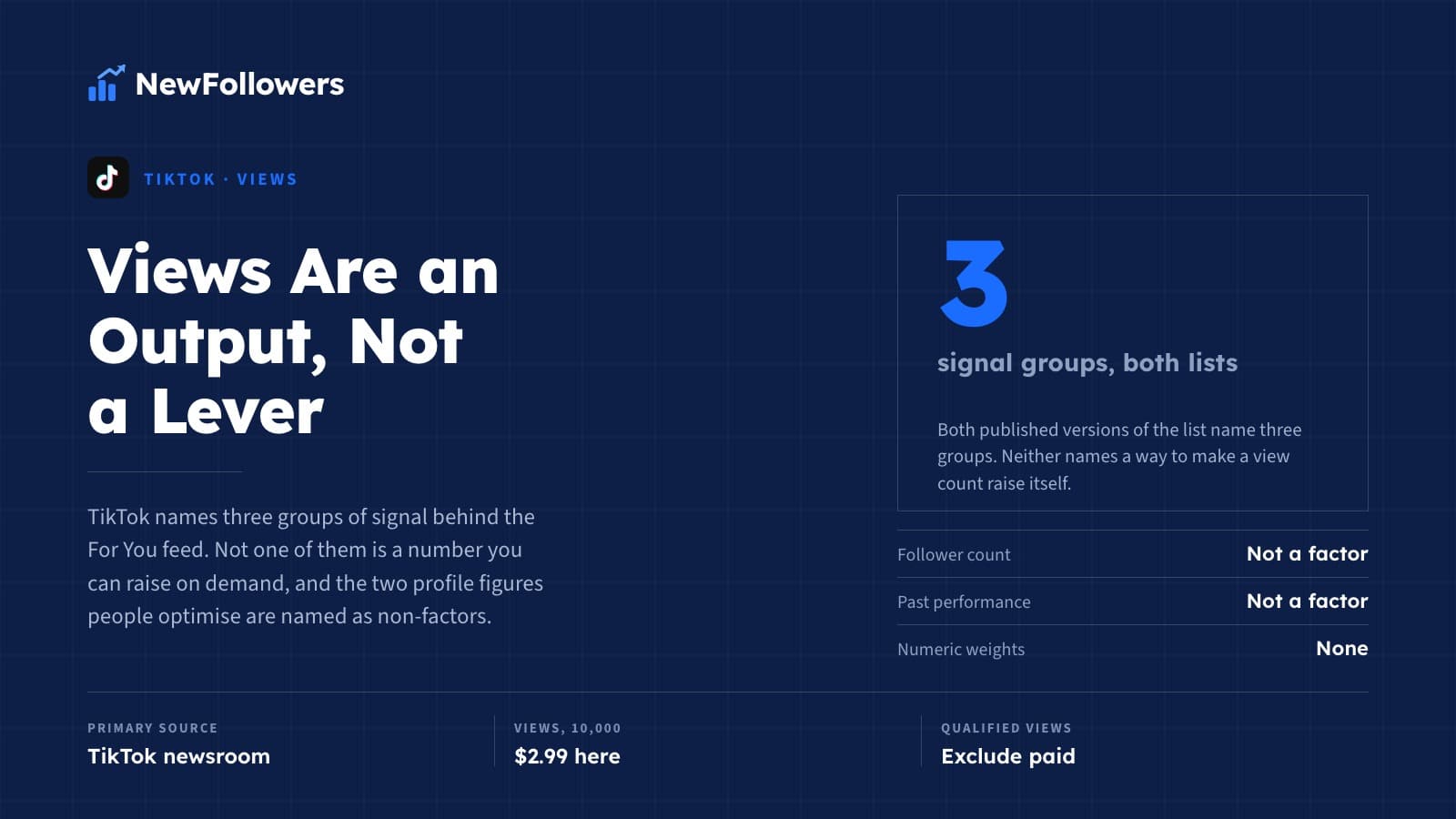
There is no views lever. TikTok publishes no mechanism by which raising the number under a video causes the video to be shown to more people. Views are an output. The only published input you control is the video itself.
That is the unflattering version, and it is the one worth having, because most of what is written about this question describes machinery TikTok has never documented. Search the phrase and you will be told that a new upload goes to a test audience of two or three hundred accounts, that completion rate is first of five ranked signals, that a certain percentage buys a bigger test. None of that appears in anything TikTok has published. It comes from creators explaining the platform to one another — a fine thing for them to do, and a poor thing to build a month of work on.
So this page is the other version: what TikTok publishes, what it does not, and — since this site sells TikTok views — what a bought view count actually is.
The Short List TikTok Publishes
TikTok's own account of the For You feed names three categories of signal and nothing else.
The third comes with a caveat TikTok writes itself. Those settings are there so the system runs properly, and they "receive lower weight in the recommendation system relative to other data points we measure since users don't actively express these as preferences". The whole description sits on TikTok's own page about how it recommends videos.
One caution before anybody builds an absolute out of that list, this page included. TikTok carries a second version of it in its Help Centre, worded differently, and both are revised without announcement. Treat any sentence of the form "X is not on the list" as a claim about a document on a particular day rather than about the system.
What is absent from every version of it, and absent by name rather than by omission, is your follower count and last week's numbers. TikTok says so outright, and the next section but one quotes the sentence.
The One Weighting TikTok Has Published
Exactly one, and it is an example rather than a formula:
"A strong indicator of interest, such as whether a user finishes watching a longer video from beginning to end, would receive greater weight than a weak indicator, such as whether the video's viewer and creator are both in the same country."
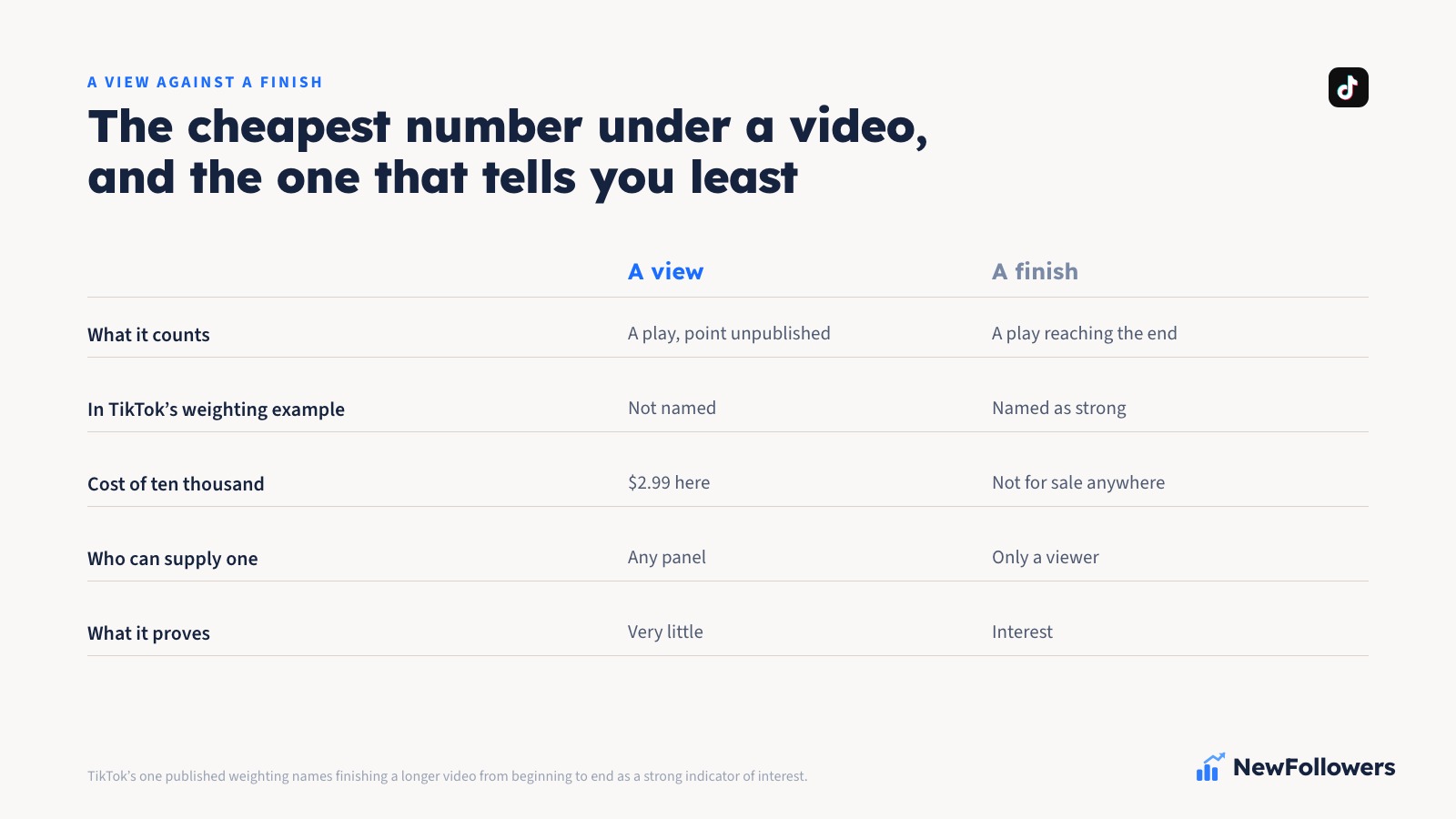
Read it precisely, because the precision is the value of it. TikTok is saying that finishing a video is a strong signal and a shared country is a weak one. It is not saying completion is first of five, and it attaches no percentage, threshold or rank to it. The sentence also says "a longer video", which is the part people skip: finishing something short is a weaker statement of interest than finishing something long.
So completion matters, on the platform's own account. How much it is worth against a share, a comment or a second watch is not published, and anyone quoting you an order of importance is quoting themselves.
Why an Ordinary Video's Count Stalls
Most writing about TikTok views is really about outliers. This section is about the other videos — the ones that reach four hundred people, or three thousand, and then stop.
A stall is the default outcome rather than a verdict on your account, and TikTok publishes the clause that settles it: "neither follower count nor whether the account has had previous high-performing videos are direct factors in the recommendation system". The full sentence concedes the obvious first — a bigger account has more followers to reach, so its videos do tend to collect more views — and then rules both numbers out as inputs.
Read that as a creator rather than as a press release and it is blunt. A video that travelled last week buys this week's video nothing. Each upload is assessed on what viewers do with it, so each one starts roughly where the last one started. The feeling that you begin again every time you post is not paranoia. It is the system working as described.
TikTok does publish two reasons a video can go nowhere, and both are checkable tonight.
Then there is the gap, stated plainly because nobody else on this query states it. TikTok does not publish how many people see a new upload first. It does not publish a tier structure. It does not publish a threshold at which a video is promoted. It does not publish the point at which a play becomes a counted view. Every confident number you have read for those four is somebody's guess, usually a sincere one.
Completion and Re-Watch, and What Each One Does
These two get treated as a pair and they are not one.
Completion is the one TikTok has actually named. Finishing a longer video from beginning to end is its published example of a strong indicator of interest. That makes it the most defensible thing to aim at, and it reframes the question. The useful one is not "how do I hold them for longer" but "is this the length the idea actually needs", because a forty-second version of a fifteen-second idea converts a finish into an exit.
Re-watch is different, and the difference is worth knowing before you spend a week building loops. TikTok does not name re-watching in its description of the system, and what it does say about repetition points the other way: the feed avoids showing people content they have already seen. So a loop is not a documented ranking input. What it genuinely is, is a way of making a short video easy to finish — and finishing is the documented part. Build loops for that reason and the reasoning holds. Build them because a re-watch is worth some multiple of a view and you are working from a number nobody published.
The Part of the System That Is Yours
Of the three published categories, one belongs to you.
User interactions are the viewer's. Device and account settings belong to nobody and carry, in TikTok's own words, lower weight. Video information — captions, sounds, hashtags — is the only category you write. That is a narrower surface than most advice implies, and it produces a short list rather than a long one.
None of that is a promise, and it is deliberately not framed as one. Beyond the single comparison quoted above, TikTok publishes no weight values, so nobody can say what any of it is worth.
Why a View Is the Cheapest Thing to Buy and the Least Informative to Own
This site sells TikTok views, so the section that would normally be a pitch is the section that has to be most careful.
Views are the cheapest thing on our TikTok list. Four packages: 10,000 views for $2.99, 50,000 for $10.99, the most chosen, 100,000 for $20.99 and 500,000 for $103.99. That is roughly 30 cents per thousand at the bottom and roughly 21 cents per thousand at the top. Prices are in US dollars and tax may be added at checkout depending on where you buy from. The order goes to the link of one public video and never a password, processing starts 5 to 30 minutes after payment, delivery is spread across the window shown at checkout — typically 1 to 48 hours — and a 30-day refill covers a count that drops below what was delivered.
Here is what that buys, stated as narrowly as it deserves: the number beside the play icon on one video goes up.
Here is what it does not buy. There is no step in anything TikTok has published where a number you paid to raise causes the video to be shown to more people, and the two profile-level figures people assume work that way — follower count and past performance — are the two TikTok specifically says are not direct factors. Anyone telling you that a bought count gets a video distributed is describing a mechanism no one has published. The opposite claim — that bought views actively suppress a video — is unpublished in the same way, and no more testable from out here.
What is published on that side is a rule rather than a ranking mechanic, and a shop is the last party entitled to leave it out. The newsroom page quoted throughout this article names spam content — its own example is a video seeking to raise its traffic artificially — among what may not be eligible for recommendation at all. TikTok's Community Guidelines on integrity and authenticity go further, forbidding fake engagement and the trade of services that inflate it, and saying inauthentic metrics are removed where they are found.
One consequence is documented and worth knowing before ordering. TikTok's Creator Rewards Program pays on qualified views, and its own definition of a qualified view excludes paid views. A purchased view moves the public counter and earns nothing.
The full ladder, the per-rung arithmetic and the comparison with Instagram are in how much TikTok views cost, and the packages themselves sit on the TikTok views page.
Which brings this round to the part that is true whether you buy anything or not: a view count is the least informative number on a video. It does not separate somebody who swiped in under a second from somebody who watched the whole thing twice, which is exactly the distinction TikTok's one published weighting turns on. So "more views" is a poor target even organically: it is the number that moves most easily and tells you least.
If You Want the Number Up Anyway
Buy the count with your eyes open, on a video that can carry it. Half a million views sitting over forty likes does not read as a strong post. It reads as a conspicuous one, and every visitor runs that comparison without being asked to. Match the size to what the clip has already earned.
And if the goal was for more people to actually watch the thing, the summary of everything above is short. The only lever TikTok has documented is the video: what it says it is about, what sound it carries, and whether somebody who started it reached the end. The rest of the advice on this query is describing a machine nobody outside TikTok has seen.
If you came here from a free-views site, free TikTok views covers what those actually hand over and what they want in return. And if the acronym in every caption is the part that is confusing, what FYP means answers that separately.
Frequently Asked Questions
How do you get more views on TikTok?
By changing the video, because that is the only input TikTok publishes that you control. TikTok says its recommendation system reads three categories of signal: user interactions such as the videos you like or share, video information such as captions, sounds and hashtags, and device and account settings, which it says carry lower weight. Follower count is absent by name: TikTok states that it is not a direct factor. The only weighting TikTok has published is that finishing a longer video from beginning to end is a strong indicator of interest, so the most defensible thing to aim at is whether people reach the end.
Why are my TikTok views so low, or stuck at a few hundred?
Usually because that is the default rather than a penalty. TikTok publishes that neither follower count nor whether an account has had previous high-performing videos are direct factors in the recommendation system, which means a video that travelled last week buys the next one nothing and each upload is assessed on what viewers do with it. There are two published reasons a video can go nowhere: it may fall under TikTok's For You feed eligibility standards, in which case it is not recommended in the feed, though TikTok says people may still find it through search or by going to the account, and the system generally will not show two videos in a row by the same creator or with the same sound.
Does TikTok show every new video to a test audience of 200 to 300 people?
TikTok does not publish that, or any other figure for how many people see a new upload first. It also does not publish a tier structure, a threshold at which a video is promoted, or the point at which a play becomes a counted view. The numbers circulating for all four come from creators and marketing blogs explaining the platform to each other rather than from TikTok. What TikTok does publish is the list of signal categories the system reads and one example of a strong signal against a weak one.
Do more followers get you more views on TikTok?
Not directly, and TikTok says so in its own words. Its explainer concedes that a bigger account tends to collect more views because it has a larger follower base to reach, and then states that "neither follower count nor whether the account has had previous high-performing videos are direct factors in the recommendation system". The larger base means more people already following you, not a stronger position in the system.
Do loops and re-watches increase views?
TikTok does not name re-watching as a factor in its description of the recommendation system. What it does say about repetition points the other way, since the feed avoids showing people content they have already seen. A looping edit is still worth making, but for the documented reason rather than the assumed one: a loop makes a short video easy to finish, and finishing a video from beginning to end is TikTok's own published example of a strong indicator of interest.
Can you buy TikTok views, and does it help the video get distributed?
You can buy them, and no. There is no step in anything TikTok has published where a number you paid to raise causes a video to be shown to more people. NewFollowers sells TikTok views at $2.99 for 10,000, $10.99 for 50,000, $20.99 for 100,000 and $103.99 for 500,000, ordered against the link to one public video and never a password. What the purchase moves is the number beside the play icon on that video. TikTok's Creator Rewards Program pays on qualified views, and its definition of one excludes paid views, so a bought view earns nothing either. There is also a rule on the other side worth reading first: TikTok's Community Guidelines on integrity and authenticity forbid fake engagement and the trade of services that inflate it, and say inauthentic metrics are removed where they are found.
What should I look at instead of the view count?
What your own video analytics show about how people watched it — how long they stayed and where in the clip they left. A view count cannot tell the difference between somebody who swiped away in under a second and somebody who watched the whole thing twice, which is precisely the distinction TikTok's single published weighting turns on. It is the number that moves most easily and tells you least, which is also why it is the cheapest metric on the market to buy.
Ready to Grow Your Social Media?
Real followers, instant delivery, 30-day refill guarantee. Pick your platform: