Buy TikTok Coins: Where to Buy Them, What They Cost and What Resellers Get Wrong
Quick Answer
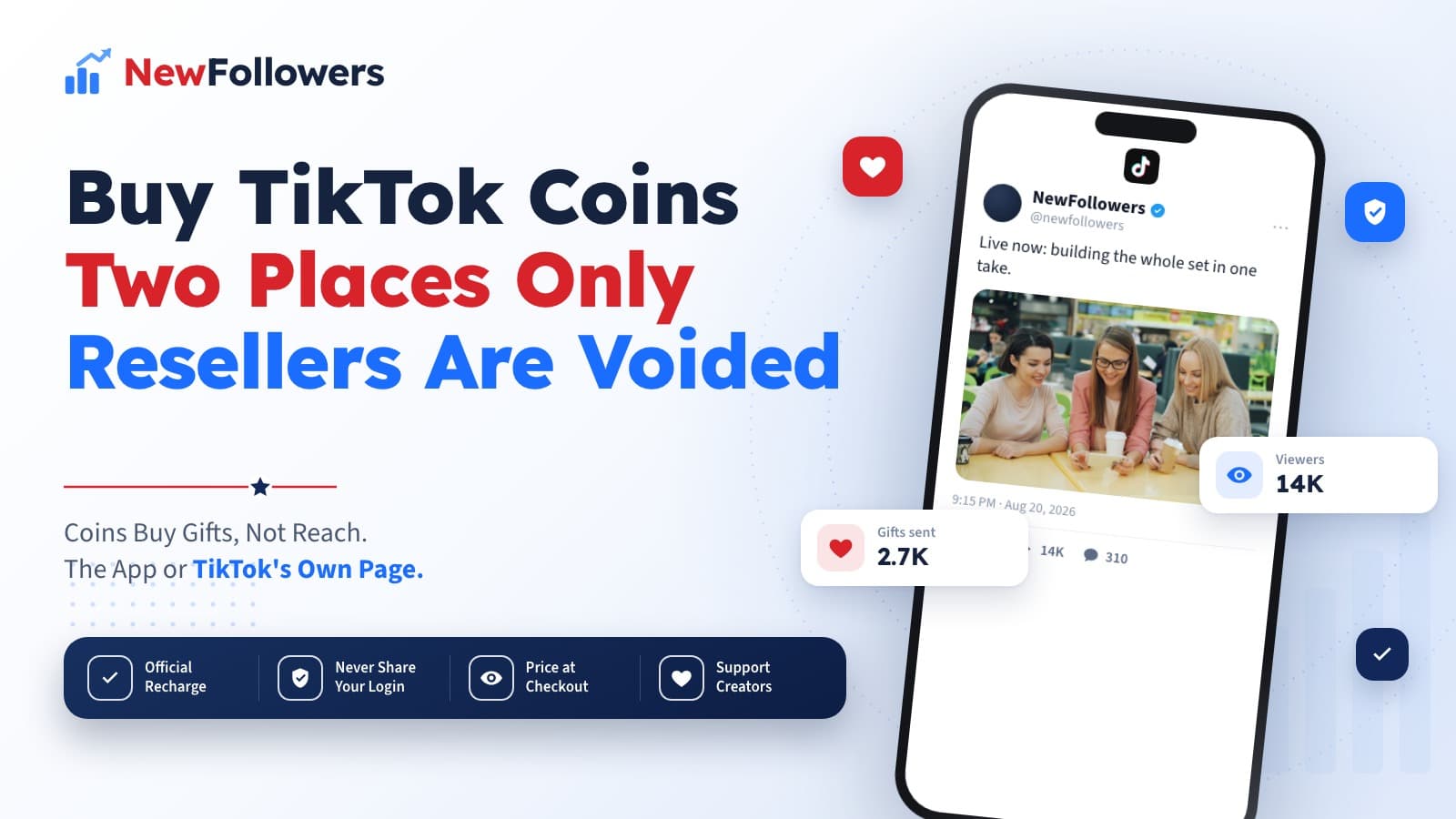
TikTok Coins are TikTok's own virtual currency, used to buy Gifts for creators during live streams and on videos. TikTok's Virtual Items Policy says users aged 18 or older may purchase Coins from TikTok using authorized payment methods, and that the price is displayed at the point of purchase, so the only legitimate places to buy are the app and TikTok's own recharge page. The same policy says Coins are not property, cannot be exchanged for cash, and that selling or transferring them outside TikTok is expressly prohibited, which is why third-party coin sellers are both against the rules and a common way to lose money or an account. Coins are for supporting creators, not for growing an account.
Most people who set out to buy TikTok Coins are trying to do something generous. A creator they watch is going live, the chat is filling with Gifts, and they want to send one too. The confusion starts at the checkout, because the price of a bundle is not the same everywhere, the app and the website do not always agree, and a search for a better rate turns up a row of sites promising Coins for a fraction of what TikTok charges.
This guide is for the viewer working out where to buy and what a bundle is worth, and for the creator on the other side of the Gift, wondering what Coins mean for their account and whether any of it helps them grow. NewFollowers is a growth service, and it is worth saying plainly at the start that it does not sell Coins and neither can anyone else legitimately, for reasons TikTok's own policy spells out. What follows is where Coins actually come from, what the rules say about moving them around, and why the discount sites are the one part of this market to avoid entirely.
What Are TikTok Coins?
Coins are the currency inside TikTok's gifting system. You buy them with real money and spend them on Gifts, the animated items viewers send creators during live streams and on videos. The creator receives Diamonds for the Gifts sent to them, which they can convert under TikTok's own terms.
TikTok's Virtual Items Policy describes the purchase directly: users of the services who are aged 18, or the age of majority in their jurisdiction, or older may purchase virtual Coins from TikTok using authorised payment methods and through payment providers made available and authorized by TikTok. Two things follow from that sentence. Coins come from TikTok, and there is an age gate.
The same policy is blunt about what a Coin is not. Accrued Coins do not constitute property and are not transferable, and Coins cannot be exchanged for cash, or legal tender, or currency of any state, region, or any political entity, or any other form of credit. You are buying a license to use something inside the app, not an asset you own.
What Coins are used for includes:
What Coins are not used for is the point most guides skip: they do nothing for your own account. Coins do not buy reach, followers, or placement in anyone's feed.
Where Can You Buy TikTok Coins?
There are two legitimate routes, and both are TikTok.
Inside the app. Open your profile, go to the menu and choose the Balance or Recharge screen. Bundles are listed with prices, and payment runs through the app store account your phone is signed in to.
On TikTok's website. TikTok operates its own recharge page on the web, where you sign in and buy the same Coins for the same account.
That is the whole list. Any other site offering Coins is a reseller, and the next section explains why the rules put those outside the system entirely.
It is worth opening both screens before you buy. The two routes do not always show identical prices, because they run through different payment paths, and the bundles on offer can differ. TikTok's policy states that the price of the Coins will be displayed at the point of purchase and that all charges and payments will be made in the currency specified at that point. So the screen in front of you is the authority on price, not a figure quoted in an article or by a reseller.
What Do TikTok Coins Cost?
Less precisely than most articles pretend.
Coin prices vary by country, by bundle size, by the currency you are charged in and by which of the two routes you use. TikTok does not publish a single global rate, and the policy language points at the checkout screen rather than a fixed table. Any guide quoting you an exact price per Coin is quoting a figure that is regional, dated, or both.
There is a second reason the numbers move around. App-store purchases and web purchases run through different payment paths, and the bundles offered on each are set separately, so the same account can see two different menus depending on where the recharge screen is opened. Neither is a discount code or a trick; they are simply two storefronts operated by the same company.
The practical approach is to treat the bundles the way you would treat any prepaid credit. Open the recharge screen, look at the price per Coin across the bundle sizes rather than the headline price, and buy the smallest amount that covers what you actually intend to send. Because there are no refunds for unused Coins, a large bundle bought for a discount you will not use is not a discount.
Why Are Third-Party Coin Sellers Against the Rules?
Because TikTok's policy addresses the transfer itself, not just the payment.
The Virtual Items Policy states that no Coins may be assigned or transferred to any other user of the services or third party except as expressly permitted by TikTok in writing, and that the sale, barter, assignment or other disposal of any Coins, other than by TikTok, is expressly prohibited. A reseller's entire business is the thing that sentence forbids.
TikTok's Terms of Service add the other half. Users agree not to give others access to their account and to take reasonable steps to keep their password confidential, which is exactly what a "cheap Coins" site asks you to hand over when it says it needs to sign in to credit your balance.
So a third-party purchase breaks the rules twice over, and the person exposed is the buyer, not the seller.
Coin Resellers vs. TikTok's Own Recharge
The discount is the tell. Here is what sits behind it.
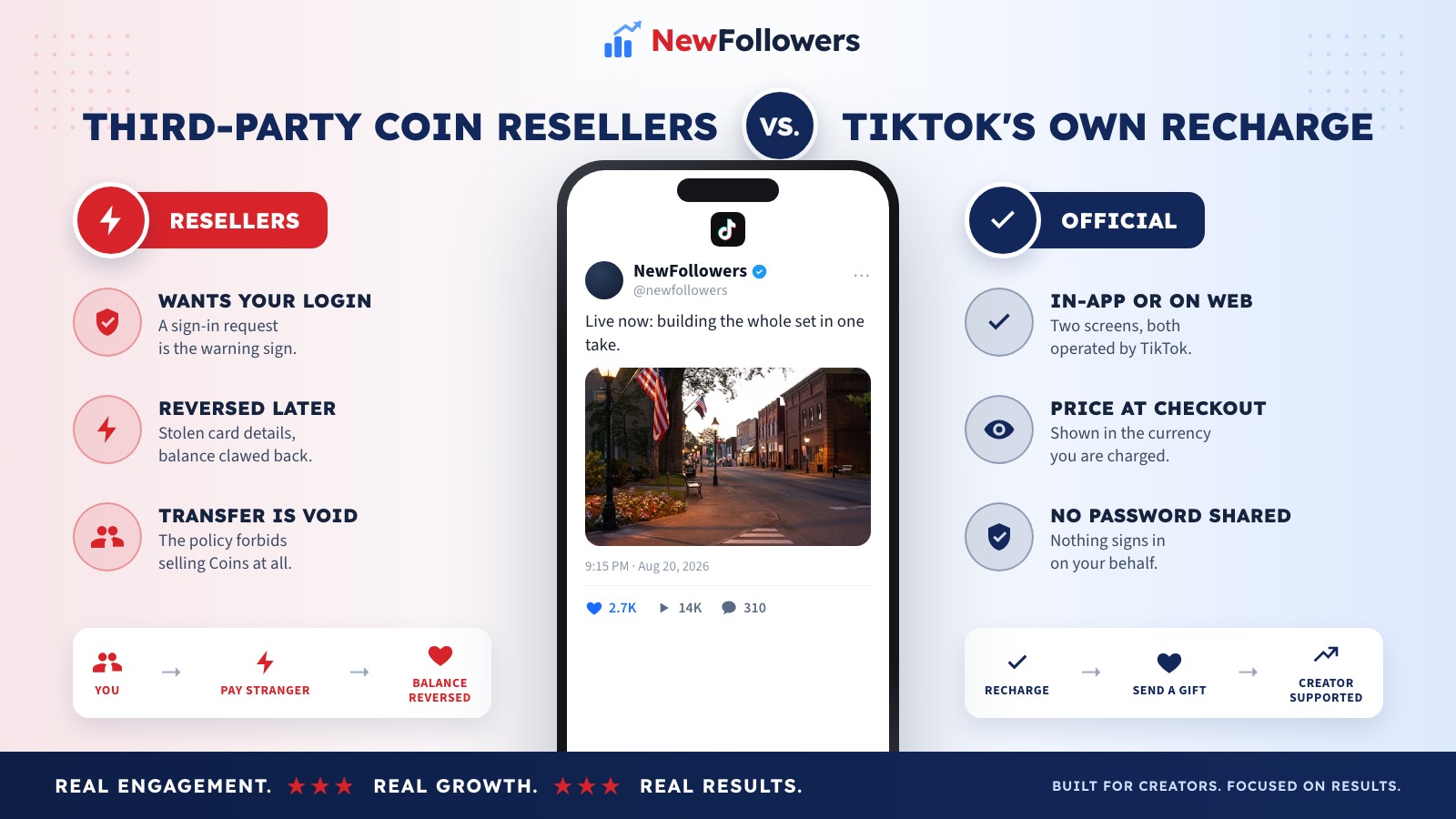
Third-party coin resellers
TikTok's own recharge, in-app or on the web
The right-hand column is not just the safer option, it is the only one that exists within the rules. A reseller is not a cheaper version of the same product; it is a different transaction that TikTok's policy voids.
How Do Coin Scams Actually Work?
Three patterns account for most of them, and it helps to know the shape rather than the brand name.
The credential harvest. The site needs to "log in to your account to add Coins". Once it has your credentials it can send Gifts from any balance you already hold, message your followers, or simply sell the account on. This is the most expensive version, because the loss is not the Coin purchase but the account.
The stolen-card flip. The seller credits your balance, funded by a card that is not theirs. Weeks later the real cardholder disputes the charge, TikTok reverses the purchase, and the balance vanishes from your account. You paid the reseller for something that has been taken back, and you have no claim against anyone.
The empty storefront. No Coins exist. A progress bar, a "human verification" wall, an app install, a survey. The verification is the product, and you are the traffic being sold.
None of the three is unusual. They are the standard shapes of any virtual-currency informal market, and TikTok's rules are written the way they are precisely because the transfer cannot be made safe.
U.S. Buyers Should Also Understand the Consumer Angle
Two practical points, both about recourse rather than legality.
A Coin purchase made through TikTok's authorized payment providers is a normal consumer transaction: there is a merchant, a receipt and a payment provider standing behind it, even though the Coins themselves are non-refundable by policy. A purchase made through a reseller has none of that. There is no merchant of record you can reach, and if the balance is clawed back you are arguing with a website that has already been paid.
Businesses and creators sending Gifts as part of a promotion should also keep the FTC's rule on consumer reviews and testimonials in view. It prohibits buying fake indicators of social media influence and using them to misrepresent influence for a commercial purpose. Gifts sent to your own live stream to make it look supported sit uncomfortably close to that line, quite apart from being an expensive way to move a number nobody weighs.
What Should You Check Before Buying Coins?
Five checks, none of which take longer than the purchase itself.
Where the checkout lives. If you are not on TikTok's app or TikTok's own domain, stop. Nothing else is a legitimate source.
Whether anything asks for your password. Buying Coins never requires giving your credentials to a third party. A login screen inside someone else's site is the single clearest warning available.
The price on the screen. Compare the in-app bundles against TikTok's web recharge before you commit, and read the price per Coin rather than the headline. The number shown at the point of purchase is the one you will be charged.
The bundle size against your actual intent. There are no refunds for unused Coins, so the cheapest per-Coin bundle is not the cheapest purchase if half of it sits unspent.
Whether you meant to buy Coins at all. If the goal was reach rather than gifting, Coins are the wrong product entirely, and the section below covers what the right ones are.
Do Coins or Gifts Help a Creator Grow?
They pay, in a small way. They do not distribute.
TikTok decides how far to push a video on what viewers do with it: how long they watch, whether they finish it, rewatch, share, comment or follow. Gifts are none of those things. A live stream flooded with Gifts and a video with none behave identically in the feed, because the gifting system and the recommendation system are separate.
This matters because a specific bad idea circulates among new creators: buying Coins to send Gifts to your own live stream so it looks supported. It costs real money, it moves no ranking signal, and if it is done to misrepresent popularity to a brand it runs into the FTC rule above. The guide to what TikTok creators actually earn sets out where gifting sits among the real income routes, which is smaller than most people expect.
What does move reach is covered in the guide to TikTok engagement, and TikTok's own paid route is Promote, which pushes a video to more viewers inside the app and is the paid option TikTok's rules endorse.
What Creators Should Know About Receiving Gifts
If you are on the receiving side, a few things are worth understanding before you build any expectations around it.
Gifts arrive as Diamonds, and Diamonds convert under TikTok's own terms rather than at the price the viewer paid. The gap between what a viewer spends and what a creator receives is the platform's cut, and it is substantial enough that gifting is rarely the largest line in a working creator's income.
Eligibility for live gifting depends on TikTok's own requirements, which include account standing and can change. The guide to live viewers covers what actually happens to a live stream's audience and what added viewers do and do not do for it.
Gifts also concentrate. Most streams receive very little; a small number of regular supporters account for most of what a creator sees. Planning around an average is misleading, which is another reason to treat gifting as a supplement rather than a strategy.
How to Support a Creator Without Buying Coins
Gifting is the most visible way to help, and one of the least efficient. These cost nothing and do more for a creator's account.
Watch to the end
Completion is among the strongest signals TikTok reads. A viewer who watches a video through does more for its reach than a Gift ever will.
Share the video with one person
A share moves a video to someone the algorithm had not chosen. It is the single most valuable free action a viewer can take.
Comment something real
Comments extend the time people spend on a video and give the creator something to reply to with a video of its own, which gets its own distribution.
Follow and turn on notifications
Showing up early to a live stream or a new post concentrates engagement in the window that matters most for reach.
Buy what the creator actually sells
Merchandise, a subscription, a product link. A creator keeps far more of a direct sale than of a Gift, and it costs the viewer no more.
Show up for the first hour of a live stream
A live stream's audience early on shapes how many more people TikTok shows it to. Arriving at the start and staying is worth more to a streamer than a Gift sent at the end, and it costs nothing at all.
Why Consider NewFollowers?
NewFollowers is a social media growth service covering TikTok and five other platforms. It does not sell Coins, Gifts or Diamonds, and this guide has explained why nobody legitimately can: TikTok's policy prohibits transferring them, and any service claiming otherwise is describing a transaction that the platform voids.
Where it fits is the other half of the search. Plenty of people arrive at Coins looking for growth and leave with a spending product that does not provide any. If the actual goal is a follower count that reads as established, NewFollowers delivers followers to a TikTok account from existing accounts, ordered with a username rather than a password, paced over hours or days rather than dumped, priced before payment and covered by a 30-day refill guarantee. The TikTok page lists the packages, and the cheap followers page shows how low-cost delivery is paced rather than dumped.
Buying followers is a platform-policy risk under TikTok's guidelines on fake engagement, and NewFollowers does not pretend otherwise. Its position is that a service should tell you what it is: it sells followers, it never asks for your password, and it will not claim that a Gift or a Coin does something it does not.
Common Mistakes to Avoid With TikTok Coins
Buying from a reseller because the price is lower
The discount exists because the transaction is not what it appears to be. TikTok's policy prohibits the transfer, so there is no version of this that ends with you protected.
Signing into a site that promises to credit your balance
The mistake that costs the account rather than the purchase. No legitimate Coin purchase needs your password.
Buying a large bundle for the per-Coin discount
Unused Coins are not refundable under TikTok's policy. A bundle you half-spend is more expensive per Coin than the small one you would have finished.
Gifting your own live stream to look supported
It costs real money, moves no ranking signal, and if you show the result to a brand as evidence of popularity it runs into the FTC rule on fake indicators of influence.
Treating Diamonds as the amount the viewer paid
The conversion is set by TikTok and is well below the purchase price. Building income expectations on the viewer's spend produces a number that will not arrive.
Expecting Coins to grow the account
Coins are a viewer's spending product. Reach comes from videos that hold attention, and paid reach comes from Promote.
Final Thoughts
People search to buy TikTok Coins for a straightforward reason: they want to send a creator something during a live stream. The purchase itself is simple, and it has exactly two legitimate homes, the app and TikTok's own recharge page, where the price is displayed at the point of purchase and payment runs through providers TikTok has authorized.
Everything complicated about this market sits outside those two screens. TikTok's Virtual Items Policy states that Coins are not property, cannot be exchanged for cash, and that selling or transferring them other than by TikTok is expressly prohibited, which is why every discount reseller is either selling nothing, selling with stolen payment details, or selling access to your own account back to you.
For creators, the honest framing is that Coins are a support mechanism, not a growth one. Gifts do not enter the calculation that decides which videos travel, and the conversion from what a viewer spends to what a creator receives is smaller than most expect. If growth is the actual goal, Promote is TikTok's own paid answer, posting videos that hold viewers is the free one, and NewFollowers can be reviewed as part of that research. Confirm what is currently available for TikTok, how it is paced and what the terms are before making a decision.
Ready to explore your options? Visit NewFollowers to review the currently available TikTok growth services and choose an approach that fits your audience, your goals and your appetite for risk.
Frequently Asked Questions
What are TikTok Coins?
TikTok's own virtual currency. You buy Coins with real money, then spend them on Gifts for creators during live streams and on videos. Creators receive Diamonds for the Gifts they are sent, which they can convert according to TikTok's own terms. Coins buy appreciation, not reach.
Where can I buy TikTok Coins?
From TikTok only, either inside the app or through TikTok's own recharge page on its website. TikTok's Virtual Items Policy says users aged 18 or older may purchase Coins from TikTok using authorized payment methods and payment providers. Anywhere else is a third-party reseller.
How much do TikTok Coins cost?
TikTok's policy states that the price of the Coins will be displayed at the point of purchase, and that charges are made in the currency shown there. Prices vary by region, bundle size and payment route, so check the price on the screen before confirming rather than trusting a figure quoted elsewhere.
Is it cheaper to buy Coins on the website or in the app?
The two routes can show different prices, so it is worth opening both the in-app recharge screen and TikTok's web recharge page and comparing the bundles before you buy. Whichever route you use, the price displayed at the point of purchase is the price that applies.
Can I buy TikTok Coins from a third-party seller?
TikTok's Virtual Items Policy prohibits it. It states that no Coins may be assigned or transferred to any other user or third party except as expressly permitted in writing, and that the sale, barter, assignment or other disposal of any Coins, other than by TikTok, is expressly prohibited.
Are cheap TikTok Coins sites safe?
No. A site offering Coins below TikTok's price is either selling nothing, asking for your login so it can charge Gifts from your own balance, or funding purchases with stolen payment details that get reversed later. All three end with you out of pocket, and the transfer itself breaks TikTok's rules.
Can TikTok Coins be refunded or cashed out?
TikTok's policy states that Coins cannot be exchanged for cash or legal tender, that accrued Coins do not constitute property, and that there will be no refunds for unused or unredeemed Coins, Gifts or Diamonds. Buy only what you intend to spend.
Do Coins or Gifts help a video get more views?
No. Gifts are a way for viewers to support a creator, not a distribution signal. TikTok decides how far to push a video on watch time, completions, shares, comments and follows. Sending yourself Gifts costs money and moves nothing.
Do I need Coins to grow on TikTok?
No. Coins are a spending product for viewers, not a growth product for creators. If your goal is reach, TikTok's own Promote tool is the paid route it endorses, and posting videos that hold viewers is the free one.
Why consider NewFollowers?
NewFollowers does not sell Coins or Gifts, and no legitimate service can, because TikTok prohibits transferring them. It is a growth service that delivers followers to a TikTok account from existing accounts, ordered with a username, paced over time, priced before payment and covered by a 30-day refill guarantee.
Ready to Grow Your Social Media?
Real followers, instant delivery, 30-day refill guarantee. Pick your platform: