Buy Legit YouTube Views: What the Word Can and Cannot Promise
Quick Answer
A legit YouTube views order is one where every promise on the page is something the seller controls: a public video link and never a login, a price fixed to a quantity before you pay, a delivery window quoted in the terms, and a refill and refund policy you can read. What no seller controls is what YouTube does with the views afterward, and a listing that calls itself legit on that basis is promising someone else's decision.
One Word, Two Different Worries
Someone who types "legit" in front of "buy YouTube views" is usually carrying two worries at once and has not separated them.
The first worry is about the seller. Will the money go out and nothing come back? Will the form ask for more than it should? Will the number on the page turn out to be a different number at checkout? Those are questions about a business, and a business can answer them in writing.
The second worry is about YouTube. Will the platform count the views, keep them, treat the video any differently because of them? Those are questions about a system the seller does not run, and the honest answer to each is that nobody selling views can see inside it.
Most listings that lead with the word answer the second worry, because it is the one the buyer feels most. This article takes the first, lists the four things a seller can commit to, and says where the commitments stop. If a seller's definition of legit sits entirely past that line, the word is decoration.
Four Things a Seller Can Put in Writing
Here is what "legit" can mean when it describes an order rather than a hope. Each is checkable on the page before you pay.
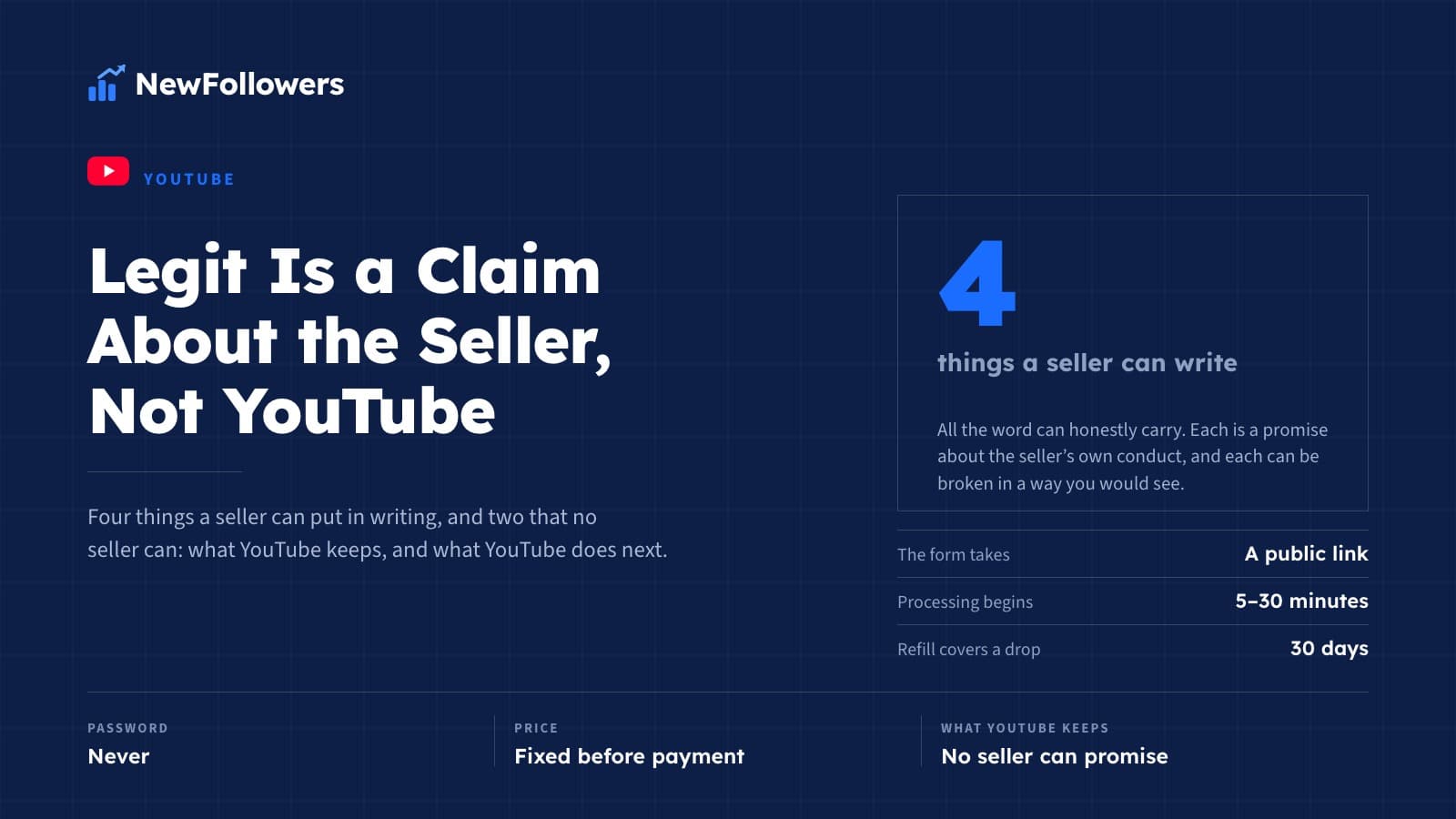
A public link and nothing else. The order form asks for the URL of one public video and an email address for the receipt. There is no field for a Google password, no channel authorization step and no request for Studio, because a view is delivered to a public video without touching the channel. A seller can state this in the terms, and the form either matches the statement or it does not.
A price attached to a quantity, shown before payment. Each tier says how many views and how much. The figure on the tier is the figure charged to your card, and the size is not revealed or revised at checkout.
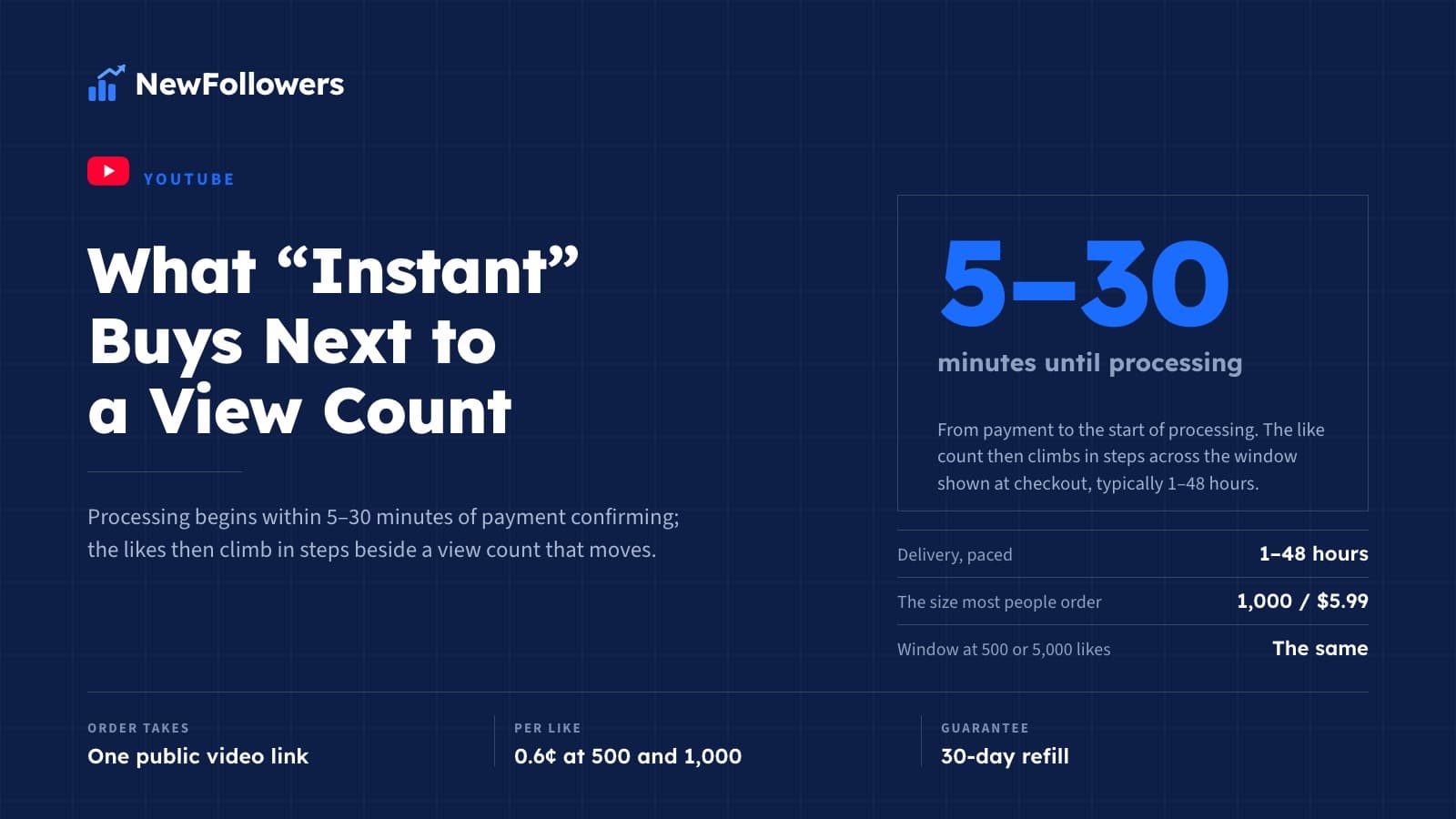
A delivery window, quoted rather than implied. The terms on this site say two things about timing and no more. "Orders begin processing within 5–30 minutes of successful payment confirmation." And: "Delivery is gradual and spread over the timeframe shown at checkout (typically 1–48 hours depending on package size)." A seller who writes the window down has made a claim you can hold them to. A seller who writes a speed adjective has not.
A refill and a refund policy you can read. Two separate things. The refill covers a count that drops below what was delivered within 30 days of the order completing; the difference is refilled without a charge. The refund covers the order itself, and the terms say when a full refund applies, when a partial one does, and when none does. Both are on the terms page before you pay, the only place a policy counts.
Those four are the whole of what the word can honestly carry. Each is a promise about the seller's own conduct, and each can be broken in a way you would see.
Two Things No Seller Can Put in Writing
Now the other side of the line, and it is short.
What YouTube keeps. A view is a unit on a public counter. The platform checks what lands on its counters and can revise them afterward, and no seller sees or controls that. The refill exists because of this: it is the honest replacement for a permanence promise nobody can make. The terms here say in so many words that retention beyond the refill window is not guaranteed, and that a platform review of the channel is not something the service can prevent.
What YouTube does next. Placement in search or suggested videos, watch hours toward a program, subscribers, revenue, a sponsor's reaction. None of these is a view, and none is for sale by anyone. A listing that folds them into the word "legit" is describing an outcome it can never show you.
That is the entire test. If a claim is about the seller, it can be legit. If a claim is about the platform, it is a guess wearing a guarantee.
The Ladder, Read for Legitimacy Instead of Price
Four tiers, each for one public video link:
The per-thousand reading belongs to the post on cheap YouTube views. The legit reading is simpler: no tier is more legitimate than another. The 1,000 order and the 25,000 order take the same link, carry the same terms, sit under the same refill and refund policy, and are charged at the price on the tier. Nothing about the four things above changes with size.
What size does change is how the finished count sits beside the channel's other videos, a judgment about your channel rather than the seller. The YouTube views page carries the ladder and the checkout, and the checkout page shows the window for whichever tier you choose.
What a Listing Is Saying When It Uses the Word
Because "legit" is the word the buyer searched for, it is the word sellers put in the headline, and the headline is where the two worries get merged. To separate them again, read every claim on the page and sort it into one of two columns.
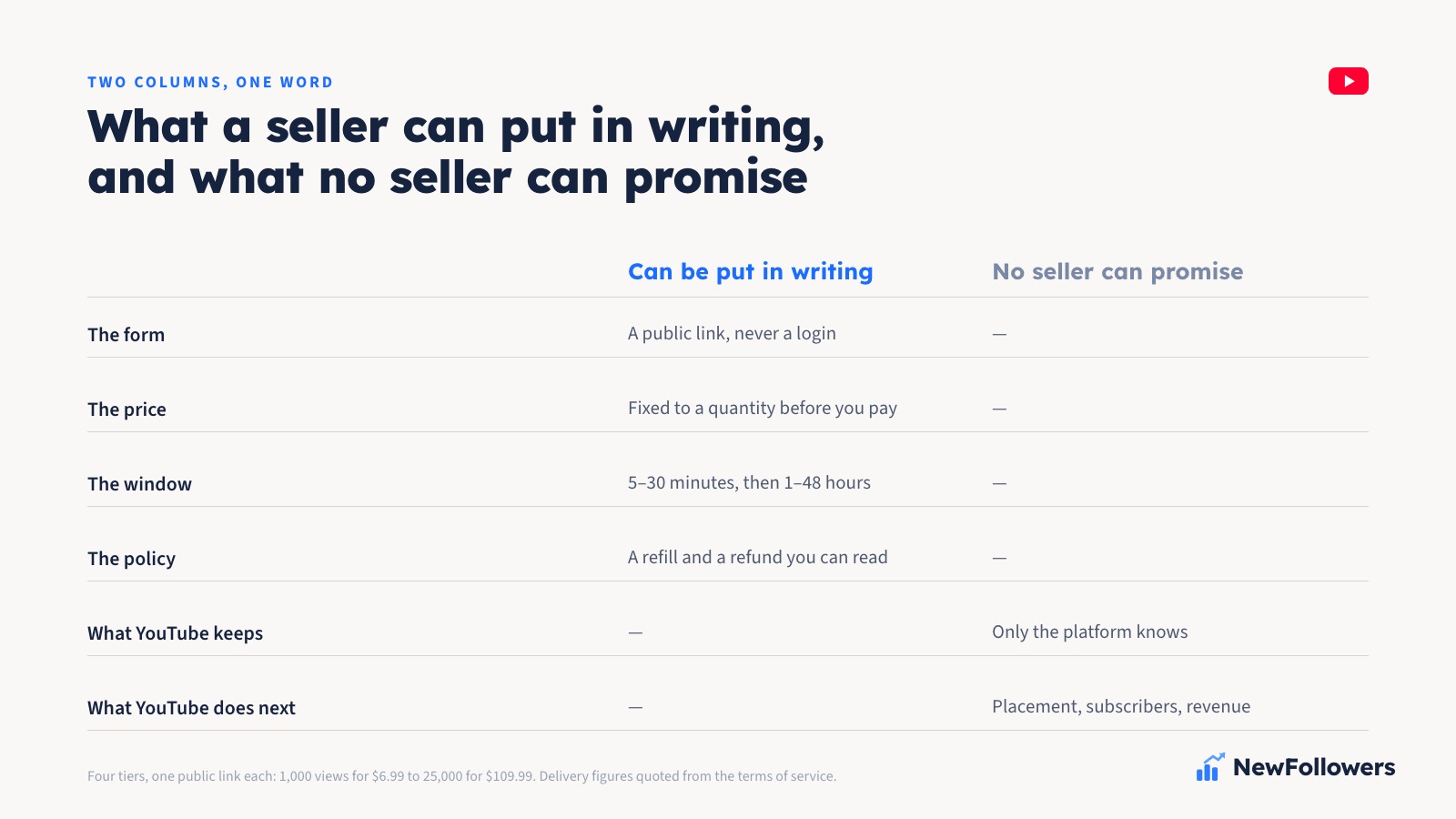
In the first column go the claims about the seller: what the form takes, what the price is, when the order starts and how it is paced, what is refilled and what is refunded. Every claim here should be specific enough to be false. "Processing begins within 5–30 minutes of payment confirmation" can be false. "Fast" cannot.
In the second column go the claims about YouTube: that the views will stick, that they will count toward something, that the video will be shown more, that the channel will not be looked at. None of these can be checked from the buyer's side, because only the platform knows, and it does not say.
A legit listing has a full first column and an empty second one. A listing whose most confident language sits in the second column has told you where the word is covering a gap: the part you were worried about is the part they declined to write down.
The Test You Can Run After the Order
Legitimacy is not only checked before paying. Each of the four commitments leaves a mark you can see from your side once the order is placed.
The link and the form: you gave a URL and an email and nothing more, so there is no login to revoke.
The price: the receipt matches the tier.
The window: processing begins within 5–30 minutes of payment confirmation, and the count under the video climbs across the window shown at checkout rather than jumping in one step. When it reaches the ordered total it stops, because the order buys a fixed total and not a stream. If the checkout window has come and gone with no change on the counter, support is the next step. The post on what "instant" means for a views order walks through that clock.
The refill: if the count reads lower than what was delivered within 30 days of completion, you email support with the order ID and the current count, and the difference is restored. You do not have to prove why it dropped.
Each of those is a fact you can observe. That is the practical meaning of legit: every promise made was the kind you could later check, and each one held.
Where the Refund Fits, and Where It Does Not
The refill and the refund are often blurred, and a legit listing keeps them apart.
The refill is about the count after delivery. It restores a drop inside the 30-day window and answers the question "what if YouTube takes some back."
The refund is about the order before or during delivery. The terms set out a full refund where delivery does not start or cannot be made to the video at all, a partial refund where an order cannot be completed, and no refund once delivery is confirmed in full, with a stated way to claim it. None of that is generous or ungenerous; it is written down, which is the point.
Neither covers the second column. A refund is not issued because the platform reviewed the channel afterward, and a refill is not a promise that the number will stand forever. A seller offering either has stepped back over the line into promising what YouTube will do.
The Forum Meaning of the Word
One more meaning is worth naming, because many searches for this phrase start from a thread. On forums the word usually means "not a scam," and the threads are mostly about sellers who took payment and delivered nothing, or delivered something that vanished before anyone could ask for a refill.
That is the first worry again, and the four commitments above answer it. The Reddit discussion of buying YouTube subscribers runs the same argument for a different counter, and the pattern holds: the sellers people regret promised the platform's behavior and skipped the terms.
What to Do With All This
Check that the video is public and take its URL from the watch page. Look at what the channel's other uploads sit at and pick the tier that belongs beside them; sizing is worked through step by step in how to buy YouTube views.
Then read the seller's page with the two columns in mind. If it is this site: the form takes a link and never a password, the price is on the tier and charged to your card as shown, processing begins within 5–30 minutes of payment confirmation, delivery is gradual over the timeframe shown at checkout, typically 1–48 hours depending on package size, a 30-day refill covers a drop, and the refund conditions are on the terms page. Nothing is promised about what YouTube will keep or do, because nothing can be.
Somewhere else, ask which of those six things is written down and which is a headline word. The safety guide to YouTube views covers the safety and audience side. The word was the search; the two columns are the answer.
Frequently Asked Questions
What can a YouTube views seller honestly call legit?
Four things, all about the seller's own conduct: an order form that takes a public video link and never a login, a price fixed to a quantity before payment, a delivery window quoted in the terms (processing begins within 5–30 minutes of payment confirmation, and delivery is gradual over the window shown at checkout, typically 1–48 hours), and a refill and refund policy you can read. Anything beyond that is a claim about YouTube, not about the seller.
Can any seller promise that YouTube will keep the views?
No. The platform reviews what lands on its counters, and no seller can see or control that. What a seller can offer instead is a refill: here, if the count reads lower than what was delivered within 30 days of the order completing, the difference is refilled without a charge. A listing that guarantees permanence is guaranteeing something outside its reach.
Does a bigger package make the order any more or less legit?
No. All four tiers, 1,000 views for $6.99, 5,000 for $24.99, 10,000 for $44.99 and 25,000 for $109.99, take the same public link, sit under the same terms and carry the same refill and refund policy. Size changes how the finished count looks beside the channel's other videos, which is a question about your channel and not about the seller.
How do I check from my side that the order did what it said?
You gave a link and an email and nothing more, so there is no access to revoke. The receipt matches the tier. Processing begins within 5–30 minutes of payment confirmation, and the count climbs across the window shown at checkout until it reaches the ordered total, then stops. If it drops within 30 days, the refill restores the difference. Every one of those is something you can see without trusting anyone.
What is the difference between the refill and the refund?
The refill is about the count after delivery: a drop below what was delivered, within 30 days of completion, is restored. The refund is about the order itself: the terms set out a full refund where delivery does not start or cannot be made, a partial refund where an order cannot be completed, and none once full delivery is confirmed. Neither covers what the platform does to the channel afterward.
Does legit mean the views come from real people?
Where views come from and whether a seller is legit are separate questions, and the post on YouTube views from real USA users takes up the first one. This article uses legit for the four commitments a seller can put in writing about its own process: a link and never a login, a price fixed before payment, a quoted delivery window, and a refill and refund policy. Judge a seller on what it writes down, not on an adjective about the platform's verdict.
What happens if the count drops after the 30 days?
The refill window closes 30 days after the order completes, and the terms say plainly that retention beyond it is not guaranteed. That is not a loophole; it is the honest edge of what a seller can promise, because what YouTube does with a counter later is the platform's decision. A seller who tells you the number will stand forever has made a promise with no way to keep it.
Ready to Grow Your Social Media?
Real followers, instant delivery, 30-day refill guarantee. Pick your platform: