How to Get More Likes on Instagram
There are two levers and only two: how many people see the post, and what share of them tap. Almost everything sold as a likes tactic is the first one under another name, and the first one is not a likes tactic at all.
A like count is reach multiplied by the proportion of people reached who tapped. That is not a theory about how Instagram works; it is what the number is made of. So "get more likes" is two unrelated problems sharing one phrase, and separating them is worth the five minutes it takes.
The Arithmetic Nobody Starts With
Open Insights on a recent post. It gives you, for that post, how many accounts it reached and how many likes it got. Divide the second by the first and you have your like rate, which is the only version of your like count that is not contaminated by how far the post happened to travel.
Do that for ten posts and something usually turns up. The post with the most likes is normally the post with the most reach, and its rate is often lower than the rate on a quiet post that only your regulars saw. That is the ordinary shape of it. Extra reach is mostly strangers, strangers have no relationship with you, and strangers tap less often than people who have been reading you for a year. A rate that slips while reach climbs is not a penalty and not a sign that the content got worse. It is what being shown to people who do not know you looks like in a spreadsheet.
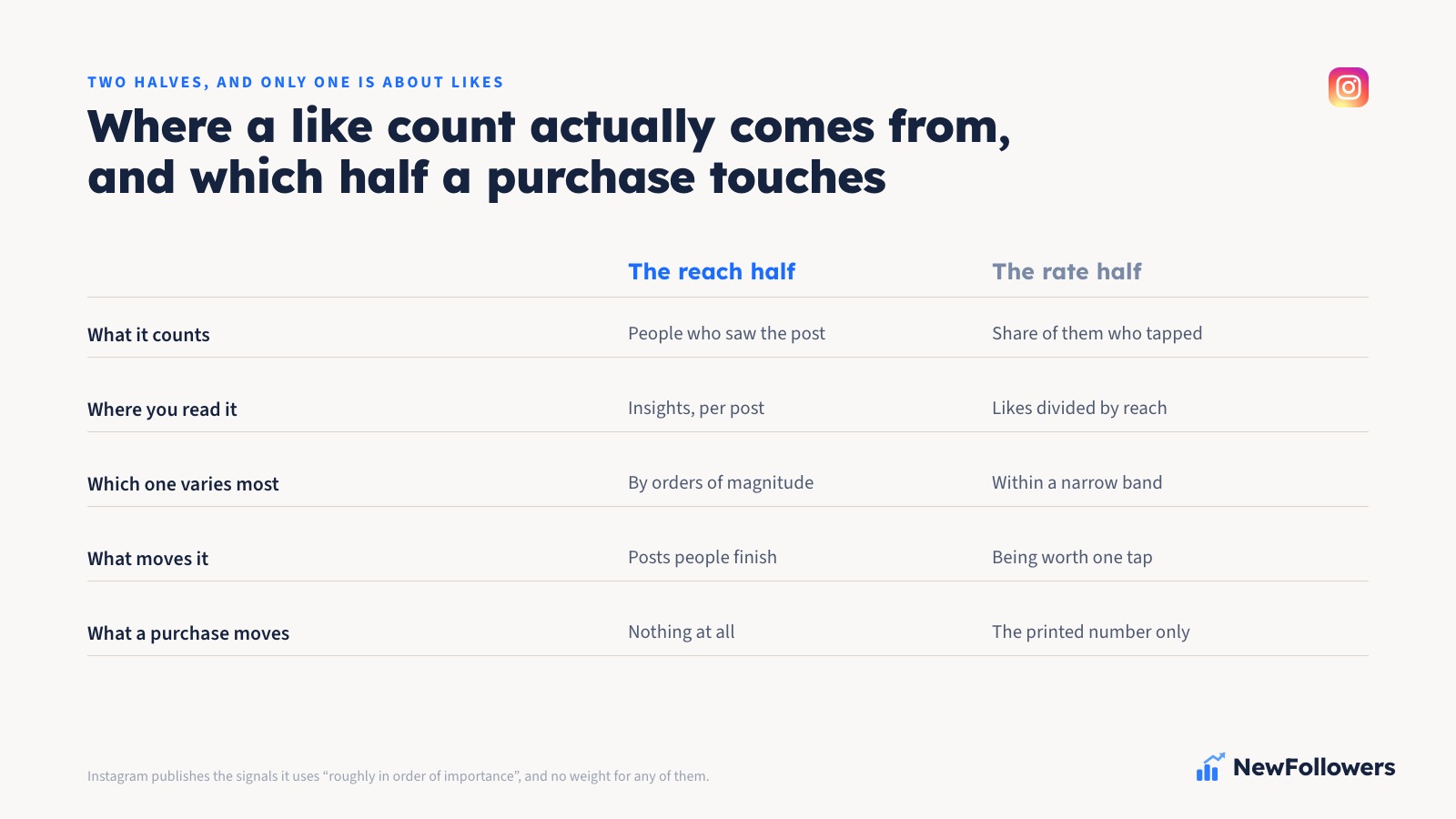
The two halves behave differently enough that merging them is the main reason likes advice fails:
A single list of fifteen ways to get more likes has merged those two, and most of the items on it will be reach advice with a heart drawn on top.
What Instagram Actually Publishes About Likes
Less than the internet implies. It is worth reading the actual sentences rather than the hierarchy tables built on top of them.
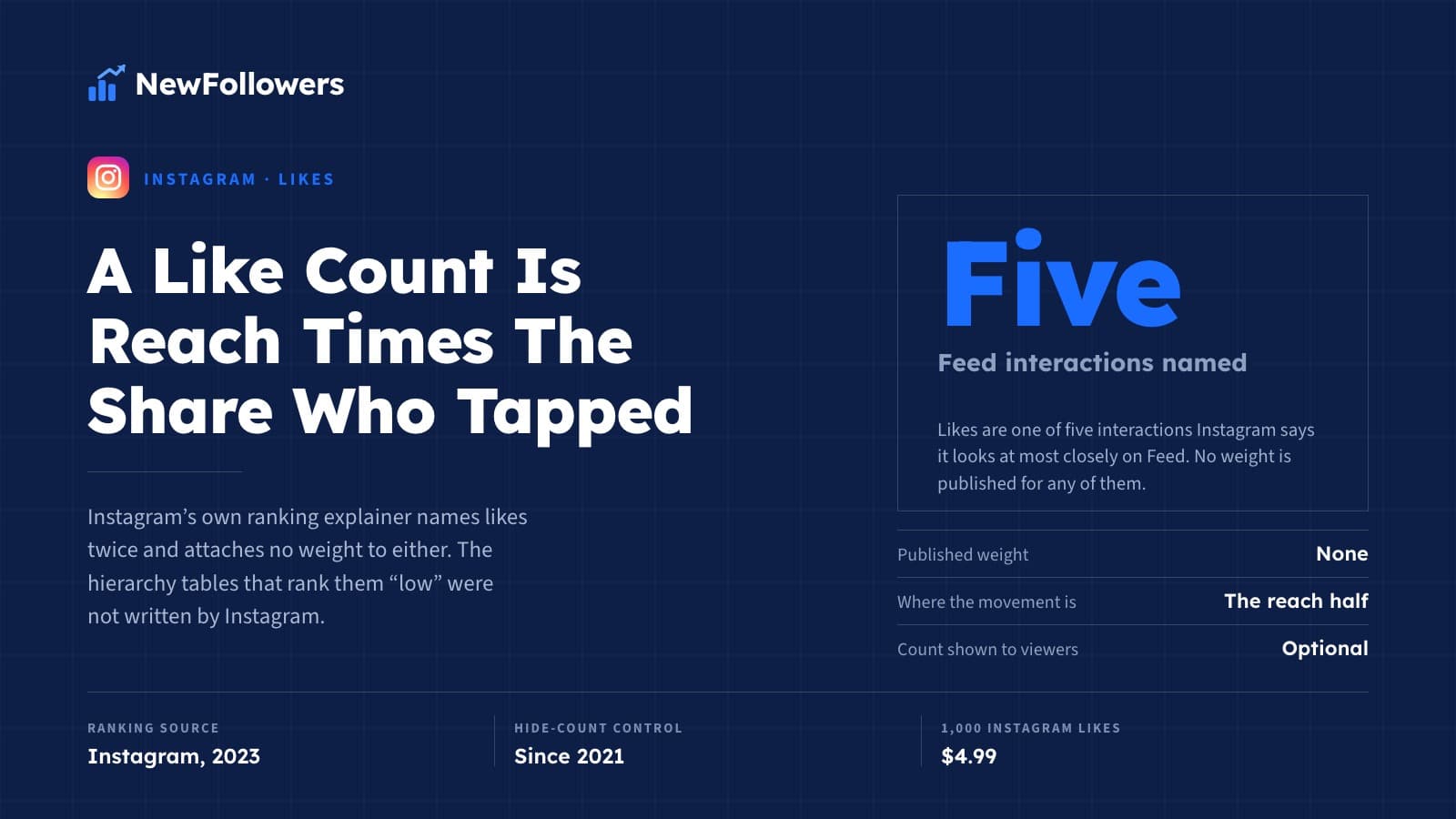
Instagram's public explanation of ranking, written by Adam Mosseri and published on 31 May 2023, says this about Feed: "The five interactions we look at most closely are how likely you are to spend a few seconds on a post, comment on it, like it, share it, and tap on the profile photo." Likes are one of the five. The sentence does not order them and does not weight them.
The same page defines one of the Feed inputs, "Information about the post", like this: "These are signals both about how popular a post is – think how many people have liked it and how quickly people are liking, commenting, sharing and saving a post – and more mundane information about the content itself, like when it was posted, and what location, if any, was attached to it."
Put those two together and two things are settled. Likes appear twice: once as something Instagram predicts a viewer will do, and once inside a popularity signal that counts both how many and how fast. And no number is attached to either. The signals are given "roughly in order of importance" and that is as precise as the document gets.
So when a page tells you that likes carry a specific share of the weight, or parks them at the bottom of a five-row table with "low" beside them, that ranking did not come from Instagram. Somebody inferred it, or made it up. Nobody outside Meta knows the weights, and a page that opens by pretending it does has nothing else worth taking.
The Count Is Optional Now
The other thing that has changed about this metric is that it is no longer guaranteed to be on screen at all.
Since 26 May 2021, when Instagram announced that "everyone on Instagram and Facebook will now have the option to hide their public like counts", the number under a post has been a display setting rather than a fixture. Two separate controls. You can hide the count on your own posts, so visitors cannot read it. And you can hide like counts across everything in your feed, so you cannot read anybody else's.
Instagram's stated reason was that its testing came back split: "not seeing like counts was beneficial for some, and annoying to others, particularly because people use like counts to get a sense for what's trending or popular."
The consequence matters if raising a like count is the goal. The number still exists, is still counted and still feeds whatever it feeds. What is no longer certain is that the person you wanted to impress with it can see it. A metric the author can switch off and the reader can switch off is a weak instrument for looking popular, and looking popular is most of the reason anyone wants more likes.
Raising the Rate
The smaller lever, and the only one that is actually about likes. A like is the cheapest thing a viewer can do: one tap, no typing, no decision to put your post in front of anybody they know.
Four things that move it, all of them observable rather than claims about ranking:
Note what is missing. No hashtag count, no posting time, no audio advice. Those are reach tactics, they belong in the next section, and not one of them changes whether a person who has already seen your post decides to tap it.
Raising the Reach
The bigger lever, and since it is not a likes problem this page will not dress it up as one.
Instagram's ranking explainer lists what it considers for Reels: "Your activity. We look at things like which reels you've liked, saved, reshared, commented on, and engaged with recently", then your history of interacting with the person who posted, then "Information about the reel ... such as the audio track or visuals in the video, as well as popularity", and last, information about whoever posted, where it names "popularity signals such as number of followers or level of engagement". Most of that describes the viewer rather than you.
The part you hold is the content, and the site keeps the separate problems on separate pages because they really are separate:
If there is only time for one thing: make more of whatever your last ten posts show people finishing. The likes follow the reach at roughly the rate you were already running, and that is the whole mechanism.
What a Like Count Is and Is Not Evidence Of
Worth being blunt about, because it decides whether the number is worth chasing.
A like count is evidence that some number of people who saw the post tapped it. That is the whole claim. It is not evidence of reach, because the figure carries no denominator. It is not evidence of audience size, because nobody who taps has to follow you. It is not evidence that the post worked, because working depends on what you wanted from it and nobody has ever bought anything by tapping a heart. And it is not comparable between two accounts, because you cannot see either one's reach.
A bought like count carries one extra piece of information, which is that somebody paid. It says nothing about the people behind the accounts, and it cannot become evidence of reach, because it did not move the denominator by a single account.
If You Buy Them
NewFollowers sells Instagram likes, so read this section as interested and check it against the two above.
What an order buys is the visible number under one public post, delivered against that post's link. 500 likes are $2.99, 1,000 are $4.99, 5,000 are $7.99 and 10,000 are $12.99. Delivery is paced across the order rather than dropped in a single block, and the form takes the post link and never a password, because liking a public post needs no access to the account that made it. Prices are in US dollars and tax may be added at checkout depending on the country you buy from. Every tier, with the terms attached to it, sits on the Instagram likes page.
What it does not buy is the other half of the equation. It moves the numerator and leaves the denominator exactly where it was, so it cannot produce reach, and nothing on this site should be read as suggesting it does. Meta's Spam standard lists "attempting to or successfully selling, buying, or exchanging for engagement, such as likes, shares, views, follows, clicks, use of specific hashtags, etc." among the things it does not allow, and there is no reading of that sentence that leaves likes out. And if the count is hidden on that post, which is one toggle in your own settings, the order still lands, somewhere no visitor can read it.
The honest use for it is narrow: a post that already has reach and a count that looks small beside it, where what you want is proportion. Past that, the arithmetic stops supporting it. The unpaid versions of the same shortcut, and why the liker apps are worse than doing nothing, are in the free Instagram likes guide.
What to Do This Week
Open Insights, take your last ten posts, and write down reach and likes for each one. Divide. You now know your like rate, which is a fact about your audience rather than your luck, and it will not move much whatever you do.
Then stop optimising the number that will not move. Put the effort on the reach side, where the figures are larger and the levers are real, and let the like count do what it has always done, which is follow along at roughly the rate it was already running.
And before any of that, check whether the count is even switched on. The quickest way to have more visible likes is occasionally to stop hiding the ones you already have.
Frequently Asked Questions
How do you get more likes on Instagram?
By moving one of exactly two numbers, because a like count is reach multiplied by the share of people reached who tapped. Nearly all the movement comes from the reach half, which is a content and distribution problem rather than a likes problem. The rate half — whether someone who already saw the post taps it — shifts slowly and responds to a short list of things: being legible before people scroll away, knowing whether you are asking for a like or a save, being a person on the account rather than a delivery mechanism, and replying to the people who already talk to you. Any single list of fifteen likes tactics has merged the two halves and is mostly giving you reach advice.
Do likes still matter to the Instagram algorithm?
Instagram's published explanation of ranking names them twice, and attaches no weight to either mention. Adam Mosseri's post from 31 May 2023 says of Feed that "the five interactions we look at most closely are how likely you are to spend a few seconds on a post, comment on it, like it, share it, and tap on the profile photo", and it describes one Feed input as signals "about how popular a post is – think how many people have liked it and how quickly people are liking, commenting, sharing and saving a post". So likes are in there. What is not published is how much they count. The signals are given "roughly in order of importance" and no further. Any page quoting a percentage, or parking likes at the bottom of a weighted table, is reporting an inference as a fact.
Why did my likes drop when my post reached more people?
Usually because the extra reach was strangers. Your like rate is likes divided by the accounts a post reached, and the people who have been reading you for a year tap at a different rate from people meeting you for the first time. A post that travels further is shown to proportionally more of the second group, so the rate slips even when the raw count rises. That is arithmetic rather than a penalty, and it is not a sign the content got worse. Work it out on ten posts in Insights and the pattern usually shows itself.
What is a good like rate on Instagram?
Instagram does not publish one, and any figure quoted as a universal benchmark was calculated by someone else's tool on someone else's sample. The useful version is your own: open Insights, take the last ten posts, divide each post's likes by the accounts it reached, and treat the resulting range as your baseline. That number is a fact about your audience, it moves slowly, and it is the only like figure that is comparable to anything — including your own posts last month. Cross-account benchmarks are worse than useless here because you cannot see anybody else's reach.
Does buying Instagram likes get me more reach?
No. A likes order moves the visible number under one post and leaves the number of accounts that post reached exactly where it was — the numerator, not the denominator. Nothing on this site should be read as claiming otherwise. Meta's Spam standard separately lists "attempting to or successfully selling, buying, or exchanging for engagement, such as likes, shares, views, follows" among the things it does not allow, so this is a platform-policy risk as well as a metric that does not do what people hope. NewFollowers sells Instagram likes at 500 for $2.99, 1,000 for $4.99, 5,000 for $7.99 and 10,000 for $12.99, against a post link and never a password, and the honest use is narrow: a post that already has the reach and a count that looks small beside it.
Can people still see the like count on my posts?
Only if neither of you has switched it off. Since 26 May 2021 Instagram has given everyone the option to hide public like counts, and there are two independent controls: you can hide the count on your own posts so visitors cannot read it, and any viewer can hide like counts across their whole feed so they never read anybody's. The count still exists and is still counted either way. What is no longer guaranteed is that the person you wanted to impress with it is looking at it — which is worth checking before spending an afternoon raising it.
Why do my posts get saves but almost no likes?
Because a save and a like are different acts, and reference content asks for the first one. A checklist, a tutorial or a template is something a viewer intends to come back to, so they save it and move on without tapping the heart. A strong save rate beside an unremarkable like rate is the audience doing exactly what the post was built for, not a failure to convert. If the visible like count is what you actually need, the post has to be the kind of thing people react to rather than the kind of thing people file.
Ready to Grow Your Social Media?
Real followers, instant delivery, 30-day refill guarantee. Pick your platform: