Can You Buy Bluesky Followers? What an Open Protocol Does to the Purchase
Can You Buy Bluesky Followers?
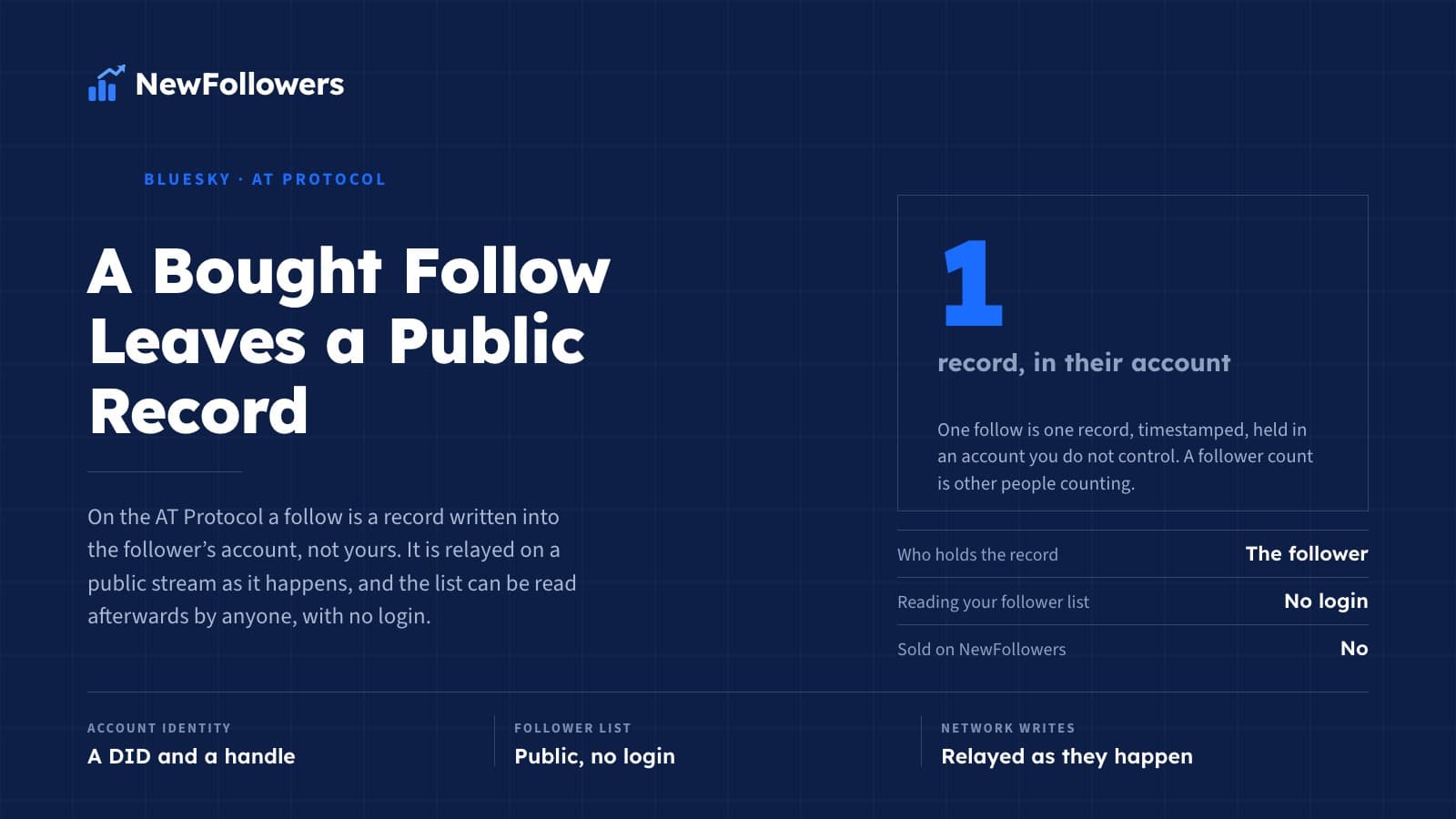
A few storefronts list them, so the literal answer is yes. Bluesky is also the worst platform in this industry to try it on, because a follow here is a record written into somebody else's account, published on an open stream as it happens and readable afterwards by anyone without a login. This site does not sell Bluesky followers and has no supplier for them, so none of what follows is a pitch.
That is not a general point about decentralisation, which gets waved at far more often than it gets explained. It is a narrow fact about where the data sits, and it changes what a purchase actually consists of.
Where a Bluesky Follow Actually Lives
On a conventional platform your follower list is rows in a company's private database. You cannot read it in bulk and neither can anybody else, which is why every argument about whether an account bought its audience is conducted from the outside, off ratios and screenshots. The underlying records are not available to the people arguing.
Bluesky runs on the AT Protocol, and one detail of that design does most of the work on this page. Every account has an identifier — a DID — and a repository of signed records, held on a server the account can move between. Posts are records in it. Likes are records. So is a follow, and the part worth knowing is whose repository it goes into.
Not yours. Nothing is added to your account at all. The follow is written into the repository of the account doing the following, naming your identifier as its subject.
Your follower count is therefore not a number you hold. It is the result of somebody counting those records. The app most people read Bluesky in is one such index, and anyone who wants to build another can.
Three consequences, all of them consequences for a buyer:
The Stream Nobody Mentions on a Sales Page
The network also publishes its own writes. New repository commits — accounts, posts, follows — are relayed on a public stream as they happen, and people consume it: to build feeds, to run statistics, to study spam. It is ordinary infrastructure, not a privileged view handed to a few.
Set that beside the public follower lists and a buyer's position here is genuinely unusual. Elsewhere, spotting purchased followers is something the platform does internally with data nobody outside it has, while everyone else makes do with inference. On Bluesky the events themselves are public. A run of accounts created inside the same hour, each writing a follow record that names the same handle a few minutes later, is not an inference from an engagement ratio. It is the thing itself, on a stream anybody can watch and anybody can keep a copy of.
Moderation is built the same way. Labelling services can be run by third parties and subscribed to by whoever wants them, so "somebody has published a list of the accounts that arrived in that batch" is a normal outcome on this network rather than a conspiracy theory about one.
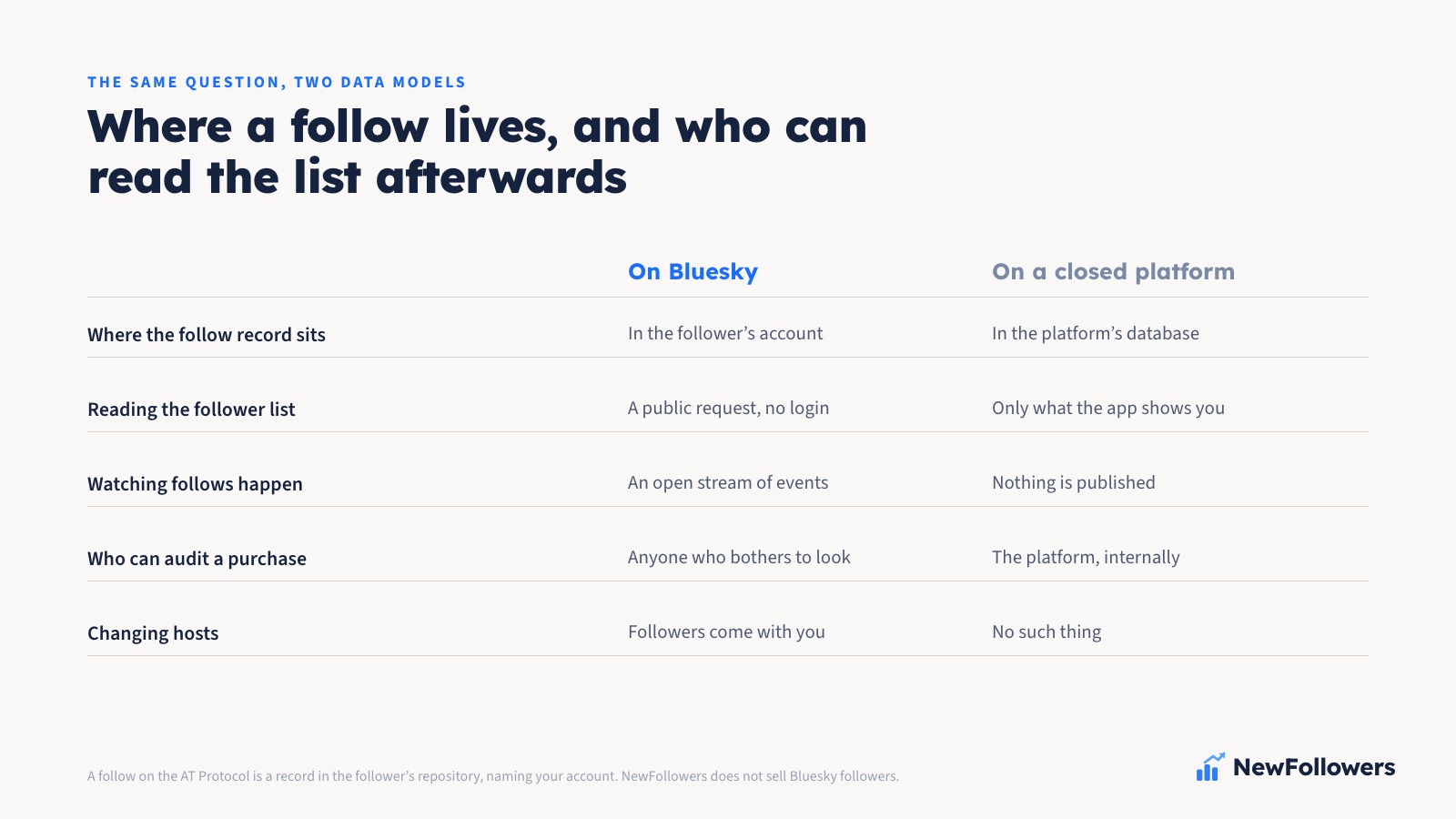
None of this requires the platform to do anything, which is the part worth sitting with. You can hold bought followers that Bluesky itself never touches and that remain legible to any reader curious enough to open your follower list.
What the Count Does for Reach, Which Is Less Than a Sales Page Implies
Three things carry a post on Bluesky, and the follower graph is only the first of them.
The Following feed is the accounts you follow, in the order they posted. Purchased accounts read nothing, so what you gain there is a place in a timeline nobody opens.
Then there are custom feeds, which anyone can build and publish, and a great many of them are assembled from explicit rules — a keyword, a list of accounts, a language. A follower count is not an input to a rule like that.
Feeds that rank rather than list rank on what people do with a post. A follower who does nothing supplies nothing to rank.
So the honest case for the number is the one this blog makes everywhere: a follower count is a credential a stranger reads before deciding whether you are worth reading. That is worth something, and it is the whole of what a purchase moves. It is not a distribution lever, and on a network where much of the distribution is rule-built it is less of one than usual.
Why Nobody Has Much of a Supply
Open sign-up means accounts are cheap to make, and cheap to make is exactly why they are cheap to spot. The openness cuts both ways again: accounts created in bulk are observable in bulk, they arrive on default handles rather than on domains somebody had to prove they control, and their repositories tend to contain a follow record and very little else.
Demand is small as well — this is a far smaller network than X. When a storefront does list Bluesky, remember that a listed line item is not evidence of a supply behind it. Catalogues are imported wholesale and re-pointed at different suppliers without anyone being told, which is the entire subject of what an SMM panel is.
What Is Sold Here, and What Is Not
Bluesky is not in the catalogue on this site and will not be, because there is nothing behind it to sell. A storefront listing a platform it cannot fill is the failure this blog keeps describing, and it would be a strange thing to do on the page about it.
If what sent you here is microblogging — short posts, replies from strangers, a follower number people glance at before deciding whether to engage — then X is the platform on this site that behaves that way, and X followers are sold. The limits travel with them, minus the protocol: the count moves, reach does not, and the price is printed in full rather than quoted on request. If the question underneath your search was really the word "real" — what a seller is claiming when it uses it — that has its own page.
On the rules, an inference rather than a quotation, because platform documents change and a summary of one ages badly. No major platform's rules make room for purchased engagement, and there is no reason to assume this one is the exception. Read Bluesky's current community guidelines yourself rather than a seller's account of them.
If You Buy From Somebody Else, the Checks Are Different Here
What You Are Left Holding
A number on a profile, the same as anywhere, and a set of records in other people's accounts saying where it came from.
On most platforms that second half stays private, and the argument about whether an account bought its audience stays an argument. Here it is a lookup. That does not make buying impossible, and this page has not claimed it does. It makes it legible — and any reason to do it has to survive being read by the people you were trying to impress.
Frequently Asked Questions
Can you buy Bluesky followers?
A few storefronts list them, so the literal answer is yes, but Bluesky is the worst platform in this industry to try it on. A follow on the AT Protocol is a record written into the follower's own repository naming your account as its subject, follower lists can be read through ordinary public requests with no login, and new repository commits are relayed on a public stream as they happen. A bought follow therefore leaves a timestamped record in an account you do not control, on a network where anyone can go and look. NewFollowers does not sell Bluesky followers and has no supplier for them.
Where is a Bluesky follower count actually stored?
Nowhere that belongs to you. Every account on the AT Protocol has an identifier called a DID and a repository of signed records held on a server it can move between. A follow is a record in the repository of the account doing the following, not in yours, so your follower count is not a number you hold at all. It is the result of a service counting those records, and anyone can build such a service. That is also why you cannot make your follower list private: you never had it.
Can other people tell that Bluesky followers were bought?
More easily than on any other platform, and without the platform's help. Follower lists are readable through public requests that need no account, and repository commits are relayed on an open stream as they happen, which people already consume to build feeds and study spam. A run of accounts created within the same hour, each writing a follow record that names the same handle minutes later, is not an inference from an engagement ratio, it is the event itself. Moderation is pluggable as well, so third parties can publish labels on accounts and other users can subscribe to them.
Do bought followers help a Bluesky post reach more people?
No. The Following feed shows the accounts you follow in the order they posted, and purchased accounts read nothing, so a post lands in a timeline nobody opens. Many custom feeds are built from explicit rules such as a keyword, a list of accounts or a language, and a follower count is not an input to a rule like that. Feeds that rank rather than list rank on what people do with a post, and a follower who does nothing supplies nothing to rank. A follower count is a credential a stranger reads, not a distribution lever.
Does NewFollowers sell Bluesky followers?
No, and it will not, because there is no supplier behind it to sell. The platforms in the catalogue are Instagram, TikTok, YouTube, Facebook, Telegram, X, Spotify, LinkedIn, Snapchat, Twitch and Discord. If the reason for the search is microblogging, X is the platform here that behaves the same way and X followers are sold, with the same limits attached: the count moves, reach does not, and the price is printed rather than quoted.
Is it safe to give a seller an app password for Bluesky?
No, and no follower order needs one. Following a public account requires your handle and nothing else. An app password is an API credential, and a client holding one can post as you, follow as you and delete as you. A seller asking for one is asking for control of the account rather than for a delivery target, which is where an evaluation should end regardless of the price on the page.
What happens to bought followers if I move my Bluesky account to another host?
They come with you, because they were never in your repository to be left behind. Each follow lives as a record in the repository of the account that made it, naming your identifier as its subject, and your identifier is what moves when you change hosts. The same design means those records outlast the order: they stay where they are, with their timestamps, until the accounts that wrote them delete them or disappear.
Ready to Grow Your Social Media?
Real followers, instant delivery, 30-day refill guarantee. Pick your platform: