What Is an SMM Panel? The Reseller Layer Nobody Explains to the Buyer
What Is an SMM Panel?
An SMM panel is a reseller dashboard for social media metrics. You pick a service, paste a link or username, pay, and the panel forwards the order to a wholesale supplier through an API. Most panels produce nothing themselves.
SMM stands for social media marketing, but panels sell something narrower than that phrase suggests: countable metrics. Followers, likes, views, subscribers, comments, live viewers. The catalogue can run to hundreds of line items, and on most panels it is somebody else's catalogue, imported wholesale and marked up.
That single fact answers most of what confuses a first-time buyer. It explains why site after site sells services that look identical. It explains why the same order can behave differently in two different weeks. And it explains why the cheapest panel and the most reliable one are rarely the same panel.
The Layer Under the Dashboard
There are three positions in the chain, and a buyer only ever sees the top one.
Suppliers sit at the bottom. These are the operations that actually control the accounts, the traffic or the automation doing the delivering. They sell in bulk, to businesses, through an API rather than a checkout page. A retail buyer never meets one and never sees its name.
Panels sit in the middle. A panel is software: a catalogue, a balance, an order form, an API key. It connects to one supplier or several, imports their service lists, adds a margin, and shows the result to whoever logs in. Running one requires no accounts, no traffic and no infrastructure beyond the website.
Resellers sit on top. Panels sell to other panels. A "child panel" is a ready-made storefront rented from a larger panel for a monthly fee, with the parent's catalogue already loaded. That storefront adds its own margin and sells again. The chain can be several links deep, and each link generally knows only the link directly beneath it.
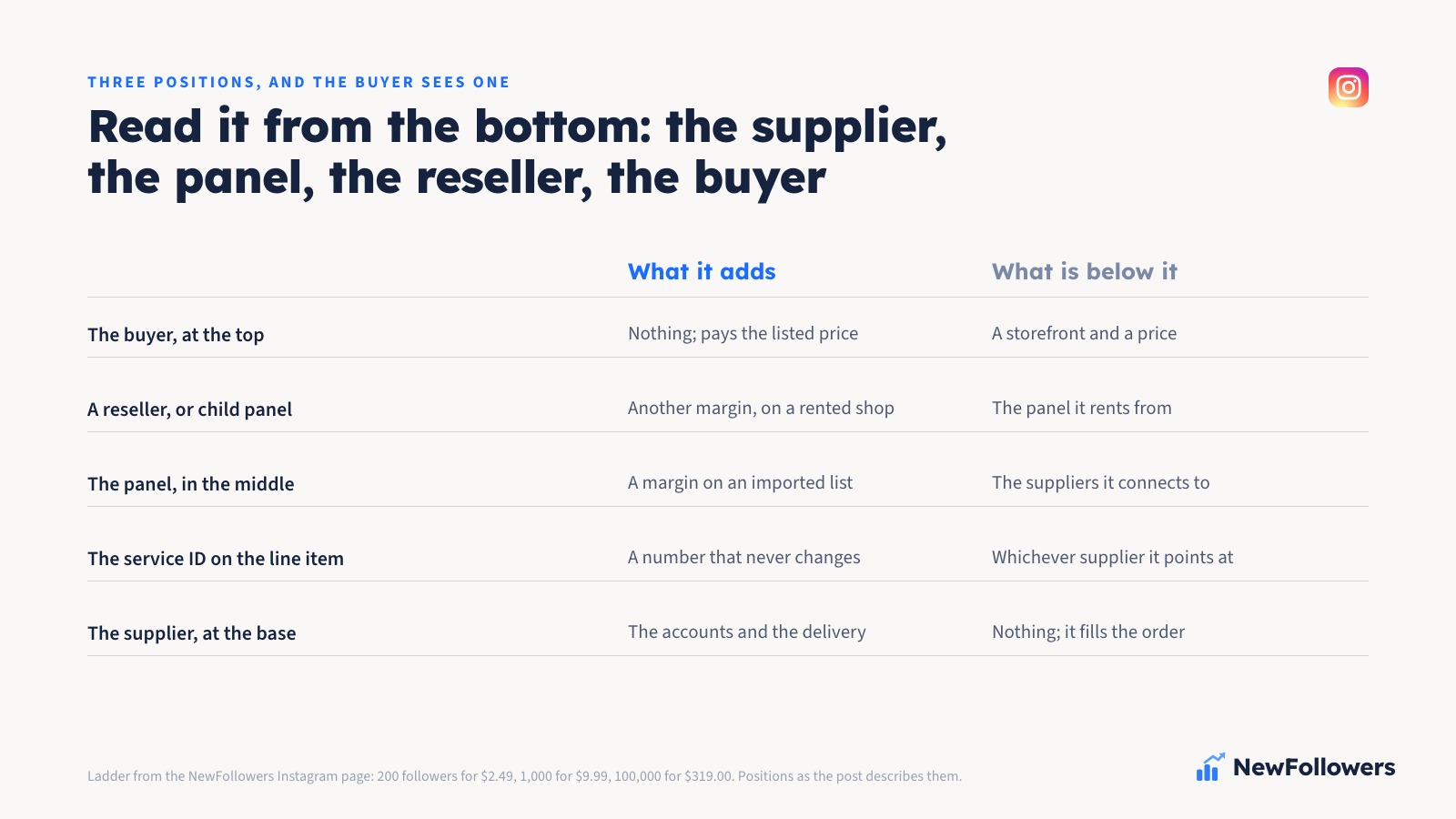
This is why "we own our own network" appears on so many homepages and means so little. A buyer cannot check it from outside, and a storefront that resells has no reason to volunteer it.
Why Site After Site Sells the Same Thing at a Different Price
Because they are selling the same thing. When several storefronts import the same supplier's service list, their catalogues match down to the wording of the line items. The only variable left is margin.
Margin pays for whatever the storefront has chosen to carry:
Notice what is not on that list: the followers themselves. Two storefronts pulling from the same supplier are, for the duration of that arrangement, shipping the same product. The price gap between them buys what happens around the order, not the order.
That is worth knowing in both directions. It means a high price guarantees nothing on its own. It also means a very low price is usually a storefront that has stripped out everything on that list.
Why the Same Order Can Be Filled Differently on Two Different Days
Panels route. A supplier goes offline, raises its wholesale rate, or starts delivering badly, so the panel re-points that service at a different supplier. The line item keeps its name, its description and often its price. What fills it has changed. Nobody is told, because from the storefront's side nothing visible happened.
This is the honest explanation for a review pattern everyone notices and nobody accounts for: a seller with a long run of clean deliveries and then a bad month, or the reverse. The storefront may have changed nothing at all. The layer underneath changed hands.
It is also why "non-drop" deserves suspicion as a phrase. A storefront that does not control, and may not even know, which supplier fills tomorrow's order cannot promise a count will hold forever. What it can promise is what it will do when a count falls: a refill, with a written window and a length.
Is NewFollowers an SMM Panel?
Not in the dashboard sense. There is no balance to top up, no API key, no catalogue of hundreds of line items. It is a retail storefront with fixed packages and a card checkout.
But it buys from the same kind of wholesale supply that panels buy from, and a page like this one is worthless if it pretends otherwise. There is no magic exception in this industry. Anyone claiming one is describing a network they cannot show you.
What a retail storefront can fairly be judged on is the part it does control: what it asks for, what it publishes before payment, what it commits to afterwards, and what it refuses to claim. That is the list below, and it is the list this site should be held to as well.
Five Questions to Ask Before You Pay
Is a delivery window stated before payment? Here the terms say orders enter processing 5–30 minutes after payment is confirmed, and that delivery is gradual, spread across the window shown at checkout — typically 1–48 hours depending on the package. Those are specific enough to hold someone to. "Instant" is not a window; it is an adjective.
Is a password ever requested? It should never be. Delivery goes to a public username, a channel URL or a post link, and none of those require access to the account. A password field beside a follower package ends the evaluation, whatever the price says.
Is the refill window written down, with a length? A refill replaces a count that falls after delivery. Thirty days is a length. A "lifetime guarantee" from a storefront that may not exist next year is not. Ask what the window is and what starts the clock.
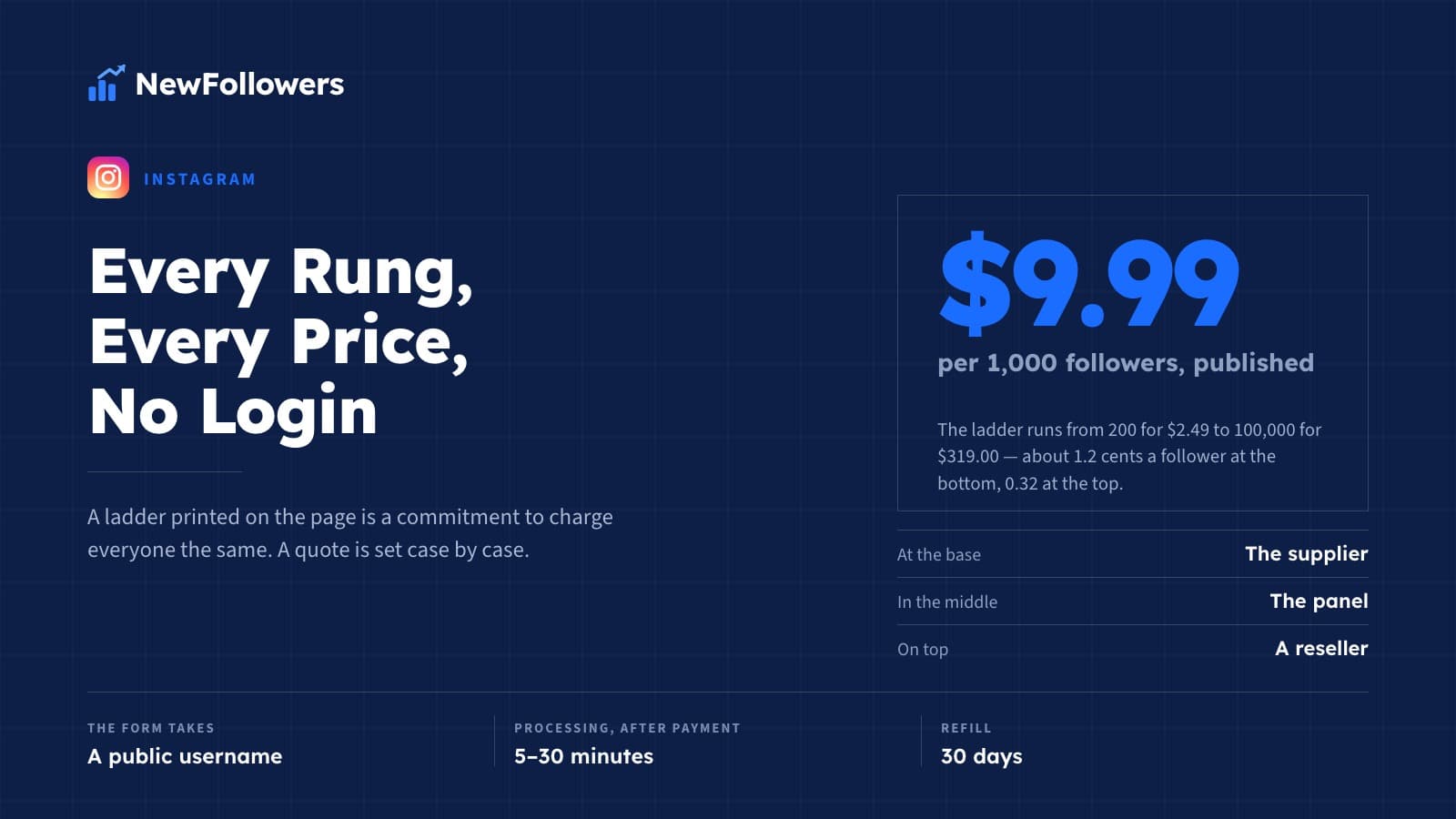
Is there a published price ladder, or do you have to ask? A ladder printed on the page — every rung, every price, no login — is a commitment to charge everyone the same. A quote is set case by case, so it need not be the price the next buyer gets.
Does the seller say what the order does not do? A page that lists only benefits has told you what kind of page it is. The limits are the part a buyer actually needs, and they are cheap to publish if they are true.
"Best Panel" and "Cheapest Panel" Are Different Questions
They get typed as if they were one question, and they pull against each other.
Cheapest is a real answer to a real problem. If the order is small and a poor fill costs you nothing but the money, the bottom of the market is a rational place to buy. Plenty of people should stop reading here and do that.
It stops being rational when the fill matters. The rungs that undercut everything else are usually undercutting because the refill is unfunded, the support is a contact form nobody reads, or the supplier behind the line item changes without anyone being told. You are not buying a discount on the same product; you are buying a product with the recovery mechanism removed. The quality-versus-quantity breakdown goes into what that looks like on the account afterwards.
"Best" only becomes answerable once you say best at what. Cheapest per thousand, widest catalogue, most services that actually deliver, clearest terms — those point at four different storefronts.
A Published Ladder, as a Worked Example
Here is what a published ladder looks like, using ours. Instagram followers:
Read per follower, that runs from about 1.2 cents at the bottom rung to about 0.32 cents at the top. TikTok is a separate ladder, because the supply behind it is separate: 500 for $8.99, 1,000 for $18.99, and on up to 100,000 for $599.99 — roughly 1.8 cents down to 0.6 cents each.
The prices are not the point of the example. The shape is: fixed rungs, visible without an account, the same for every buyer, with the delivery window shown at checkout and a 30-day refill attached to each one. Every rung and its window sits on the Instagram page and the TikTok page.
What a Panel Order Does Not Do
Whatever the storefront, the limits are the same, and they are not negotiable by price:
The Words Panels Use
Before You Pay
Work out which layer you are buying from, then judge the layer rather than the logo. Ask for the delivery window in writing before payment. Check that no password is requested. Find the refill length. Look for a ladder instead of a quote. And read what the seller admits the order will not do, because that paragraph is the most reliable thing on any page in this industry, including this one.
If a panel is not the right shape at all — if what you want is someone managing the account rather than filling an order — the four kinds of Instagram growth service are laid out separately, with what each one wants from you in access as well as money.
Frequently Asked Questions
What is an SMM panel?
An SMM panel is a reseller dashboard for social media metrics. You pick a service from a catalogue, paste a link or username, pay, and the panel forwards the order to a wholesale supplier through an API. Most panels produce nothing themselves: they import a supplier's service list, add a margin, and resell it. Panels also sell to other panels, so the same catalogue can pass through several storefronts before it reaches a buyer.
Why do different SMM panels charge different prices for the same service?
Because the service is often literally the same one. When several storefronts import the same supplier's list, their catalogues match down to the wording, and the only remaining variable is margin. That margin pays for a card checkout, human support, a refill the seller funds itself, a curated catalogue, and advertising. It does not buy different followers. So a high price guarantees nothing on its own, and a very low price usually means those things have been stripped out.
Is NewFollowers an SMM panel?
Not in the dashboard sense: there is no balance to top up, no API key and no catalogue of hundreds of line items. It is a retail storefront with fixed packages and a card checkout. It does buy from the same kind of wholesale supply that panels buy from, and there is no magic exception in this industry. What it can be judged on is what it asks for, what it publishes before payment, and what it commits to afterwards.
How do I judge whether an SMM panel is trustworthy?
Five questions. Is a delivery window stated before payment, as a window rather than the word instant? Is a password ever requested, which it never should be, since delivery goes to a public username, channel URL or post link? Is the refill window written down with a length, such as 30 days, rather than promised for a lifetime? Is there a published price ladder instead of a quote? And does the seller say what the order does not do?
Why can the same order be delivered differently on different days?
Panels route orders to suppliers, and they change suppliers. If one goes offline, raises its wholesale rate or starts delivering badly, the panel re-points that service at another supplier. The line item keeps its name, description and price while what fills it changes, and nobody is notified because nothing visible happened on the storefront. This is why a seller can have a long run of clean deliveries and then a bad stretch, and why a promise that a count will never drop is worth little.
What does 1,000 Instagram followers cost, and what does the price include?
1,000 Instagram followers cost $9.99 on the published ladder, which starts at 200 for $2.49 and runs to 100,000 for $319.00, with 5,000 for $34.79 the most chosen rung. That works out at roughly 1.2 cents per follower at the bottom and 0.32 cents at the top. TikTok is a separate ladder: 500 for $8.99, 1,000 for $18.99, up to 100,000 for $599.99. Every rung includes the delivery window shown at checkout and a 30-day refill.
What can an SMM panel order not do?
It is one delivery to one public username, channel URL or post link, not a subscription, and nothing renews by itself. It changes a number; it does not change how the platform distributes posts, which is decided by how people who see them react. It carries no promise about what the platform will do, and platforms remove accounts they judge fake. A 30-day refill restores a count that falls inside that window, but it does not extend past it and it does not remove the cause.
Ready to Grow Your Social Media?
Real followers, instant delivery, 30-day refill guarantee. Pick your platform: