Buy Telegram Reactions: The Only Engagement a Broadcast Channel Shows
Quick Answer
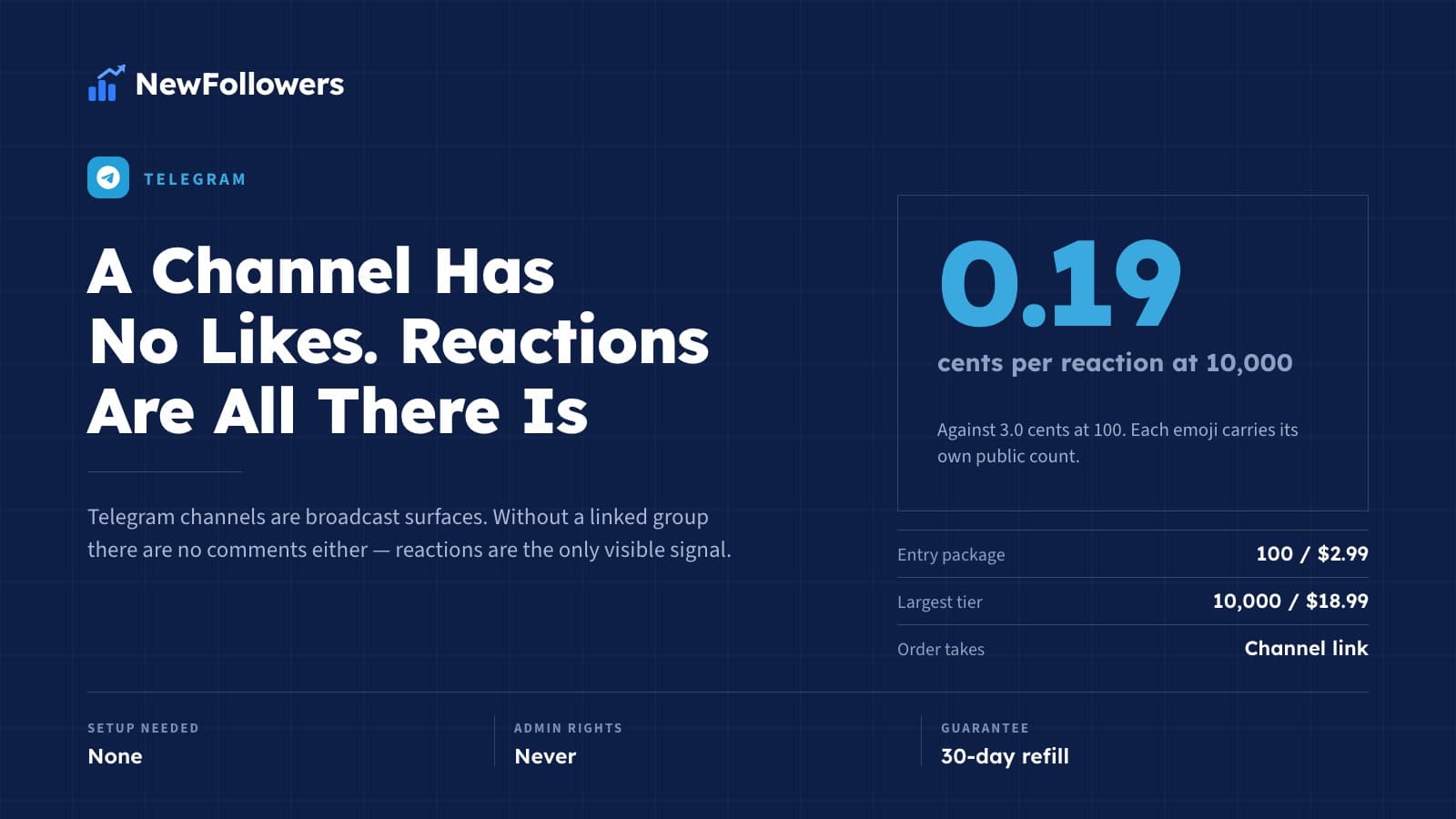
A Telegram reaction is an emoji attached to a channel post, shown publicly under it with a count per emoji. On a broadcast channel it is usually the only visible engagement there is — Telegram channels have no like button, and comments only exist if you have separately linked a discussion group. Reactions need no such setup. They run from $2.99 for 100 to $18.99 for 10,000, which is 3.0 cents each at the smallest tier and 0.19 cents at the largest.
Why a Channel Looks Empty Without Them
A Telegram channel is a broadcast surface. One-way by design: you post, subscribers read. There is no like button, no share count on the post itself, and no reply unless you have gone and connected a discussion group.
So a new visitor opening your channel sees posts, a subscriber count at the top, and — if reactions are off or unused — nothing else. No evidence that anyone on the other side of that subscriber number is reading.
That is the specific gap reactions fill. They are the only signal a broadcast channel carries per post, and they sit directly under the post being judged rather than at the top of the channel.
The Per-Emoji Mechanic
Telegram reactions are not a single counter. Each emoji has its own count, and they display side by side under the post: 👍 42, 🔥 18, ❤️ 9.
That changes what a purchase looks like. A thousand of one emoji on a post is not the same object as a thousand spread across four, and the second reads far more like an audience. Real reactions cluster but they do not converge — a post that genuinely landed collects a dominant emoji plus a scatter of others, because people disagree about what they felt.
Worth deciding before you order which emoji you want and in what proportion, rather than accepting a block of one.
What Reactions Are Not
They are not subscribers. The count at the top of the channel is a different number with a different ladder, and the subscribers guide covers it.
They are not comments. Comments on a Telegram channel require a linked discussion group, which is a setup step many channel owners have never taken — that post covers the gate. Reactions have no equivalent requirement: if the channel exists, a post can be reacted to.
And they are not distribution. Telegram does not have an algorithmic feed that promotes well-reacted posts to strangers. Channels grow through links, directories, forwards and word of mouth. A reaction makes a post look read; it does not make it travel.
What They Are Worth
The honest case for reactions is narrow and real: they are the difference between a channel that looks maintained and one that looks abandoned.
A channel with 8,000 subscribers and zero reactions on the last twenty posts reads as a list somebody bought and stopped tending. The same channel with a modest, uneven reaction count on each post reads as a place with people in it. That judgement is made in seconds by anyone deciding whether to subscribe, and it is made per post, which is why the number sitting under the post matters more here than on platforms with a like button at the top.
Sizing the Order
Reactions cost $2.99 for 100, $5.99 for 500, $10.99 for 2,500 and $18.99 for 10,000 — 3.0 cents each at the smallest tier down to 0.19 cents at the largest.
The sizing question is not how many you can afford, it is what proportion of your subscriber count is plausible. A post carrying more reactions than the channel has subscribers is self-refuting. Somewhere in the low single-digit percentage of subscribers reads as an ordinary, healthy post on most channels; a number that exceeds the audience does not read as anything except purchased.
Spread across posts rather than stacking one, too. A single post with 4,000 reactions in a channel where nothing else has any is more conspicuous than the silence it was meant to fix.
What a Real Reaction Spread Looks Like
Since reactions display per emoji, the shape is as visible as the total, and the shape is what gives a purchase away.
A post that genuinely landed collects a dominant emoji plus a tail. Something like 👍 60, 🔥 22, ❤️ 11, 😁 4, 🤔 2. One reaction is clearly the majority view, several others trail behind it, and one or two people felt something different from everybody else. That untidiness is the signature of a real audience: individual people picking individually.
A bought block collects one emoji, or an even split. 👍 500 and nothing else. Or 👍 250, 🔥 250, which is a proportion no group of humans has ever independently arrived at.
The fix is straightforward but has to be decided before the order, not after: pick three or four emoji, weight them unevenly, and let the smallest be genuinely small.
Channels, Groups and Supergroups
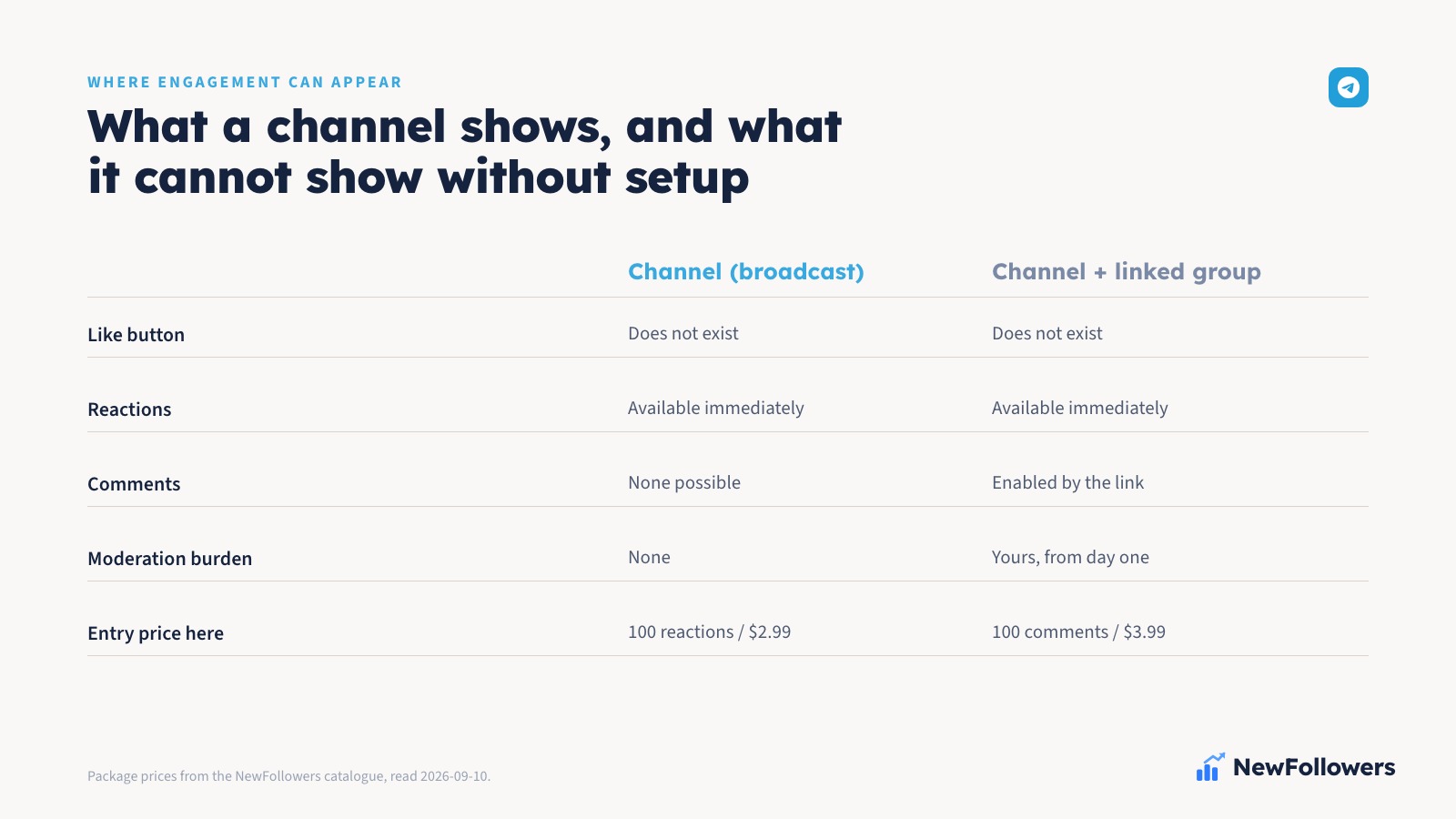
Telegram uses three surfaces and they behave differently, which matters because the advice for one is wrong for another.
A channel is broadcast. One-way, unlimited subscribers, no member list visible to subscribers, no replies unless a discussion group is linked. This is where reactions do the most work, because they are the only visible engagement.
A group is conversation. Members talk to each other, everyone sees everyone, and engagement is self-evident from the messages. Reactions here are a convenience rather than a signal.
A supergroup is a large group with moderation tooling. Same logic as a group for our purposes.
If you are buying reactions, you are almost certainly working on a channel — and the value proposition only really holds there. On a group with active conversation, reactions add very little that the conversation is not already showing.
Free Ways to Get Reactions
Worth stating, because for a small channel these work better than a purchase.
Ask once, in the post. A single line inviting a reaction converts far better than expecting it unprompted, because tapping an emoji costs a reader nothing and most simply do not think of it.
Pin the ask, not every post. Repeating it under every message trains people to ignore it.
Post things with a reaction-shaped response. A question with two plausible answers, a "which of these" pair, an opinion someone might disagree with. Posts that state a fact collect fewer reactions than posts that invite a position, and that is a property of the post rather than the audience.
Use the emoji set deliberately. Telegram lets a channel restrict which reactions are available. A short, relevant set gets used more than the full picker, because choosing is friction.
What Reactions Cost You If They Go Wrong
The downside here is smaller than on most platforms and it is worth being accurate about it rather than dramatic.
Telegram does not have an algorithmic feed to be demoted in. There is no reach penalty, because there is no reach mechanism — a post goes to subscribers and stops. So a badly-judged reaction count does not cost distribution.
What it costs is credibility with the specific person who notices, and on a channel where the audience is often technical, some will. A post carrying more reactions than the channel has subscribers is the version that gets screenshotted.
Red Flags
A request for a bot token or admin rights. Reacting to a message needs neither. Administrator access grants the ability to post and to remove members, which is far more than the task requires and is the clearest reason to walk away.
One emoji only, with no option to choose. A seller with no emoji selection is delivering a block, and a block is the recognisable pattern.
Instant delivery on a large order. Ten thousand reactions in a minute on a channel of four thousand people is self-refuting.
Claims about reach or growth. Reactions do not distribute a post. Any seller implying they do has confused Telegram with a platform that has a feed.
Delivery
We need the public link to the channel or the specific post, and nothing else — never a bot token, never admin rights on the channel, and never your account. A service asking to be added as an administrator is asking for the ability to post and to remove people, which reacting to a message does not require.
Delivery is gradual. Every package carries a 30-day refill guarantee if the count drops below what you ordered.
Frequently Asked Questions
What is a Telegram reaction?
An emoji attached to a channel post, displayed publicly beneath it with a separate count for each emoji. On a broadcast channel it is normally the only visible engagement, because Telegram channels have no like button.
Why do Telegram channels have no likes?
A channel is a broadcast surface — one-way by design. There is no like button, and comments exist only if the owner has separately linked a discussion group. Reactions are the built-in engagement mechanic and need no setup.
How much do Telegram reactions cost?
$2.99 for 100, $5.99 for 500, $10.99 for 2,500 and $18.99 for 10,000 — 3.0 cents each at the smallest tier and 0.19 cents at the largest.
Should I buy one emoji or several?
Several, in uneven proportion. Real reactions cluster around a dominant emoji but do not converge on one, because people disagree about what they felt. A single block of one emoji is the most recognisable purchased pattern.
Will reactions make my channel grow?
Not directly. Telegram has no algorithmic feed promoting well-reacted posts to strangers — channels grow through links, forwards, directories and word of mouth. Reactions make a post look read, which affects whether a visitor subscribes.
Do you need admin rights on my channel?
No. The public channel or post link is enough. Any service asking to be added as an administrator is requesting the ability to post and remove members, which reacting to a message does not require.
Ready to Grow Your Social Media?
Real followers, instant delivery, 30-day refill guarantee. Pick your platform: