Buy LinkedIn Comments: Why They Cost Eleven Times a Telegram One
Quick Answer
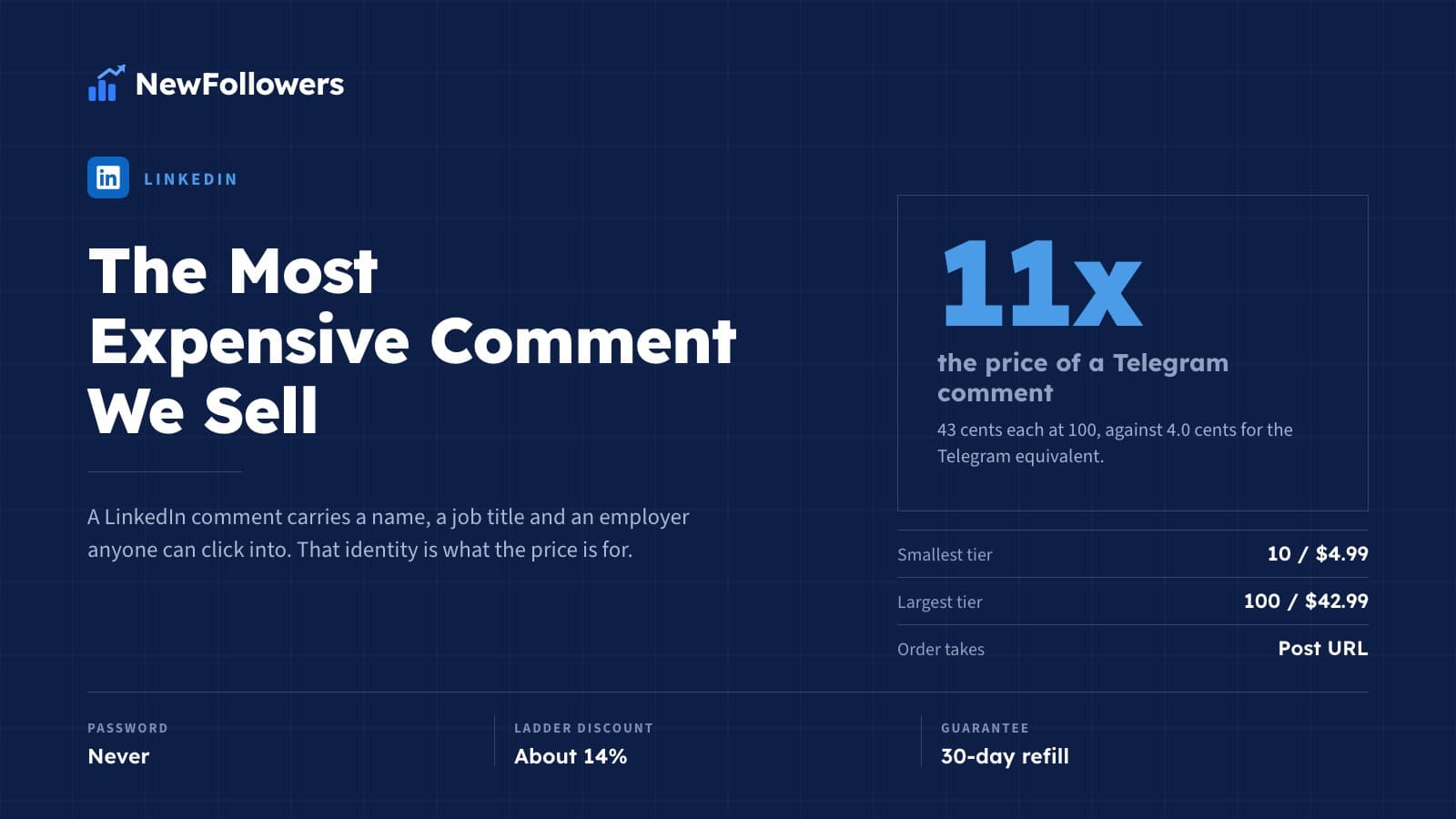
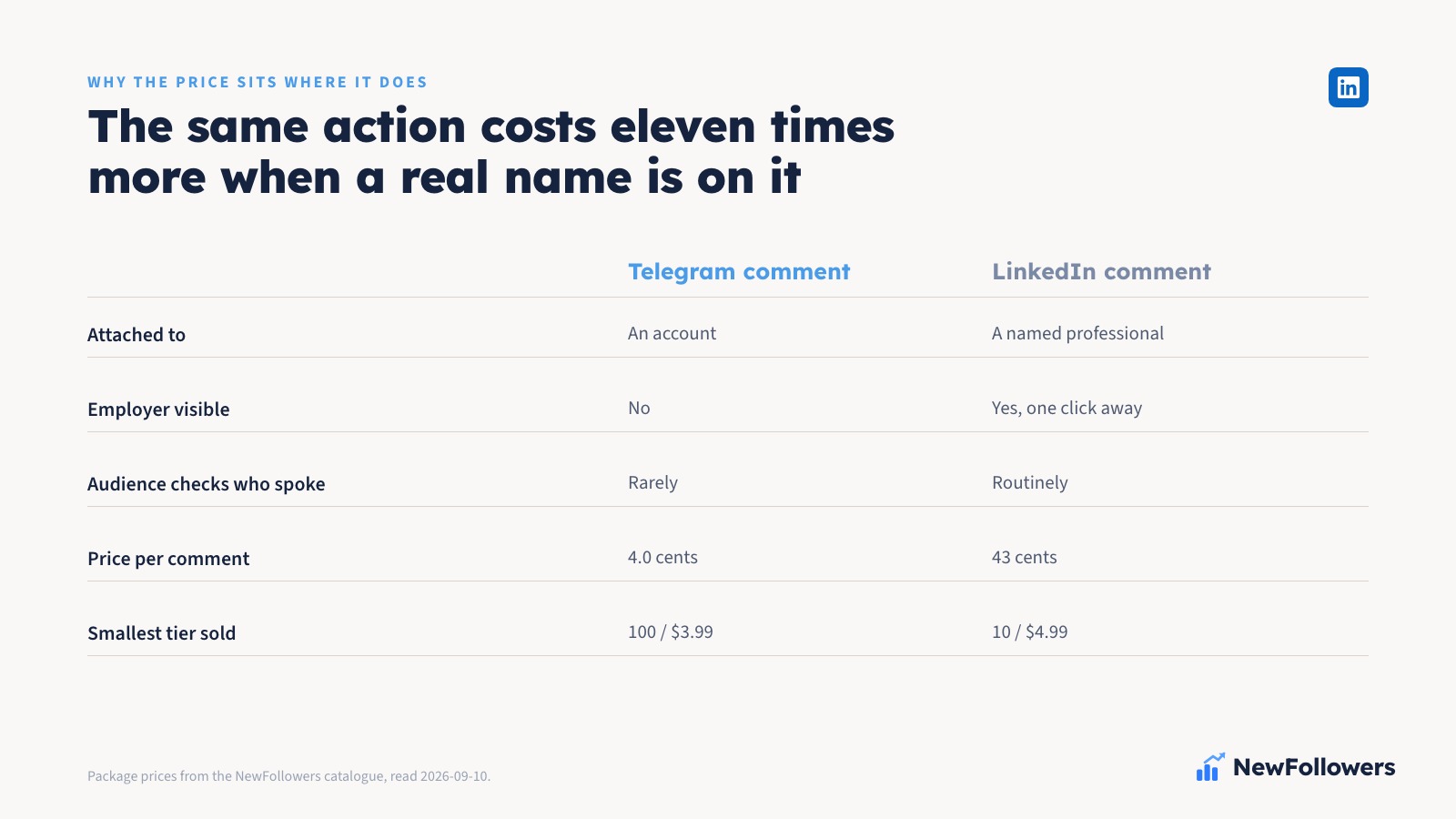
LinkedIn comments are the most expensive engagement in our catalogue: $4.99 for 10, rising to $42.99 for 100 — roughly 50 cents each at the smallest tier and 43 cents at the largest. A Telegram comment is about 4 cents. The difference is that a LinkedIn comment is written under a real person's name, on a profile with an employer and a work history attached, on a platform where the audience checks who is speaking. That identity is the product, and it is why the price sits where it does.
The Price, Stated First
Ten comments cost $4.99. A hundred cost $42.99. That is 49.9 cents each at the bottom of the ladder and 43.0 cents at the top — a discount of about 14%, which is almost nothing by the standards of this catalogue.
Set that beside the rest of what we sell and the outlier is obvious. Telegram comments are $3.99 for 100 — 4.0 cents each. LinkedIn comments cost roughly eleven times that per unit.
Anyone comparing prices across a site like ours should be asking why. Here is the answer.
What You Are Paying For
On Telegram a comment comes from an account. On LinkedIn it comes from a person — a profile with a name, a photograph, a job title, an employer, and a history that anyone reading the comment can click into in one second.
That is the entire difference. LinkedIn is the one platform in this category where the audience routinely inspects the commenter rather than the comment. A post with six thoughtful replies from people whose profiles look like the people you claim to serve is a strong signal. The same post with six replies from blank profiles is worse than no replies at all, because it invites the click that exposes it.
So the sourcing problem is different in kind, not degree. Somewhere near half a dollar is what it costs to put a sentence under a post attached to a credible working identity, and any LinkedIn comment offered at Telegram prices is not that.
What This Buys, and What It Cannot
It buys the appearance of a post that landed with the audience you want. On LinkedIn that reads more strongly than a reaction count, because comments are what the feed surfaces and what colleagues notice.
It does not buy relevance to your specific field. A generic comment under a specialist post is the most common failure here — it is grammatical, positive, and clearly written by someone who did not read the post. On LinkedIn, where the audience is professional and often knows the subject better than the commenter, that lands worse than silence.
It does not buy conversation either. A delivered comment does not answer the reply it gets. If your post takes off, the thread underneath it will be visibly one-sided, and you are the person who has to carry it.
And it does not buy distribution. LinkedIn's feed weighs engagement, but it weighs dwell time and meaningful interaction rather than reply count alone. Comments make a post look discussed to a human scrolling past.
The Sizing Argument Is Different Here
Everywhere else in this catalogue the advice is to keep the number proportionate. On LinkedIn the advice is stronger: buy fewer than you think, and read what arrives.
A post with 90 comments and 14 reactions is structurally wrong — on LinkedIn reactions always outnumber comments on a genuine post, usually by a wide margin, because reacting is one click and commenting is a paragraph in front of your employer. The inverted ratio is the most recognisable purchased shape on the platform, and it costs more to produce than the shape it is meant to imitate.
If you also want the reaction side of that ratio to make sense, that is the likes package at $12.99 for 100 — a tenth of the per-unit cost, which is roughly the proportion a real post displays.
On the Risk, Honestly
LinkedIn is the platform where buying engagement carries the most professional exposure, because your name is on the post and your employer is on your profile. That is a different category of risk from an anonymous Instagram account, and it is worth weighing before spending anything.
It is also why we sell in tiers as small as ten. Ten comments on a post that deserved them is a nudge. A hundred on a post nobody read is a document that stays on your profile.
What a Comment That Works Actually Contains
Since you are paying roughly ten times the going rate for engagement elsewhere, it is worth knowing what you should be receiving.
It refers to something specific in the post. Not "great insights" — a sentence that could only have been written by someone who read past the first line. This is the single distinguishing feature, and it is the one most commonly missing.
It adds rather than agrees. A second example, a mild qualification, a question the post left open. Agreement alone is what a reaction is for; the reason a comment costs more is that it is supposed to carry information.
It sounds like the commenter's profile. A comment about supply-chain economics from a profile that says "student" reads wrong regardless of how well written it is. Coherence between the sentence and the person saying it is the thing LinkedIn readers actually check.
It is not the first comment within sixty seconds. The reply that arrives before anyone could have finished reading is the one that gets noticed.
Order the smallest tier first — ten comments for $4.99 — and read what arrives before spending more. On this platform the sample is the whole basis for the decision.
Engagement Pods, and Why They Are Not the Safer Option
The usual alternative suggested to buying is a pod: a group of real people who agree to comment on each other's posts.
They are real accounts, so the identity problem disappears. But pods have their own failure mode, and it is more visible than people expect. The same twelve names appear under every post you publish, in roughly the same order, saying roughly the same kind of thing. Anyone who follows two pod members sees the pattern immediately, because it repeats across both feeds.
Pods also cost you the thing they are supposed to buy: your comment section stops being a signal about the post and becomes a signal about your membership of a group. And the obligation runs both ways — you owe comments on their posts, which is time, on subjects you may not care about, under your own name.
Neither route is clean. The genuinely clean route is a post worth replying to, which is slower than both and is what the rest of this section is about.
The Version That Costs Nothing
Comments follow from posts that leave something to say. A few things reliably produce them.
Take a position. A post that states a defensible opinion collects replies; a post that summarises a consensus collects reactions. If nobody could reasonably disagree, there is nothing to write underneath.
Ask a real question at the end. Not "thoughts?" — a specific question with a specific answer, ideally one your audience has direct experience of.
Reply to every comment for the first hour. The most reliable driver of a second comment is a visible first exchange. This is free, it takes twenty minutes, and it outperforms most of what can be bought.
Post about the work, not about posting. The subjects that generate professional discussion are the concrete ones — a decision you made, a number that surprised you, something that failed. Meta-content about LinkedIn itself collects engagement from people who will never buy anything from you.
Red Flags
Any request for your password or account access. LinkedIn credentials protect your professional identity, your contacts and your messages. Commenting on a public post requires none of them, and this is the point at which to close the tab.
Comments priced near other platforms. If LinkedIn comments are being sold at a few cents each, they are not coming from established professional profiles. The whole value of the product is the identity attached to it.
No sample offered. On a platform where the text is read, refusing to show what the text looks like is the most informative thing a seller can do.
Volume tiers in the thousands. A LinkedIn post with a thousand comments does not exist in nature. A seller offering it has not thought about the platform.
Guaranteed reach or feed placement. LinkedIn weighs dwell time and interaction quality, and no supplier controls what the feed shows. Reach is not a deliverable.
Delivery
We need the public URL of the post. Never your LinkedIn password, and never access to your account — LinkedIn login credentials protect your professional identity and your contacts, and no engagement service has any legitimate reason to hold them.
Delivery is gradual, over hours, for the obvious reason: a post that collects a hundred comments in four minutes describes nothing that happens naturally on a professional network. Every package carries the same 30-day refill guarantee as the rest of the catalogue.
If it is the follower count on your page you are trying to move rather than the response to a single post, that is a different object again — the connections guide covers how LinkedIn splits those.
Frequently Asked Questions
How much do LinkedIn comments cost?
$4.99 for 10, $10.99 for 25, $21.99 for 50 and $42.99 for 100 — about 50 cents each at the smallest tier and 43 cents at the largest, a discount of only around 14% across the whole ladder.
Why are LinkedIn comments so much more expensive than other platforms?
Because a LinkedIn comment is attached to a real professional identity — a name, a photo, a job title and an employer that any reader can click into. A Telegram comment is about 4 cents; a LinkedIn one is roughly eleven times that. The identity is what is being paid for.
How many comments should I buy?
Fewer than you think. On a genuine LinkedIn post reactions outnumber comments by a wide margin, because reacting is one click and commenting is a paragraph in front of your employer. More comments than reactions is the most recognisable purchased shape on the platform.
Will the comments be relevant to my industry?
Generic comments under specialist posts are the common failure mode here, and on LinkedIn the audience often knows the subject better than the commenter. Judge what arrives on your first small order before scaling.
Do bought comments reply to responses?
No. A delivered comment sits under the post and does not answer replies. If the post takes off, the thread will be visibly one-sided and you will be the one carrying it.
Do you need my LinkedIn password?
No. The public URL of the post is enough. LinkedIn credentials protect your professional identity and your contacts, and no engagement service has a legitimate reason to hold them.
Ready to Grow Your Social Media?
Real followers, instant delivery, 30-day refill guarantee. Pick your platform: