Buy Cheap YouTube Likes: Why Bigger Is Not Cheaper Here
Quick Answer
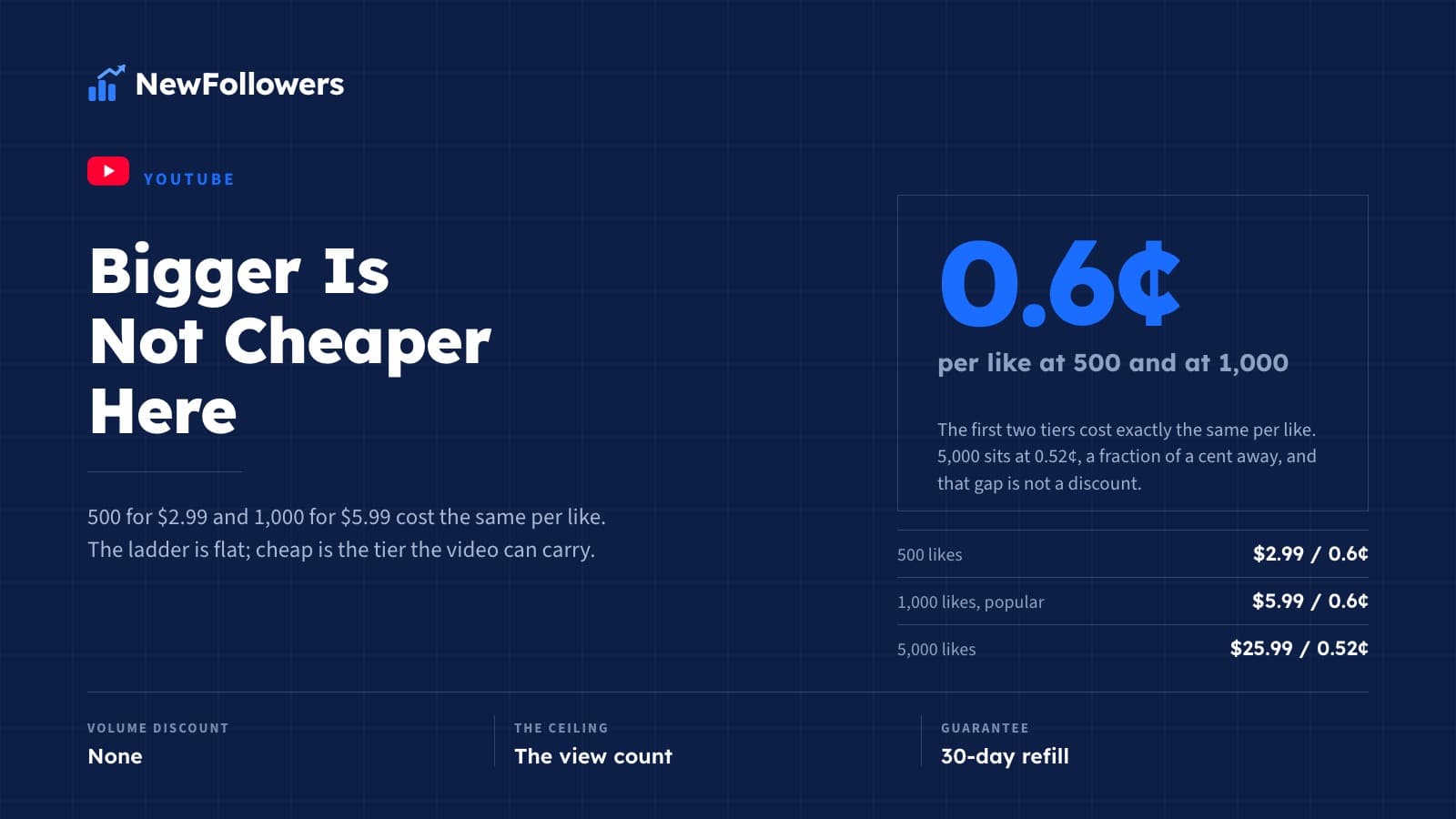
Cheap YouTube likes on this site are 500 for $2.99, 1,000 for $5.99 and 5,000 for $25.99, which is 0.6¢, 0.6¢ and 0.52¢ per like. The ladder is flat: a bigger package does not make each like cheaper here. What "cheap" should mean on a likes order is the smallest tier that sits comfortably under the video's view count, and that is the question the rest of this article answers.
The Ladder Does Not Slope
Three packages, each delivered to one public video link:
Read the per-like column and there is almost nothing to read. The first two tiers cost exactly the same per like. The largest sits within a fraction of a cent of the other two, and that gap is not a discount: nothing on this ladder rewards the bigger order, and 0.52¢ is not a reason to choose 5,000 over anything.
That is not how most ladders behave. The views ladder on this site falls as the package grows, and the cheap YouTube views post is mostly about reading that fall. Likes are not sold that way here. Each package is priced by its count and nothing else, and the YouTube likes page shows the three prices on the tiers before you pay, against a video link and never a login.
It is worth saying plainly because it changes what a bargain hunter should do next. There is no larger package to reach for in the hope that each like costs less. There is only the question of which count the video needs.
What Flat Does Not Mean
Flat is not the same as expensive. $2.99 is the smallest sum on the ladder, and the rate at that tier is the same rate the popular tier gets. Nobody is paying a premium for ordering small, which on a sloping ladder is exactly what the smallest tier does.
Flat also does not mean there is a wrong tier on price. There is not. Any of the three is the same fair rate, and the receipt will not punish you for picking one over another. The only wrong tier is the wrong size, and that is a question the price cannot answer for you.
The Lever That Is Not Here
Most people who type "cheap" into a search for likes are looking for a lever, and the lever they expect is volume. Buy more, pay less per unit. It is how views are sold, how most bulk goods are sold, and it is a fair thing to expect.
On this ladder the lever is disconnected. Pulling it buys more likes, not cheaper ones. Moving from 500 to 1,000 costs the same per like; moving from 1,000 to 5,000 shifts the per-like figure by a fraction of a cent, which nobody would notice on a receipt. What changes between the tiers is the count landing on the video, and that count is the thing the video has to carry afterward.
So the sensible reading of "cheap" turns inward. It stops being about the rate and becomes about the order: the cheap purchase is the one where none of the likes were wasted on a video that could not hold them. On a sloping ladder you could at least argue that an oversized tier bought a discount. Here it bought nothing but a bigger number.
Cheap Is a Ratio, Not a Rate
YouTube prints the like count on the watch page, beside the view count and under the title. It is not on the thumbnail and it is not in the search result. Whoever reads it is already watching, and they read it next to the view count because the two figures sit side by side.
That placement is what makes sizing matter. Every like was left by someone who opened the video, so a like count is read as a share of the view count whether or not anyone does the division. A like count that runs close to the view count says almost everyone who opened the video pressed the button, which is not a shape anyone who uses YouTube has seen. A like count that exceeds the view count is a number that could not have arrived on its own, printed on the same line as the figure that proves it.
The view count is therefore the ceiling on any order, and the cheap order is the smallest tier that sits well under it. The guide to buying YouTube likes from real users treats the like-to-view ratio as a quality signal. This post treats it as a price signal, because on a flat ladder it is the only thing that separates a cheap order from an expensive one.
Three Tiers Against a View Count
Put the ladder next to the video and the choice mostly makes itself.
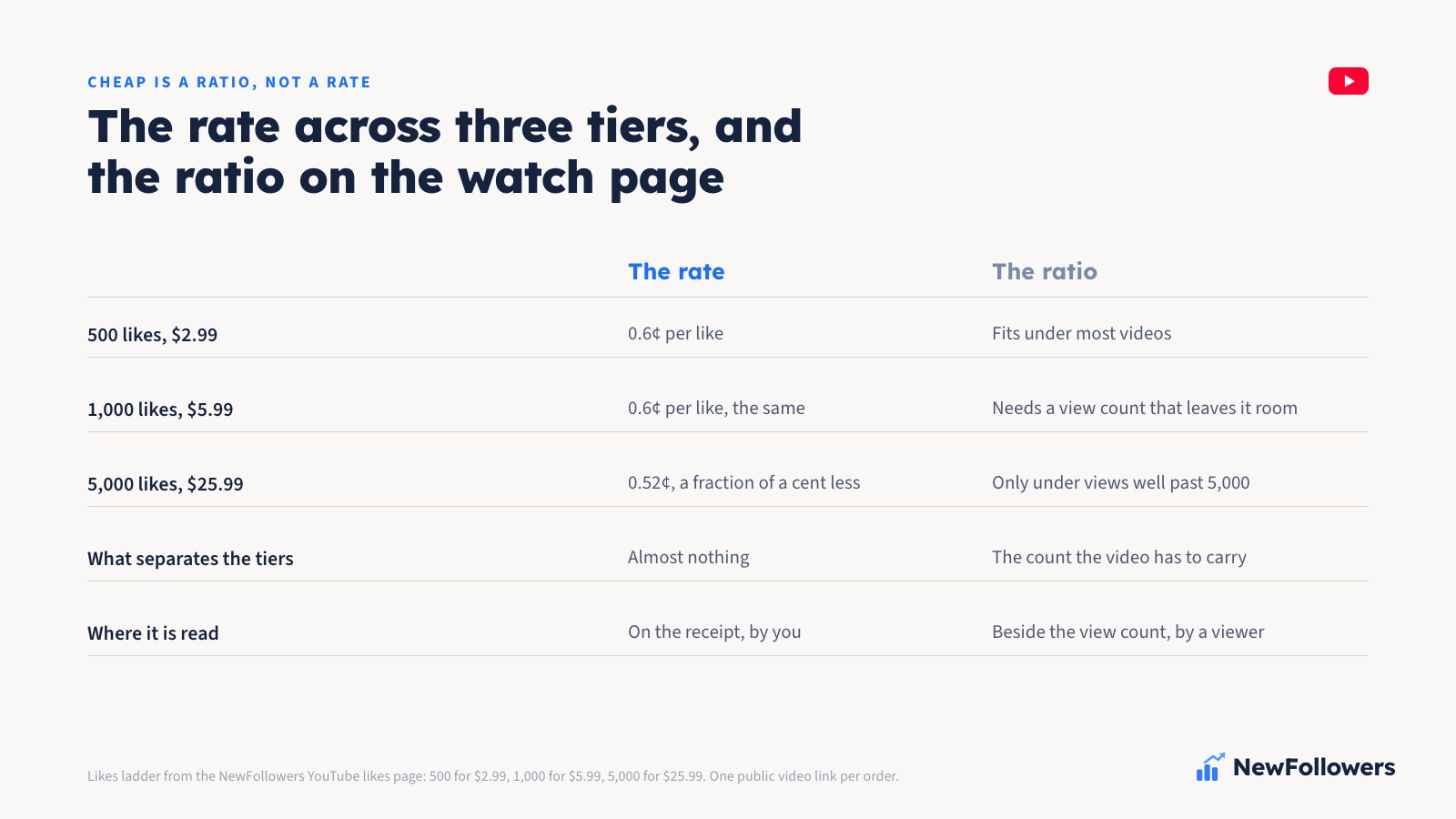
The arithmetic is not hard. The mistake is skipping it because the per-like price looked like the thing to compare.
Why $2.99 Is Usually the Right First Order
Since 500 and 1,000 cost the same per like, starting small carries no penalty. There is no discount left on the table by ordering 500 for $2.99 and looking at the result before deciding whether the video needs more.
Each order is a one-time delivery to one link. Nothing renews, nothing recurs, and a second order is a second decision made with the first one visible on the page. For most videos the first order is also the last, because 500 likes under a healthy view count already does the job a like count has, which is to tell someone who is watching that other people thought the video was worth the tap.
The 5,000 tier exists for the video that can carry it. It is not the tier for the video that might, one day.
What Every Tier Includes
The three packages differ in count and in nothing else. Each comes with the same terms:
None of those is cheaper at 5,000 than at 500, and none is missing at $2.99. What the price buys is the same at every tier; only the count changes.
Reading a Lower Price Through the Ratio
A listing well under 0.52¢ per like usually gets there by being bigger. The headline rate is real, and the minimum order it is attached to is large. That is the first thing to check, and the ratio is how to check it: run the seller's minimum against your video's view count. If the minimum is larger than the view count, the rate is irrelevant, because the order cannot go on the video without exceeding the figure printed beside it.
Two more things, briefly. Ask what the order form takes; a like needs a public link, and a form that asks for your Google sign-in is asking for something the delivery never uses. And ask for the delivery window in hours or days, because a seller who cannot name one is telling you that pacing is not part of the product.
Below cheap is free, and the free YouTube likes post walks through what exchange sites and trials hand out in place of a price. The short version is that the ratio test fails hardest there, because the count you get is whatever the site decides rather than a size you chose against the video.
Order Against the Video, Not the Ladder
Open the video and copy the link from its own watch page. Note the view count printed beside the like count. Pick the tier that sits well under it, which for most videos is 500 for $2.99 and for some is 1,000 for $5.99. Reach for 5,000 for $25.99 only when the view count is already far past it, and never because 0.52¢ is a smaller figure than 0.6¢.
The same word gets read for other counters. The cheap Instagram likes and cheap TikTok likes guides cover their own ladders, and those ladders have their own shapes. This one is flat, so the price does not reward the bigger order, and the only saving on offer is the one you make by not buying likes the video cannot carry.
Frequently Asked Questions
Does buying more YouTube likes lower the price per like?
No. 500 likes cost $2.99 and 1,000 cost $5.99, which is 0.6¢ per like either way, and 5,000 for $25.99 comes to 0.52¢, a fraction of a cent apart. The ladder is flat and carries no volume discount, so a bigger package should be chosen for the count the video can carry, not for the rate.
If bigger is not cheaper, which YouTube likes package is the cheap one?
The smallest tier that sits well under the video's view count. For most videos that is 500 for $2.99, and since it costs the same per like as the 1,000 tier, nothing is lost by starting there. On a flat ladder the expensive order is the oversized one, whatever it cost per like.
Can a video's like count be higher than its view count?
Not on its own. Every like is left by someone who opened the video, so the like count is read as a share of the view count, and the two figures are printed side by side on the watch page. A 5,000-like order under a video that has not reached 5,000 views produces a number that could not have arrived by itself.
How do I check whether a tier fits my video before I pay?
Open the video, read the view count beside the like count, and ask whether the tier would still look like a share of it once delivered. 500 fits under most videos. 1,000 needs a view count that leaves it room. 5,000 belongs only under a video whose views run well past it. The delivery window for the tier you pick is shown at checkout before you pay.
Can I order 500 likes now and more later?
Yes. Each order is a one-time delivery to one video link, nothing renews, and a second order is a second decision. Because 500 and 1,000 cost the same per like, there is no discount lost by ordering $2.99 first and looking at the result before deciding whether the video needs more.
A cheaper listing has a large minimum order. Does the lower rate still matter?
Run the minimum against your video's view count first. If the minimum is larger than the view count, the rate is irrelevant, because the order cannot go on the video without exceeding the figure printed beside it. Then ask what the form takes, which should be a public link and never a Google sign-in, and ask for the delivery window in hours or days.
What is the same across all three YouTube likes packages?
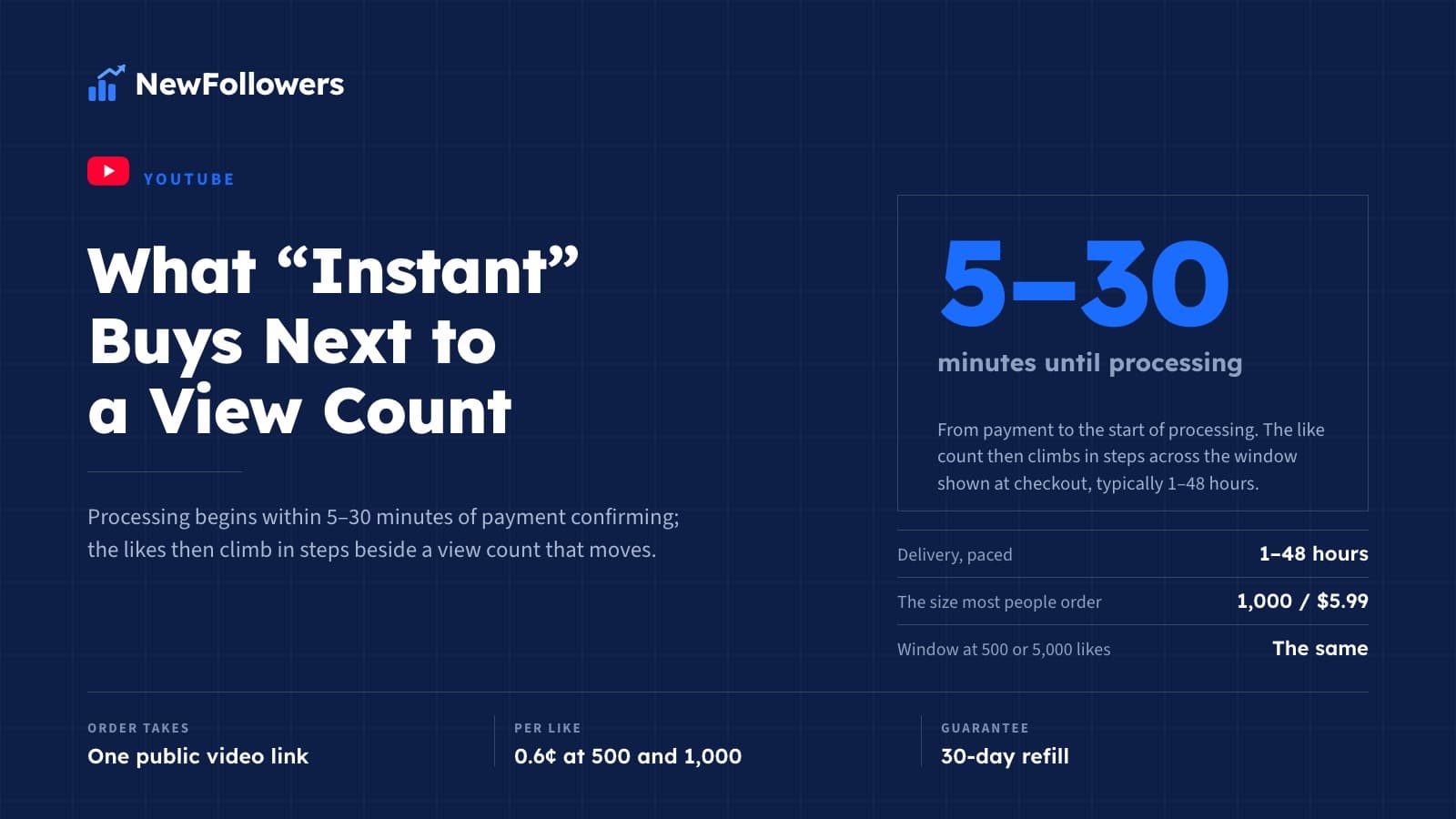
Everything except the count. Each order takes a public video link and an email, never a password. Orders begin processing within 5–30 minutes of successful payment confirmation, and delivery is gradual and spread over the timeframe shown at checkout, typically 1–48 hours depending on package size. A shortfall within 30 days of completion is refilled at no charge, and nothing is promised about what YouTube does afterward.
Ready to Grow Your Social Media?
Real followers, instant delivery, 30-day refill guarantee. Pick your platform: