What Does DW Mean? Don't Worry, and When It Means the Opposite
Quick Answer
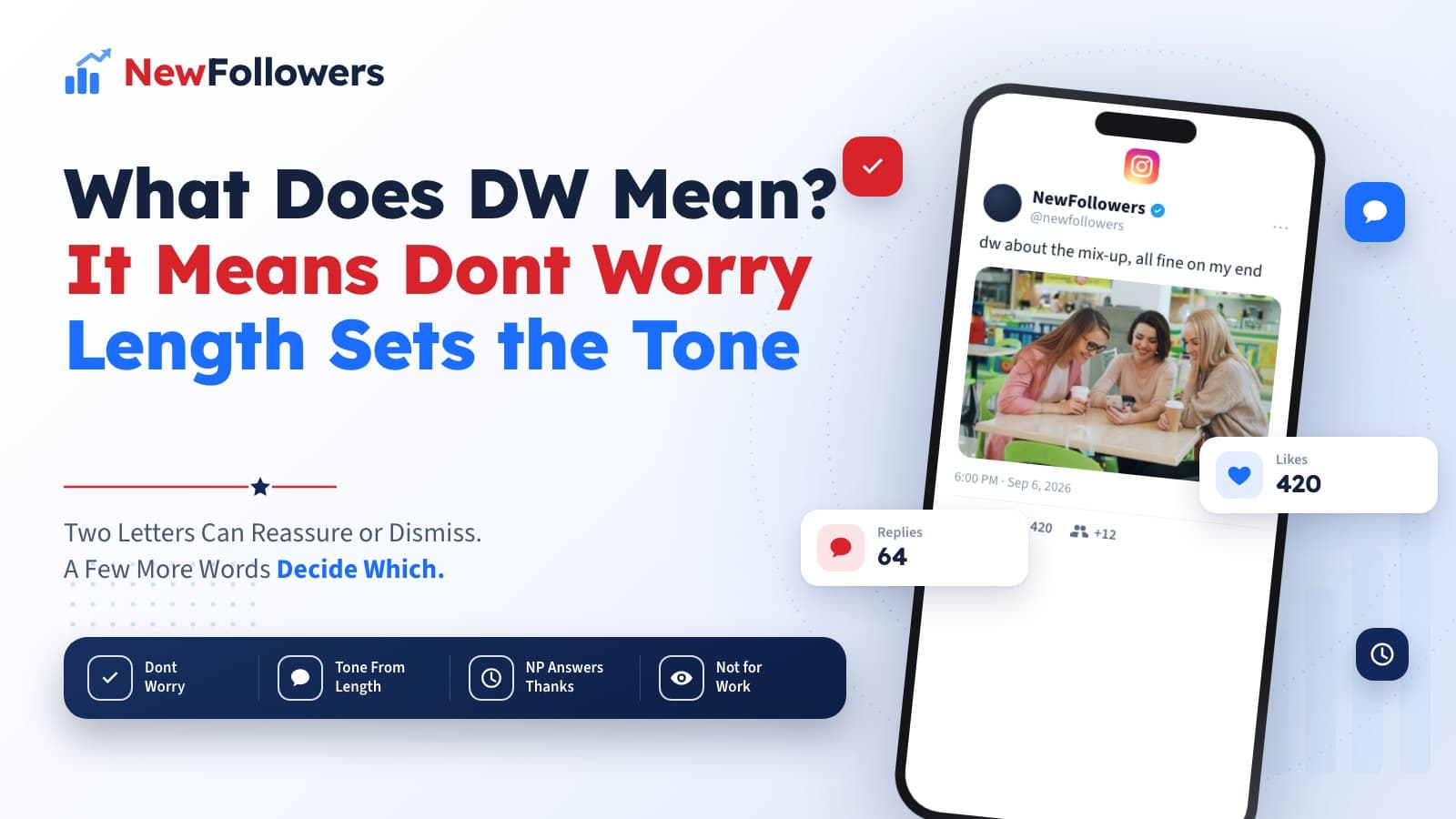
DW means "don't worry". It is used to reassure someone, wave off an apology, or close a small problem: "dw about it", "dw i got you". The tone depends entirely on what surrounds it. Warm when it follows an apology, dismissive when it arrives alone in a tense conversation, since a bare "dw" can read as ending the subject rather than resolving it. In some contexts DW also stands for Doctor Who or for dishwasher in listings, but in messages it is don't worry almost every time.
Anyone asking what does DW mean has usually just been sent it and is trying to read the tone. The literal expansion is easy, and it is not really the question. What people actually want to know is whether the two letters were kind or cold, and that depends on more than the letters.
This guide covers the meaning, the three ways it gets used, how the tone shifts, and the situations where the same two letters mean something else entirely. It is written by NewFollowers, a social media growth service, which is to say we spend a lot of time reading messages for a living.
What Does DW Stand For?
Don't worry. It is a compression of an ordinary phrase rather than slang with a hidden meaning, which is why it slots into sentences the same way the full phrase would.
You will meet it in three broad jobs.
The main uses of DW include:
In every case it does the same underlying work: it tells the other person that whatever they were carrying, they can put down.
Why the Tone Varies So Much
This is the part worth understanding, because the same two letters can land warmly or coldly.
A bare "dw" with nothing after it is short by definition, and shortness in a tense conversation reads as distance. If someone has written a long apology and receives "dw" back, the brevity can feel like the subject is being shut down rather than forgiven. The sender usually did not intend that; they meant it is fine and were being efficient.
The same message with three more words is unambiguous. "dw about it, fine" or "dw i wasn't annoyed" carry the reassurance the bare version only implies.
So the practical rule is proportion. If what you are waving off was small, DW alone is fine. If the other person clearly invested something in the message, matching a little of that length is what makes the reassurance land.
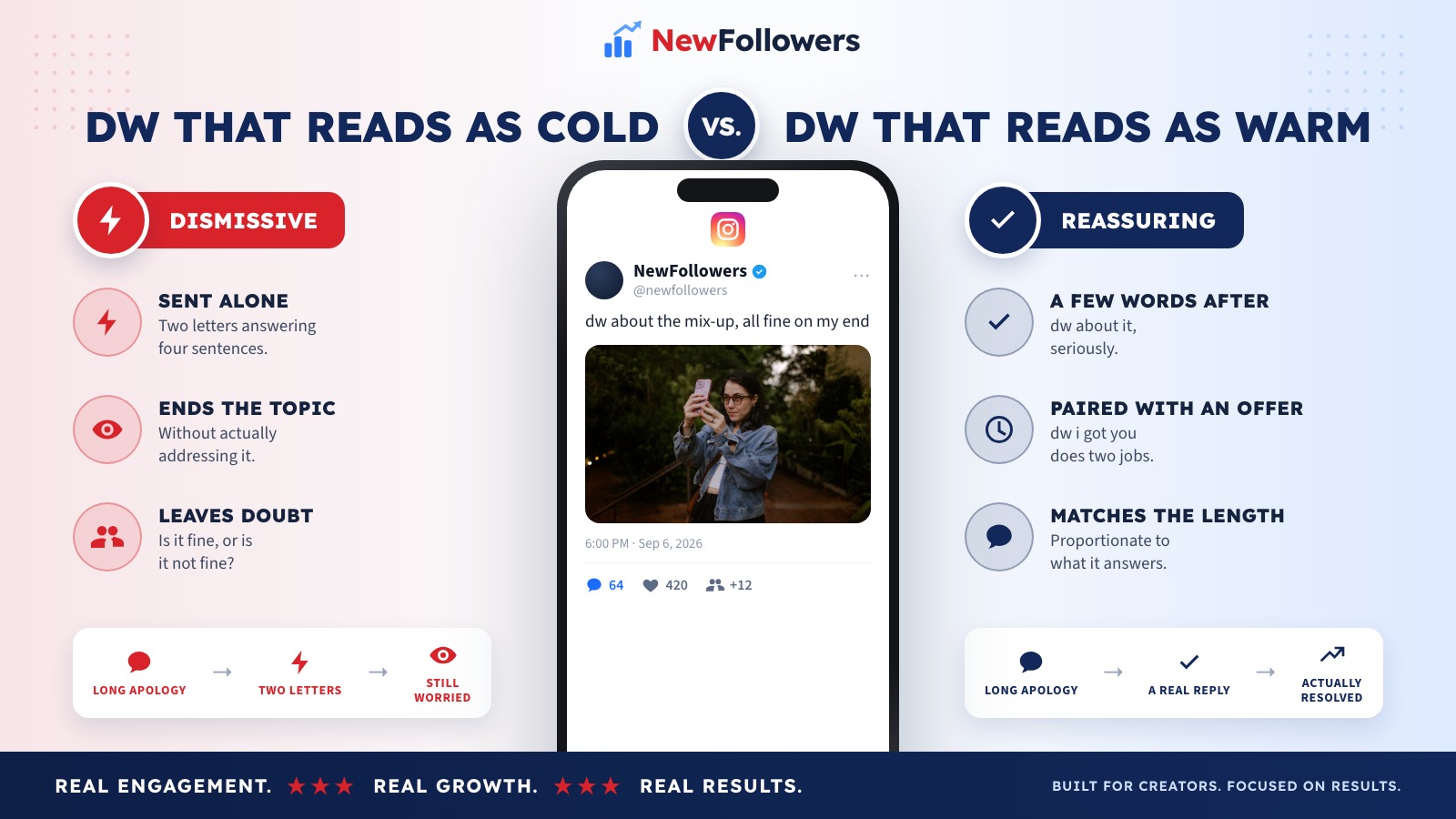
Warm vs. Dismissive
The same two letters, read two ways.
DW that reads as warm
DW that reads as dismissive
Neither column is about the sender's intent, which is usually kind in both. It is about how a very short message reads on the other end, which is worth a moment's thought when the subject matters.
DW, NP and NVM
Three short closers that get mixed up, with a clean division of labour.
DW is don't worry. It answers worry, apology or fuss. Someone says sorry, you say dw.
NP is no problem. It answers thanks. Someone says thank you, you say np. Using dw here works but is slightly off, because nobody was worried, they were grateful.
NVM is never mind. It withdraws something the sender said themselves, usually because they answered their own question. It is not a reassurance at all, and it can read as mild frustration.
Getting these right is a small thing that makes short messages read more naturally.
When DW Means Something Else
Two contexts where the expansion changes, both obvious from the surroundings.
Doctor Who. In fandom conversations DW is the show, and the messages around it will be about episodes, doctors, companions or actors rather than about reassurance. No real ambiguity arises.
Dishwasher. In marketplace and property listings, DW abbreviates dishwasher alongside other appliance shorthand. Again, the context is unmistakable: nobody reassures you in a rental listing.
Some workplaces also use DW for internal terms, which is one more reason the abbreviation is a poor choice in professional writing.
Related Acronyms Worth Knowing
DW sits among a small vocabulary that appears in the same conversations.
WSG means what's good, covered in what WSG means.
PMO means put me on or piss me off depending on position, explained in what PMO means.
FYP is TikTok's For You Page, covered in what FYP means.
PFP is a profile picture, covered in what PFP means.
OTP usually means one true pairing, explained in what OTP means.
ik means I know, istg means I swear to God, tbf means to be fair, and lmk means let me know. All four turn up beside DW constantly.
How to Use DW Well
Five short rules that cover nearly every case.
Add a few words when it matters
"dw about it" is fine for something small. Anything the other person clearly worried about deserves a sentence.
Use NP for thanks and DW for worry
The distinction is small and it makes messages read more naturally.
Do not use it to end an argument
A bare DW in a real disagreement closes the topic without resolving it, and the other person will read that accurately.
Keep it out of work writing
Don't worry takes a second longer to type and never reads as careless.
Pair it with an offer when you can
"dw i got you" is the warmest form because it does two things at once: it reassures and it helps.
Why Consider NewFollowers?
A note on the source. NewFollowers is a social media growth service covering Instagram, TikTok, YouTube, X, Facebook and Twitch. This page is a glossary entry with nothing to sell.
If you landed here while getting to grips with a platform you also want to grow on, the guide to how the TikTok algorithm works is the more useful read, since it explains the feed that spreads most of this vocabulary. The Instagram page covers the paid services if that is what you are researching, and those pages say plainly that buying engagement is against platform rules.
Common Mistakes to Avoid With DW
Sending it alone after a long apology
Two letters answering four sentences reads as dismissal even when it is not meant that way.
Using it to close a real disagreement
DW ends a topic. It does not resolve one, and the difference is visible to the person on the other end.
Using it where NP belongs
Answering thanks with don't worry is slightly off. Nobody was worried.
Writing it at work
It reads as careless in professional contexts, and in some workplaces it means something else entirely.
Assuming tone carries
Short messages lose tone. If the reassurance matters, spell a little of it out.
Reading a bare DW as hostile
The sender was usually being brief, not cold. If you are unsure, asking is cheaper than assuming.
Final Thoughts
DW means don't worry, and it does three jobs: waving off an apology, reassuring someone anxious, and signaling that something is handled. The expansion is the easy half of the question.
The half worth knowing is that its tone comes from its length. A bare DW after something small is friendly and efficient. The same two letters answering a long, careful message can read as closing the subject rather than settling it, which is rarely what the sender meant. A few extra words fix it entirely.
If you are working through the rest of the shorthand, WSG, PMO, FYP, PFP and OTP each have their own guide here.
Frequently Asked Questions
What does DW mean?
Don't worry. It is used to reassure someone, dismiss an apology, or close off a small problem, as in "dw about it" or "dw i already sorted it".
Is DW rude?
Not by itself, but it can land that way. A bare "dw" with no follow-up in a tense conversation can read as shutting the subject down rather than resolving it. Adding a few words removes the ambiguity.
How do I reply to DW?
Usually no reply is needed, since it is closing a topic. If someone reassured you about something you apologised for, a short thanks works. If it followed an offer of help, confirm whether you still need it.
What is the difference between DW and NP?
NP is no problem and responds to thanks. DW is don't worry and responds to worry or apology. If someone thanks you, NP fits. If someone apologises or frets, DW fits.
What does DW about it mean?
Don't worry about it. It waves off whatever the other person raised, whether an apology, a favor or a mistake, and signals the matter is closed as far as the sender is concerned.
Does DW mean Doctor Who?
In fandom conversations, yes. Context makes it obvious, since the surrounding messages will be about episodes, characters or actors rather than about reassurance.
Does DW have other meanings?
In marketplace listings DW sometimes abbreviates dishwasher, and in some workplaces it stands for other internal terms. Outside those niches, don't worry is the reading in messages.
Is DW formal enough for work?
No. Like most texting shorthand it belongs in casual messages. In a work context, writing don't worry in full costs nothing and avoids reading as careless.
What does dw i got you mean?
Don't worry, I have taken care of it, or I will. It combines reassurance with an offer of help and is a warmer construction than DW alone.
What related acronyms should I know?
WSG means what's good, PMO means put me on or piss me off depending on position, FYP is TikTok's For You Page, PFP is a profile picture and OTP usually means one true pairing. Each has a guide on this site.
Ready to Grow Your Social Media?
Real followers, instant delivery, 30-day refill guarantee. Pick your platform: