Stormlikes Review: It Does Not Sell Likes Any More, and What That Means
Quick Answer
Stormlikes is no longer a service that sells Instagram likes. Checked in September 2026, stormlikes.net describes itself as an independent editorial research site about social media growth services, covering Instagram, TikTok, YouTube, Facebook, SoundCloud and Twitch, and states plainly that it does not sell these services and that vetted providers are linked through disclosed affiliate links. So if you arrived looking to buy likes from Stormlikes, there is nothing to buy: what you will find is research pages, and the provider links on them earn the site a commission. That disclosure is more than most comparison sites offer, but an affiliate link is still a paid recommendation, and it should be read as one.
Most people searching Stormlikes are looking for a shop. The name was one of the better-known places to buy Instagram likes, it appears in years of listicles and forum threads, and the reasonable assumption is that typing it into a search bar leads to a checkout. It does not, at least not any more, and that is the single most useful thing this guide can tell you before you spend any more time on it.
This guide is written by NewFollowers, which sells competing growth services, and that conflict is worth naming at the top. What follows is limited to what stormlikes.net itself says, read in September 2026, and to a framework for reading any provider comparison, including the ones on that site and the one you are reading now. Where something is unknown, this guide says so.
What Is Stormlikes Now?
An editorial site about the market it used to be part of.
Its homepage describes it as an independent editorial research site about social media growth services, and says it documents how buying likes, followers, views and plays interacts with each platform's ranking systems across Instagram, TikTok, YouTube, Facebook, SoundCloud and Twitch. The disclosure is placed in the same paragraph: it does not sell these services, and vetted providers are linked via disclosed affiliate links.
The content is structured as research guides rather than product pages, with articles on things like how Instagram weights likes by the account delivering them, why bought views that never watch can work against a TikTok video's distribution, and what YouTube reviewers look at during a monetization review. Each carries an update date.
What the site offers a reader includes:
What it does not offer is a way to buy anything directly. There is no basket, no package list and no checkout.
Why This Matters If You Came to Buy
Two practical consequences follow, and they point in different directions.
The first is simply that you need to look elsewhere for the purchase. Whatever you remember about Stormlikes as a seller, the transaction is not there now, so the decision in front of you is which provider to use rather than whether to use this one.
The second is subtler and more useful. A site that earns commission on provider links is not a neutral referee, however good its research is. That is not an accusation; it is the structure. Affiliate publishing pays when a reader clicks through and buys, which means the incentive runs toward recommending providers that convert and pay well, not necessarily the ones that would serve you best. Stormlikes discloses this, which puts it ahead of the many comparison sites that do not, but disclosure changes what you know rather than how the incentive works.
Reading a Comparison Site vs. Reading a Provider
Both are trying to sell you something. Knowing which is which makes both more useful.
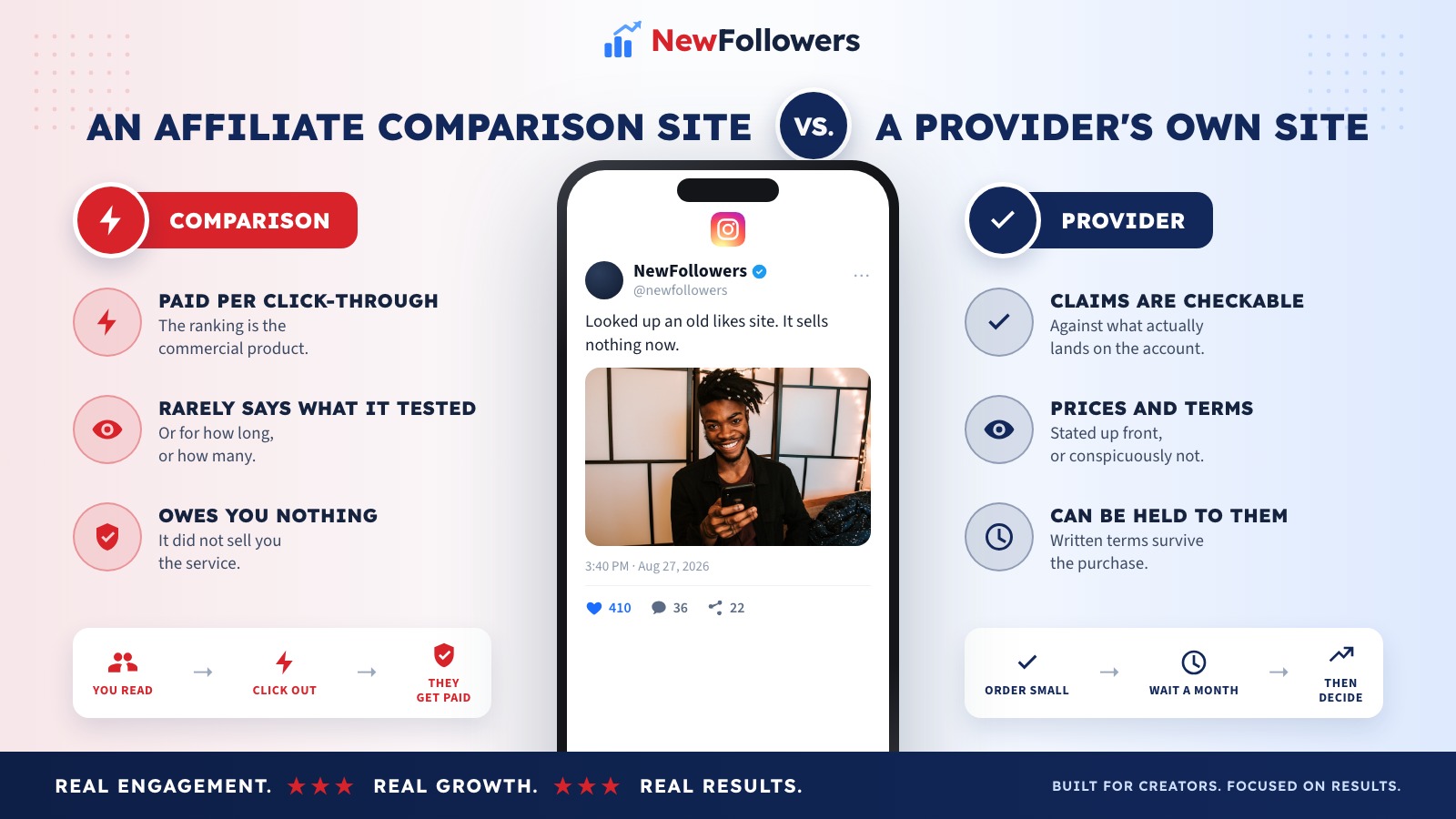
An affiliate comparison site
A provider's own site
Neither column is the villain. The mistake is reading the left one as independent and the right one as neutral. Both are commercial; they simply monetize at different points.
How to Judge Any Provider Review
Three questions do most of the work, and they apply to this page as much as to any other.
Does it disclose how it makes money? Affiliate commission, its own product, or advertising. A review that never mentions revenue is not free of an incentive, it is just not telling you what the incentive is.
Does it separate what was verified from what was assumed? A useful review says where each claim came from. When it quotes a provider's site, it should say so, because a company's own figures are claims rather than measurements.
Does it say what it could not check? Retention after thirty days, refund handling, and where accounts come from cannot be established from outside. A review confident about all three has either run tests it is not describing or is filling gaps with plausible writing.
By that standard the useful part of a site like Stormlikes is its platform research, which can be checked against the platforms' own published rules. The ranked provider lists are where the commercial pressure concentrates, and they deserve independent verification.
What the Platform Rules Say, Whoever You Buy From
This does not change with the provider, the comparison site, or the price.
Meta's Spam Community Standard prohibits attempting to or successfully selling, buying or exchanging engagement such as likes, shares, views and follows. TikTok's Community Guidelines prohibit fake engagement, including trading or marketing services that artificially increase likes, followers or views. YouTube's fake engagement policy states that it does not allow anything that artificially increases the number of views, likes, comments or other metrics, and adds that three strikes within 90 days may result in channel termination.
A well-run provider reduces the practical risk that a delivery is obvious or removed in a sweep. No provider, and no comparison site's endorsement, changes the policy. Any page claiming a service is platform-approved is describing something that does not exist.
U.S. Businesses Should Also Understand FTC Considerations
Two parts of the FTC's rule on consumer reviews and testimonials are relevant on a page about a comparison site.
The first is the part this whole market runs into: the rule prohibits buying or selling fake indicators of social media influence when the buyer knows or should know they are fake and uses them to misrepresent influence for a commercial purpose. Followers and likes are named among those indicators, so a business citing bought numbers as evidence of its audience is doing what the rule targets.
The second concerns the reviews themselves. The rule addresses deceptive review practices, and the FTC has long required that a material connection between an endorser and a seller be disclosed clearly. An affiliate relationship is a material connection. A comparison site that discloses it, as Stormlikes does, is doing the thing the rules expect; one that ranks providers without mentioning commission is not.
What to Do If You Actually Wanted to Buy Likes
The checks are the same regardless of which provider you land on.
Never share a password. Delivering likes to a public post needs the link and nothing else. A login request means the service is acting as your account, which every platform's terms prohibit.
Look for prices before payment. A provider that reveals cost only after you enter card details is telling you something.
Ask how delivery is paced. Likes arriving in one burst on a post with few views is the pattern that gives an order away. Sized and spread is what you want.
Get the refill terms in writing. Accounts drop on every platform. What matters is whether the remedy is defined and time-bound.
Order small and wait a month. The only reliable test. The guides to buying cheap Instagram likes and buying likes without a password cover what the low end of the market actually delivers and how a safe order is placed.
Why This Market Has So Many Comparison Sites
It is worth understanding the shape of what you are reading when you research this category, because it explains why every search returns the same kind of page.
Growth services pay affiliate commission, the products are cheap enough to buy on impulse, and the buyers are motivated and largely unable to verify quality before purchase. That combination is close to ideal for affiliate publishing, so the search results fill with ranked lists rather than tests. The pages are cheap to produce, they rank on brand names people already search, and each click through is worth money.
The consequence for a reader is structural rather than sinister. When most of the available writing about providers is commission-funded, the scarce thing is not opinion but verification: someone who actually ordered, waited a month and reported what stayed. Almost nobody does that, because it costs money and produces a less flattering article than a top-ten list.
Which points at the only reliable move available to you. Treat every ranking, including any published by a provider like this one, as a starting point rather than a finding, and spend a few dollars proving it yourself.
Do Bought Likes Do Anything?
Worth answering directly, since it is the underlying question behind the original search.
They change how a post reads to a human. A visitor who sees a plausible like count treats a post as more worth their attention than one with two likes, and for a business page about to be looked at by customers that difference is real, if modest.
They do not create reach. Every platform decides distribution from what the people who see a post actually do: watch, save, share, comment, return. A like from an account that did none of those adds nothing to that calculation, and a like count that outruns the view count is a mismatch both the platform and your visitors can see.
So the realistic use is narrow: a small, paced order sized to what the post already earns, treated as appearance rather than growth. Anything larger is visible, and nothing bought substitutes for posting things people want to see.
How to Get Likes Without Buying Them
The free version costs time and is the only one that produces likes with viewers behind them.
Post the format that reaches non-followers
Reels, TikToks and Shorts are shown to people who do not follow you. Every other format mostly reaches the audience you already have.
Earn the first three seconds
Retention decides reach and reach decides likes. Lead with the point and let the setup follow.
Ask once, after you have delivered something
An ask at the end of a video that just helped someone works. An ask at the start, before anything has been earned, trains people to ignore it.
Reply to comments
An active comment section produces more comments and gives you material for follow-up posts, which get their own distribution.
Post consistently enough to have a baseline
Without a steady cadence there is nothing to compare against, so you cannot tell whether anything you tried, paid or free, actually changed the numbers.
Track likes per view, not likes
The rate is the number platforms read. Watching it tells you which posts actually worked, which is a better guide to the next one than any provider comparison. The guide to what happens after buying followers covers the same question for follower counts.
Why Consider NewFollowers?
NewFollowers is a provider rather than a comparison site, and it competes with the services Stormlikes links to. That is the conflict, stated plainly, and this section is the only part of this guide making a case for anything.
The relevant difference from an affiliate ranking is accountability. A comparison site that recommends a provider has no obligation to you if the delivery goes badly; the provider does. NewFollowers publishes prices before payment on the Instagram page, takes orders with a username or link and never a password, paces delivery from existing accounts rather than dumping it, and covers drops with a 30-day refill guarantee. The cheap followers page explains how low-cost delivery is paced rather than dumped.
Its core product is followers across six platforms. For likes specifically, confirm what is currently offered and on what terms on the platform page before ordering. Buying any metric remains a platform-policy risk under the rules quoted above, and the recommendation in this guide holds even when it points away from a sale: order small from whoever you choose, and watch for a month.
Common Mistakes to Avoid
Assuming a familiar brand still sells what it used to
Services in this market change hands, pivot and close. Stormlikes is the clearest example: a name people still search as a shop that is now a publisher.
Reading an affiliate ranking as a test result
A ranked list on a commission-funded site is a commercial product. The research around it may be excellent; the ordering is where the incentive lives.
Taking a provider's own rating as independent
Company-published ratings are claims. They may be accurate, but they are not outside verification.
Ordering large before testing small
A few dollars and a month of watching tells you more than every review of this market combined.
Believing any provider is platform-approved
None are. Every major platform prohibits buying engagement, and a seller claiming otherwise is misrepresenting the rules.
Using bought likes on content a customer might read as proof
For a U.S. business that is where the FTC rule bites. Keep added engagement off product posts and out of pitch decks.
Final Thoughts
People search Stormlikes expecting a place to buy Instagram likes, and the useful finding is that the site is not that any more. As of September 2026 it presents itself as an independent editorial research project covering six platforms, and it states in its own words that it does not sell these services and links vetted providers through disclosed affiliate links.
That disclosure is worth more than it might appear. Most comparison sites in this market are funded exactly the same way and never mention it. Knowing how a page earns its money does not make its research wrong, and the platform explanations on a site like that can be useful, but it does tell you which parts to verify: the rankings, not the reasoning.
If the purchase is what you came for, the checks do not change with the brand. Never share a password, insist on published prices, ask how delivery is paced, get refill terms in writing, and order small before ordering again. And keep the underlying limit in view: every platform prohibits buying engagement, bought likes change appearance rather than reach, and the only method that compounds is posting things people want to see.
Ready to explore your options? Visit NewFollowers to review the currently available growth services for all six platforms and choose an approach that fits your audience, your goals and your appetite for risk.
Frequently Asked Questions
Can you still buy likes from Stormlikes?
No. Checked in September 2026, stormlikes.net presents itself as an independent editorial research site and states that it does not sell these services, linking vetted providers through disclosed affiliate links instead. There is no checkout on the site.
What is Stormlikes now?
A research and comparison site about buying social media engagement. It publishes guides on how bought likes, followers, views and plays interact with each platform's ranking systems, covering Instagram, TikTok, YouTube, Facebook, SoundCloud and Twitch.
Does Stormlikes make money from its recommendations?
Its own disclosure says vetted providers are linked via disclosed affiliate links, which means it earns a commission when a reader clicks through and buys. Disclosing that is better practice than hiding it, but the recommendations are still commercially funded.
Should I trust an affiliate comparison site?
Read it as informed opinion with a financial interest attached, not as a neutral test. The useful parts are the explanations of how platforms treat bought engagement. The ranked provider lists are where the commercial incentive is strongest, so verify those independently.
Why did Stormlikes stop selling likes?
The site does not say, and this guide will not speculate. What can be verified is what the site is today: an editorial project that links to providers rather than selling anything itself.
Is Stormlikes safe to use?
As a site to read, there is nothing to lose because there is no checkout and no account to connect. The risk moves to whichever provider you click through to, which is where the ordinary checks apply: never share a password, look for published prices and written refill terms.
What should I do if I wanted to buy likes?
Apply the same checks you would to any provider: it should need only a post link, publish prices before payment, describe how delivery is paced, and put refill terms in writing. Then order small and watch what happens over a month before spending more.
Are bought likes against the rules?
Yes, on every platform. Meta's spam standard prohibits buying or exchanging engagement such as likes, TikTok's guidelines prohibit trading services that artificially increase likes, and YouTube's fake engagement policy prohibits anything that artificially increases likes or other metrics.
How do I judge a provider review?
Ask three things: does it disclose how it makes money, does it separate what it verified from what it assumed, and does it say what it could not check. A review that reads as uniformly positive about every provider it links is describing its commission structure.
Why consider NewFollowers?
NewFollowers is a provider, not a comparison site, which is a conflict worth stating. It sells followers on six platforms, orders are placed with a username, delivery is paced from existing accounts, prices are published before payment and drops are covered by a 30-day refill guarantee.
Ready to Grow Your Social Media?
Real followers, instant delivery, 30-day refill guarantee. Pick your platform: