Instagram Marketing Agency: What They Do, What They Charge and When to Hire One
Quick Answer
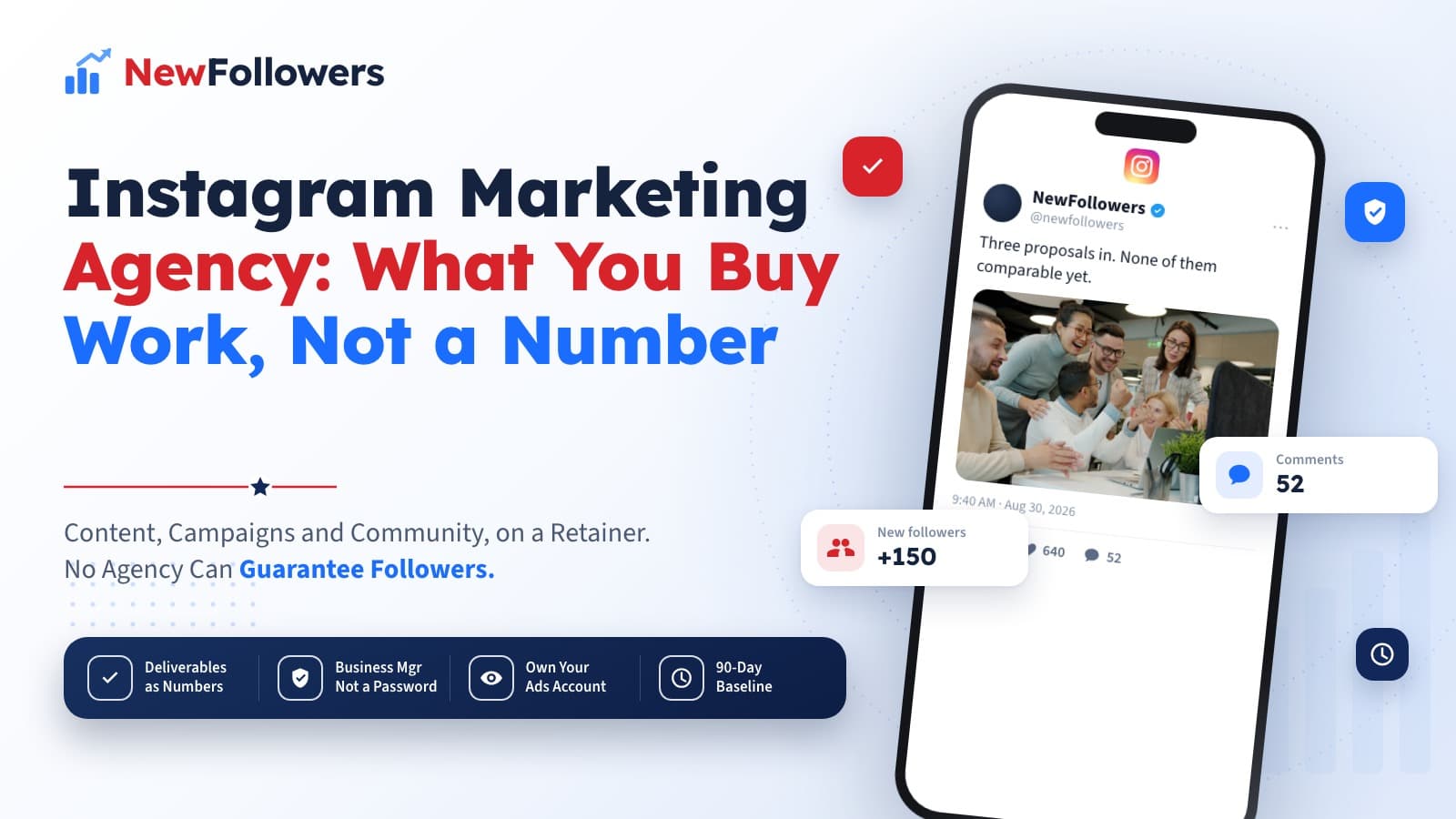
An Instagram marketing agency sells the work of running an Instagram account: strategy, content production, posting, community management and paid ads, usually on a monthly retainer. That is a different purchase from a growth service, which delivers followers or likes to an account you already run, and from an automation tool, which acts from your login and breaks Instagram's terms. Agencies bill for hours and media spend, so the fee scales with how much content is produced and how much ad budget is managed, not with follower counts. Hire one when you have a budget, an offer that converts and no capacity to produce content. Do not hire one expecting guaranteed followers, which no agency can promise.
The search for an Instagram marketing agency usually starts from the same place: the account matters to the business, nobody internally has time to run it properly, and the results reflect that. Hiring the problem out is a reasonable response, and it is also where a lot of money gets spent on the wrong thing, because three quite different products present themselves as the answer to that search.
This guide is written by NewFollowers, which sells growth services rather than agency work, so it has an interest in the distinction being clear. It also has no agency to sell you, which makes it easier to be direct about when hiring one is the right call and when it is not. What follows is what agencies actually do, how the money is structured, what to put in a contract, and the cases where the answer is to keep it in house.
What Does an Instagram Marketing Agency Actually Do?
The deliverable is work, not a number. That single sentence resolves most of the confusion in this market.
An agency takes over some or all of the ongoing labour an Instagram account requires. What that includes varies by engagement, and the scope is what the price is built from.
Services an agency typically provides include:
Notice what is absent. No agency line item says followers, because followers are an outcome of the work rather than a thing an agency holds in stock. Any proposal that lists a follower number as a deliverable is describing either purchased engagement or a promise nobody can keep.
Agency, Growth Service or Automation Tool?
Three products, three prices, three completely different risk profiles. Getting this wrong is the most expensive mistake in this whole category.
An agency produces content and runs campaigns. It costs the most, because it is people's time. It carries no platform-rules risk, since everything it does is what Instagram wants accounts to do.
A growth service delivers followers or likes to an account you already run. It is cheap by comparison and changes how the profile reads without producing anything. It breaks Meta's rules on buying engagement, which is a policy risk you accept knowingly or not at all. The guide to growth services sorts that market into its four kinds.
An automation tool logs into your account and follows, unfollows and likes on your behalf. It is sold as a cheap agency and is neither. Instagram's terms prohibit automated access and third-party credential use, and the practical consequence is action blocks. The guide to Instagram bots covers why this is the option to rule out first.
The trap is an agency retainer whose growth results quietly come from the second or third product. If a proposal promises follower growth without describing the content that would produce it, ask directly how the number will be reached.
An Agency vs. A Growth Service
Both get sold into the same moment of frustration. They are not substitutes.
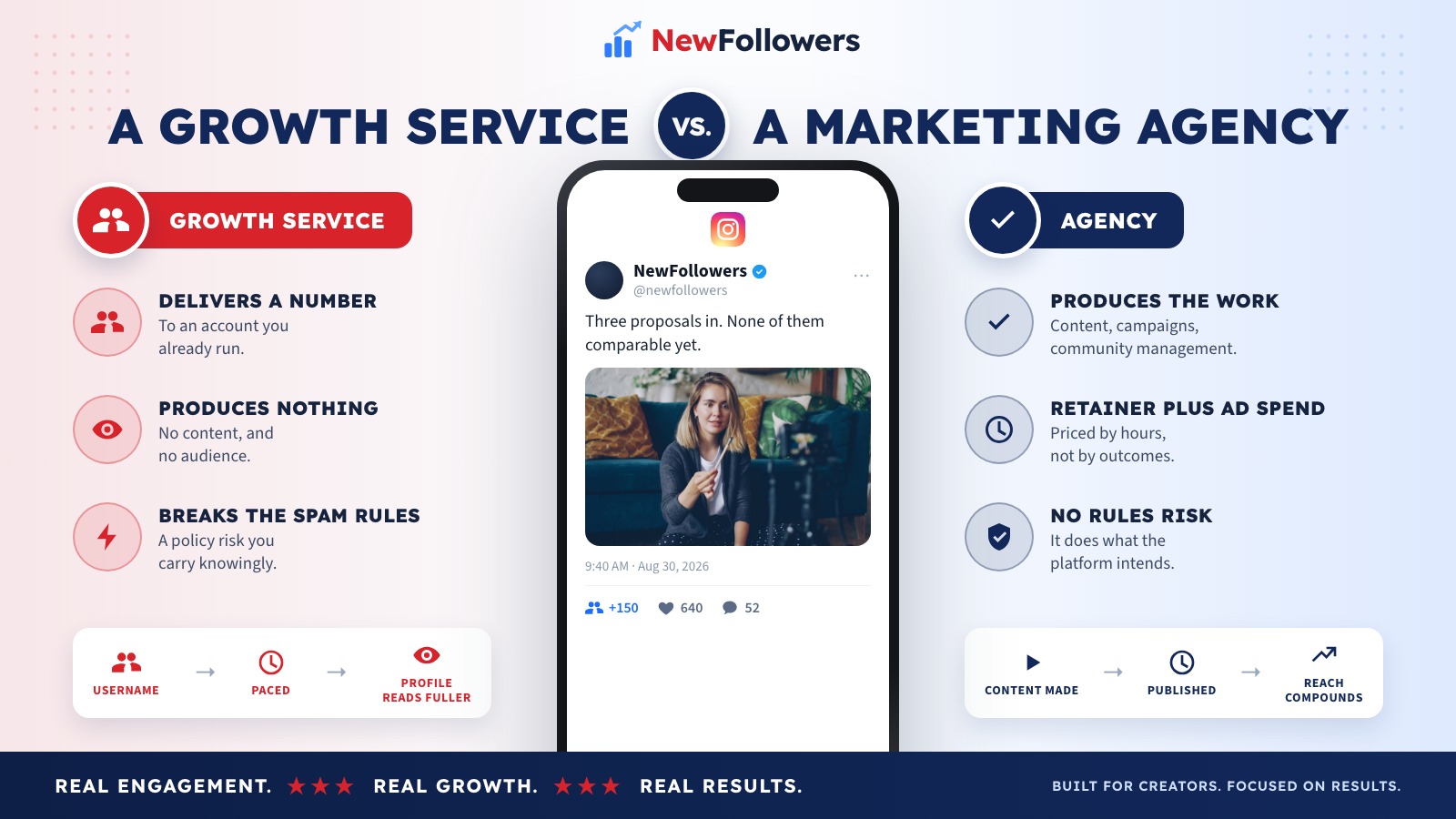
A growth service
An Instagram marketing agency
The honest framing is that these solve different problems. An agency answers "nobody is making the content". A growth service answers "the profile looks empty to visitors right now". If your problem is the first one, no package of followers will fix it.
How Agency Pricing Actually Works
Retainers look opaque from outside, and the structure underneath is straightforward once you know what to ask.
The fee is time. Agencies price by how many people work on your account and for how long. A retainer covering four reels a month costs less than one covering twelve, because the difference is production hours. This is why quotes vary so widely for the same-sounding service: they are not the same service.
Ad spend is normally separate. Media budget should be its own line, paid to Meta rather than to the agency, from an ads account you own. Some agencies charge a percentage of managed spend on top of the fee. Both models are normal; blending them into one number is not, because it hides what you are paying for.
Scope creep is the usual dispute. Retainers go wrong when deliverables are described in adjectives rather than quantities. "Regular content" is not a scope. "Eight in-feed posts and six reels per month, two rounds of revisions" is.
The guide to the cost of social media growth puts agency retainers next to the other routes so a quote can be judged against something. And the packages guide covers how bundled tiers are usually assembled, which is the format most agencies quote in.
What to Ask Before You Sign
Six questions. The answers separate agencies that will do the work from agencies that will send you a monthly report.
What exactly is produced each month, in numbers? Posts, reels, stories, revisions. Written as quantities.
Who owns the content and the accounts? Raw files and finished assets should be yours. So should the Instagram account, the ads account and the Business Manager, with the agency added as a user.
How will you access my account? The correct answer is through Business Manager with an assigned role. A request for your password is a reason to walk away, and it is unnecessary because Instagram provides the proper mechanism.
Where does ad spend sit and who controls it? Your ads account, your card, your data. An agency running your ads from its own account keeps the performance history when the relationship ends.
What does the reporting show, and how often? Reach, follows, saves, shares, profile visits and link clicks, tied to what was published. A report of follower count alone tells you nothing about whether the work is working.
What is the notice period, and what happens at the end? Assets handed over, access revoked, campaigns paused cleanly. Agree this at the start, when everyone is friendly.
When Is an Agency Worth It?
Three conditions, and the honest answer is that if any is missing, the money usually goes further elsewhere.
You have budget beyond the fee. An agency retainer with no ad spend behind it is producing content into a feed that shows it mostly to people who already follow you. The content needs distribution to do anything, and on Instagram that increasingly means paying for reach or making reels good enough to earn it.
You have an offer that converts. Agencies amplify what already works. If people who visit your profile and click through do not buy, more visitors will not fix that, and you will have paid a retainer to discover it.
You simply cannot produce content. This is the real reason to hire. Consistent publishing is the hardest part of Instagram, and an agency is a way to buy consistency when nobody internally can maintain it.
If you have budget but can produce content, a freelancer for editing or ads is usually better value. If you have neither budget nor capacity, the free playbook in the section below is the realistic path, and the guide to promoting an Instagram account covers it in detail.
U.S. Businesses Should Also Understand FTC Considerations
Two points, both about what gets said publicly rather than what gets bought.
The Federal Trade Commission's rule on consumer reviews and testimonials prohibits buying or selling fake indicators of social media influence when the buyer knows or should know they are fake and uses them to misrepresent influence for a commercial purpose. If an agency delivers follower growth by purchasing it and you present those numbers to partners or advertisers, the rule reaches you as the buyer, not only the agency. Asking how growth will be achieved is therefore a compliance question as well as a quality one.
Separately, if the agency runs influencer or creator partnerships on your behalf, disclosure obligations attach to those posts. The FTC has long required that a material connection between an endorser and a brand be disclosed clearly, and that responsibility sits with the advertiser as well as the creator.
What Results Should You Actually Expect?
Setting this correctly at the start prevents most agency relationships from souring at month three.
The first ninety days are largely about establishing a baseline: getting a consistent publishing rhythm, learning which formats your audience responds to, and building enough data for ad targeting to be worth anything. Reach and follows usually move slowly in that window, and an agency that promises otherwise is setting up a disappointment it will later have to explain.
What good looks like after that is a rising rate rather than a rising count: more reach per post, more saves and shares, more profile visits converting into follows, and eventually more clicks converting into whatever the account exists to produce. Follower growth is the lagging indicator of all of those, which is why it is the worst single metric to judge an agency on and the one most contracts are written around.
How to Do It Yourself If Hiring Is Not the Answer
Most small accounts are better served here than by a retainer they cannot sustain.
Commit to a cadence you can actually keep
Three posts a week for six months beats twelve in a fortnight and then nothing. Consistency is what an agency is really selling, and you can buy it from yourself.
Make reels, because they reach non-followers
Reels are shown to people who do not follow you. Everything else mostly reaches the audience you already have.
Write captions that ask something
A question converts a scroller into a commenter, and an active comment section is what makes the next visitor take the account seriously.
Set up Business Manager properly now
Own the ads account, the pixel and the asset library from the start. If you do hire later, you will be adding someone to your infrastructure rather than borrowing theirs.
Reply to every comment for the first year
An active comment section is what makes a new visitor take a small account seriously, and it is the one thing an agency cannot do in your voice.
Track saves, shares and profile visits
These are the signals that predict growth. Watching them tells you which posts to make more of, which is the whole of strategy at a small scale.
Why Consider NewFollowers?
NewFollowers is not an agency and this section is not a pitch to replace one. It produces no content, runs no campaigns and manages no accounts. If the problem you are solving is that nobody is making the content, nothing here addresses it and an agency or a freelancer is the right hire.
What it does is narrower. It delivers followers to an account you already run, from existing accounts, on a paced schedule. Orders are placed with a username, so nothing signs in as you and no credentials change hands, which is the same access standard this guide recommends holding an agency to. Prices are published before payment on the Instagram page: 200 followers at $2.49, 500 at $5.49 and 1,000 at $9.99, with larger packages above that. Drops are covered by a 30-day refill guarantee. The active followers page explains how delivery is paced.
That is a different purchase from agency work, and buying engagement is a platform-policy risk under Meta's spam standard which NewFollowers does not pretend otherwise about. The reason it appears in a guide about agencies is that the two get confused constantly, and a business that hires a retainer expecting a follower count, or buys followers expecting content, has bought the wrong thing either way.
Common Mistakes to Avoid When Hiring an Agency
Accepting a follower guarantee
No agency controls distribution. A guaranteed number means purchased engagement, which makes you the buyer under the FTC rule and puts the account at policy risk.
Handing over your password
Instagram provides roles through Business Manager precisely so this is unnecessary. A password handover also means access you cannot cleanly revoke.
Letting the agency own the ads account
When the relationship ends, so does your campaign history, your pixel data and your audiences. Own the infrastructure and add the agency to it.
Signing a scope written in adjectives
"Regular, high-quality content" is not a deliverable. Quantities and revision rounds are.
Judging month one on follower count
The first ninety days establish a baseline. Judge on publishing consistency and on reach per post, then on follows.
Hiring before the offer converts
An agency multiplies what already works. If visitors do not convert now, more of them will not change that.
Final Thoughts
Searching for an Instagram marketing agency means the account matters and nobody has time for it. That is a real problem and an agency is a real solution to it, provided you are buying what an agency actually sells: content produced, campaigns run, community managed, on a monthly fee that reflects hours rather than outcomes.
The three products that answer this search are not interchangeable. An agency produces the work. A growth service adds a number to an account you already run and breaks Meta's rules doing it. An automation tool acts from your login and is the one to rule out entirely. The expensive mistake is buying one while expecting another, which is exactly what happens when a retainer promises follower growth without describing the content that would produce it.
Before signing, get deliverables as quantities, keep ownership of the accounts and the ad spend, insist on Business Manager access rather than a password, and agree what happens when it ends. Judge the first ninety days on consistency and reach per post rather than on the follower count. And if budget or a converting offer is missing, keep it in house, post reels on a cadence you can sustain, and spend the retainer on something that pays back.
Ready to explore your options? Visit NewFollowers to review the currently available Instagram growth services and choose an approach that fits your audience, your goals and your appetite for risk.
Frequently Asked Questions
What does an Instagram marketing agency do?
It runs the account as a service: strategy, content production, scheduling and posting, caption and hashtag work, community management, and usually paid campaigns through Meta's ads manager. The deliverable is work performed, not a number reached.
How much does an Instagram marketing agency cost?
Agencies bill on retainers priced by scope, so the fee tracks how much content is produced and how much ad spend is managed. Ad budget is normally separate from the fee. Ask for the split between fee and media spend in writing before signing, since a quote that blends them hides what you are paying for.
Is an agency the same as a growth service?
No. An agency produces and runs content. A growth service delivers followers or likes to an account you already run. They solve different problems, and an agency that quietly subcontracts follower delivery is selling you the second thing at the first thing's price.
Can an agency guarantee followers?
No agency can honestly guarantee follower numbers, because distribution is decided by Instagram based on how audiences respond. An agency promising a specific follower count by a date is either buying them or describing something it cannot control.
When is hiring an agency worth it?
When you have a budget that can absorb a monthly fee plus ad spend, an offer that already converts when people see it, and no internal capacity to produce content consistently. If any of those three is missing, the money is usually better spent elsewhere.
What should an agency contract include?
Deliverables stated as quantities, who owns the content and the account, where ad spend sits and who controls the ads account, reporting cadence, notice period, and what happens to assets and access when the relationship ends.
Should an agency have my Instagram password?
No. Instagram supports adding people through Business Manager and assigning roles, which gives an agency the access it needs without sharing credentials. A password handover is unnecessary and leaves you unable to revoke access cleanly.
What is a realistic result from an agency?
Consistent publishing, better production values, tracked ad performance and a slow rise in reach and follows. It is a compounding process rather than an event, and the first ninety days are usually about establishing a baseline.
What is the difference between an agency and a freelancer?
Scope and overhead. A freelancer typically covers one function such as content or ads and costs less. An agency coordinates several functions and charges for that coordination. For a small account, one good freelancer is often the better value.
Why consider NewFollowers?
NewFollowers is not an agency and does not produce content or run ads. It delivers followers to an account you already run, ordered with a username, paced from existing accounts, priced before payment and covered by a 30-day refill guarantee. It solves a different problem from an agency.
Ready to Grow Your Social Media?
Real followers, instant delivery, 30-day refill guarantee. Pick your platform: