How to Get More Story Views on Instagram: Every Signal Instagram Names Is a History
How to Get More Story Views on Instagram
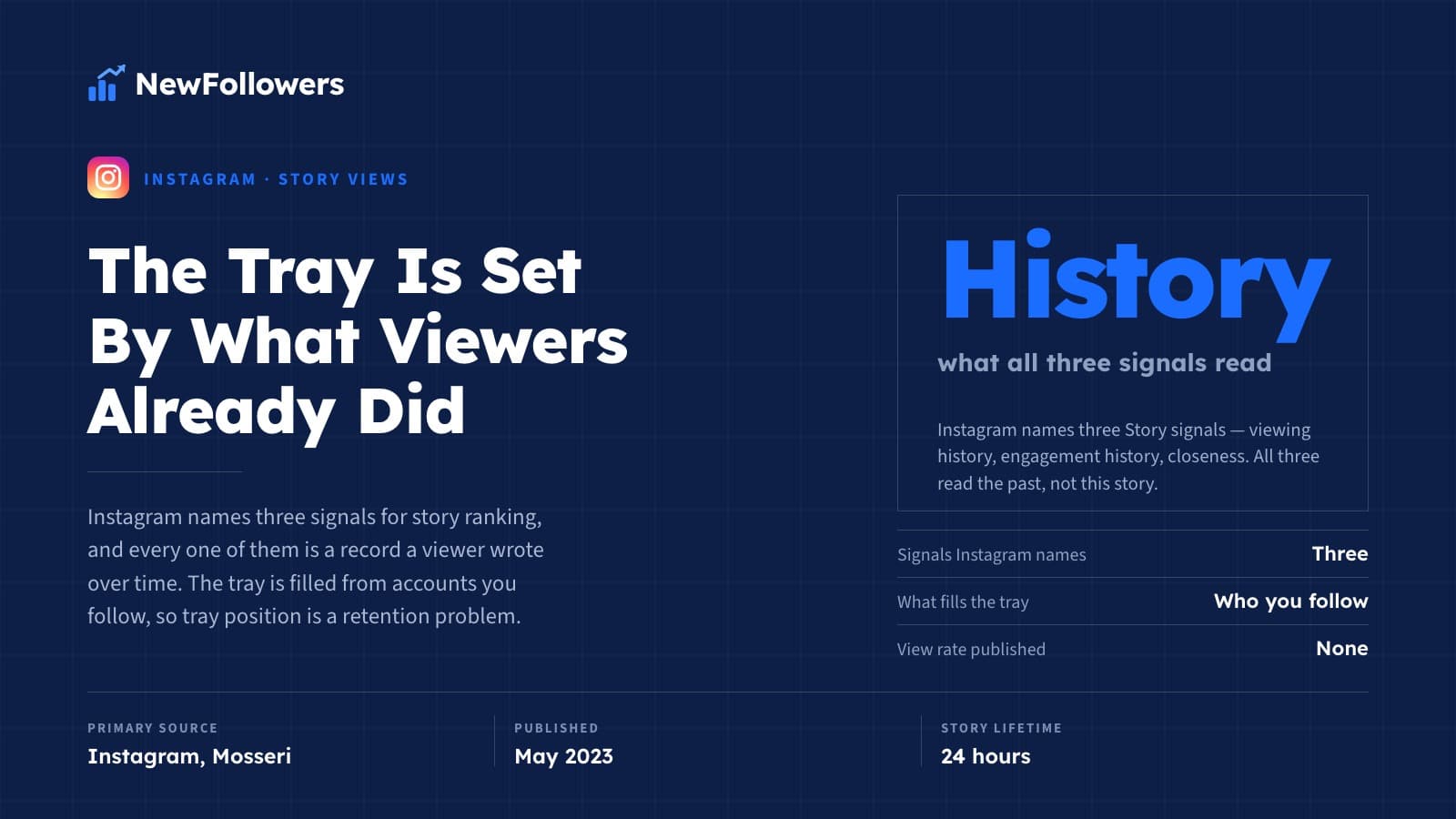
The route Instagram documents for a story is the tray at the top of a follower's Feed, and Instagram states plainly what fills that tray — "The stories you see are from people you've chosen to follow, as well as ads" — which makes this a retention question wearing a discovery question's clothes. And the three signals Instagram names for story ranking are all histories: what a viewer already did with your account, not what you posted this morning.
That second half is the unflattering one. Every published input is backward-looking, so nothing you post this afternoon changes where you sit in anybody's tray this afternoon. What follows is the documented version: the sentences Instagram has written down, what they imply for the things you can change, and — from a shop that sells story views — what an order does and does not buy.
What Instagram Publishes About Story Ranking
Two documents, at two levels of detail.
The creator-facing one is Instagram Ranking Explained, written by Adam Mosseri and published on 31 May 2023. It opens by refusing the singular — "Instagram doesn't have a singular algorithm that oversees what people do and don't see on the app" — and gives Stories a section of their own. Three signals, quoted in full, because they are the entire published mechanism:
And what Instagram says it does with them: "Based on these signals, we make a series of predictions about stories you'll find more relevant and valuable – including how likely you are to tap into a story, reply to a story or move on to the next story – to determine which stories will be shown higher in your stories tray."
The second document is Meta's ranking explainer for Instagram Stories in the Transparency Center, updated 18 September 2025, and it is much more specific. It describes the ordering as a score: "Finally, the system puts all the stories in order by score. Stories that the system predicts will be most valuable or relevant for you (those that have the highest score) are shown to you first in the Instagram Stories tray." Then it lists the signals behind each prediction. A sample, verbatim: "How often you view posts from the story's author". "Where data privacy laws permit, the number of messages exchanged between you and the story's author". "The strength of your connection with the suggested person, such as whether or not you are friends with them on Facebook or if they are a friend of your friends".
Read the grammar rather than the content. In every one of those, the subject is the viewer and the object is your account. They describe a relationship. Not one of them describes the story.
Why Today's Story Cannot Fix Today's Position
Follow the two documents to the end and something awkward falls out. Your place in one person's tray is worked out from that person's record with you: how many of your stories they have watched, how often they reply or react, how connected the two of you are otherwise. All three are accumulations, and none can be written by a story that went up forty minutes ago.
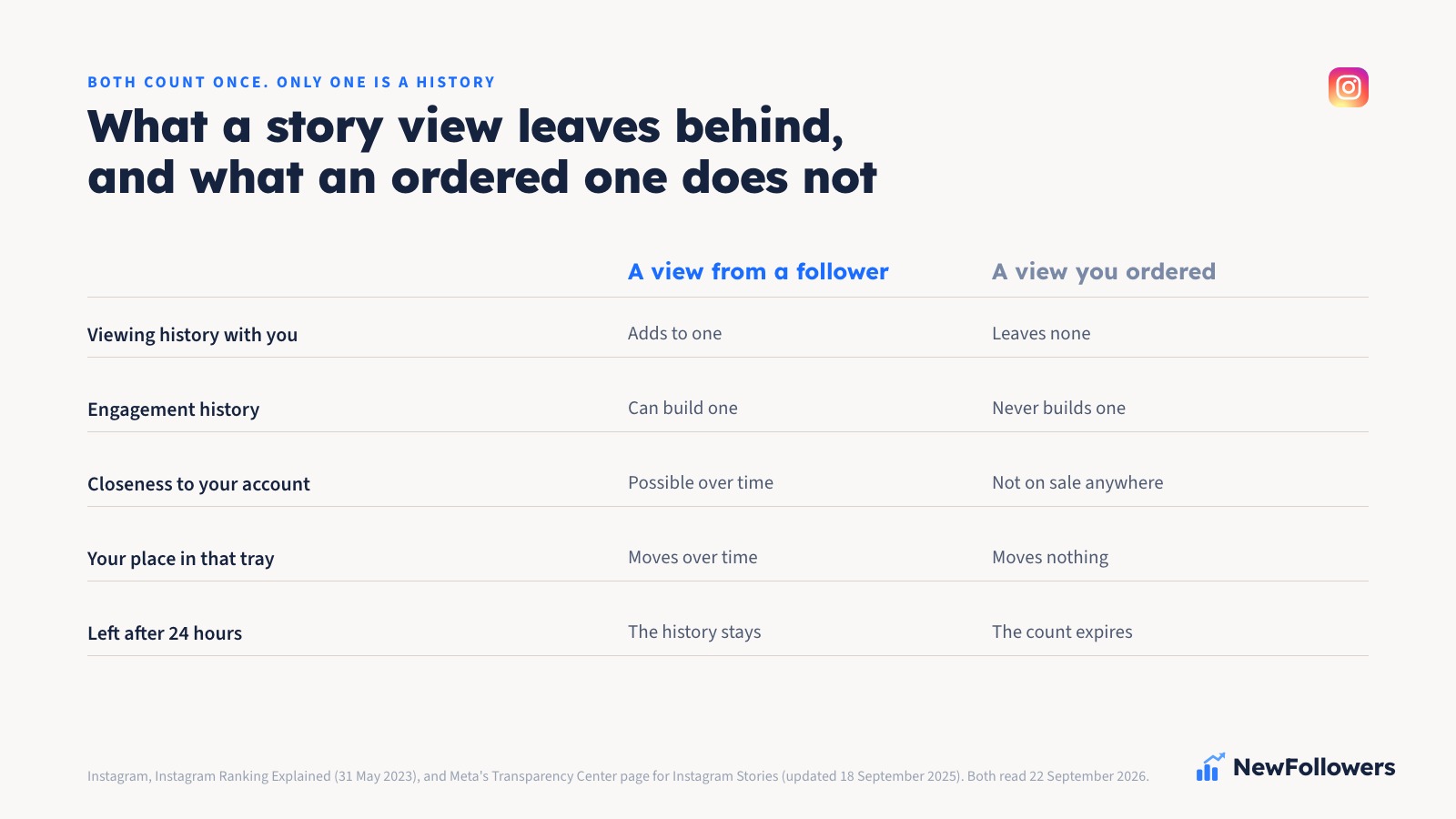
So the thing most people want from this question — a change I can make now that lifts the number on the story I just posted — is the one thing the published mechanism does not offer. What today's story does is add a line to the record that decides where you sit next week. That is not nothing. It is slower than the question assumes.
It also explains the shape of the number. The same article says of Reels that "much like Explore, the majority of what you see is from accounts you don't follow", and that is the difference in one line: a Reel sits on a discovery surface and the stories tray does not. The tray is not the only door — Instagram's help page on where your story appears says the ring on your profile is something "people can tap", and that on a public account a story "may also appear" in Search & Explore. But neither route is named in either ranking document, and neither is the tray. So a story count has little to swing on. The audience is mostly a list that changes slowly, ordered by relationships that change slowly, and the number sits in a band and drifts. A story that doubles your usual figure almost always had something outside the story pushing at it.
The Ratio Nobody Should Quote at You
The next question is always what a normal story view count looks like against a follower count. Instagram has never published one.
Every percentage offered as a benchmark was calculated by somebody else, on somebody else's sample, in a year that may not be this one. None of them knows how many of your followers open the app, or how much of your list arrived at once. Your own history is the only comparison worth having: take your last twenty stories, divide views by followers, and treat the range that comes back as the baseline. It is good for one thing, which is spotting a slide early.
What Actually Follows From the Signals
Four things, all duller than the tricks.
Post for the people already there. Viewing history is the signal Instagram names first, and it is a count of how often a person views your stories. Every story either adds to that record or does not, and the accounts sitting at the front of a tray are the ones somebody has been watching for months.
A like or a DM is the named interaction. Instagram's own wording for engagement history is "such as sending a like or a DM", so a story that gives somebody a reason to tap back is asking for exactly the thing the signal is described as counting. How much it counts is not published, and no honest page will tell you.
Closeness is the one with no tactic under it. Instagram describes it as your relationship with the author overall and how likely you are to be connected as friends or family; Meta's version adds messages exchanged and whether you are connected on Facebook. Worth saying plainly, because every other page on this subject pretends there is a lever there.
The ratio signal is real; the advice built on it is not. The Transparency Center lists, under more than one prediction, "how many times you've interacted with the author's stories, such as by replying to them, compared to the number of stories from the author you've watched". That is a published ratio of interactions to watches, measured for one viewer against one author. Whether posting fewer frames raises it is an inference — a reasonable one, and not in the document.
Missing from that list: a frame count, a time of day, a sticker quota, a posting streak. Instagram publishes none of them.
What the Story Screen Already Tells You
More than the view count does. Open a story you posted and you get a named list of the accounts that watched it — the one place Instagram attaches identities to attention rather than only counting it. Two things to read there: whether the same names keep appearing, because a stable core watching every story is the record the ranking is built from, and where in a sequence the list gets shorter, which is the frame people stopped at. Neither is a ranking signal you can see. Both are facts about your own audience, which is more than a benchmark will give you. What Instagram does and does not name elsewhere in the app is covered in does Instagram show profile views.
Where Buying Story Views Fits, Honestly
NewFollowers sells Instagram story views. This section is written to be checkable rather than persuasive, and everything in it can be tested against the two documents above.
What an order buys is the number under one live story and a set of rows in its viewer list. 1,000 story views cost $2.99, 5,000 — the most chosen package — cost $10.99, 10,000 cost $21.99 and 25,000 cost $54.99. The first rung works out at about 0.3 cents a view; every rung above it sits near 0.22 cents and stays there, so the ladder stops getting cheaper after the second step. Prices are in US dollars and tax may be added at checkout depending on where you buy from. The order takes the link to a story that is already live and never a password, because watching a public story needs no access to the account that posted it, and delivery is spread across the hours the story has left rather than dropped in a block. The packages sit on the Instagram story views page.
Two things it does not buy, both structural rather than a matter of provider quality.
It does not touch any of the three signals. A bought view arrives from an account with no viewing history with you, no engagement history with you and no connection to you, so it cannot enter a ranking computed out of exactly those three things. Your position in a real follower's tray is the same after the order as before it. A seller claiming a package improves your story reach is describing a mechanism absent from both documents.
And it breaks the rules, in wording that leaves no room. Meta's Spam standard, last updated 26 June 2024, does not allow "attempting to or successfully selling, buying, or exchanging for engagement, such as likes, shares, views, follows, clicks, use of specific hashtags, etc." Views are named in that list. A shop that calls this safe is announcing a permission only Meta could grant.
There is also a deadline on it that no other purchase here has. Instagram describes Stories as "photos and videos that disappear after 24 hours", so the count you bought expires with the story rather than sitting on a profile. Our 30-day refill window covers a count that drops below what was delivered, but on this service the real limit is the story's own day: once it is gone, there is nothing left to refill.
So the honest use is narrow: a story a real audience is already watching, where the count looks small beside the interest it is getting. Past that it is a number nobody will see twice.
If the Number Has Been Sliding
What Neither Document Contains
No view rate to hit, because Instagram publishes none. No frames per day, no best hour, no sticker quota, for the same reason. No reset trick: pausing for a day or two appears in neither document, and the published signals are records of what already happened, which a gap does not erase. And nothing anywhere suggesting a purchased view changes what the ranking does, because the ranking reads three things and a purchase is none of them.
Frequently Asked Questions
How do you get more story views on Instagram?
By giving the people who already follow you a reason to keep opening your stories, because Instagram publishes that the stories a person sees come from accounts they chose to follow. The three signals it names for story ranking are viewing history, engagement history and closeness, and all three are records of what a viewer has already done with your account rather than properties of the story you just posted. So the number moves on a scale of weeks, not hours. The story you publish this afternoon is adding to the record that decides where you sit next week; it cannot change where you sit today.
Why did my Instagram story views drop?
Usually one of two things, and they are worth telling apart before changing anything. Either the follower list shrank, in which case the fall is arithmetic rather than ranking, since most story views come from that list. Or the histories that decide tray position have thinned out: Instagram names viewing history and engagement history as signals, both of which are accumulations, so a slide that shows up in September was written across the preceding months. Check the viewer list for whether your regulars are still there. Losing the core is a different failure from never reaching anyone new, and only the first one is visible in that list.
Can people who do not follow me see my Instagram story?
Yes, if your account is public — though not by the route most of your views arrive through. Instagram's help page on where your story appears says the coloured ring around your profile picture is something "people can tap" to see your story, and that if your account is set to public the story "may also appear" in Search & Explore. The row at the top of Feed, by contrast, that page places in "your followers' Feeds". What none of that changes is the Stories tray, which is the thing both ranking documents describe: "the stories you see are from people you've chosen to follow, as well as ads". That is the difference between Stories and Reels on the same platform — of Reels, the same article says "much like Explore, the majority of what you see is from accounts you don't follow" — and it is why a story view count sits in a band and drifts instead of swinging the way a Reels count does.
What is a good story view rate on Instagram?
Instagram does not publish one, and every percentage quoted as a universal benchmark was calculated by somebody else on somebody else's sample of accounts, in a year that may not be this one. None of those samples knows how many of your followers open the app, how old your account is, or how much of your follower list arrived at once. The version that means something is your own: take your last twenty stories, divide views by followers, and treat the range that comes back as your baseline. It is worth tracking for one reason, which is that it shows a slide starting before the raw count makes it obvious.
Do polls and interactive stickers increase story views?
Neither of Instagram's two published documents on story ranking mentions stickers at all. What they do name is engagement history, which Mosseri's ranking explainer describes as how often you engage with an account's stories "such as sending a like or a DM". A sticker that leads someone to send a reply is producing the thing that sentence describes, so the connection is reasonable. It is still an inference rather than a published mechanic, and the common claim that a poll is the single best story lever has no source behind it. Anyone stating a weight for it is reporting a guess as a fact.
Does pausing for a day or two reset the story algorithm?
Nothing of the kind appears in either document. The reset idea circulates widely — stop posting for 24 to 48 hours, let the stories expire, and come back at the front of the tray — and it does not survive contact with the published signals, which are records of what a viewer already did. Viewing history, engagement history and closeness are accumulations, and a gap in posting does not erase an accumulation. That is not proof the trick never appears to work; it is a statement that the mechanism people give for it is not one Instagram has described.
Does buying Instagram story views increase my reach?
No, and the reason is structural rather than a question of provider quality. A bought view comes from an account with no viewing history with you, no engagement history with you and no connection to you, so it cannot enter a ranking computed out of exactly those three things. Your position in a real follower's tray is identical before and after the order. What an order does move is the number under one live story and the rows in its viewer list: 1,000 story views are $2.99 and 5,000 are $10.99, ordered against a story link rather than a password. Meta's Spam standard also names buying views among the things it does not allow, and the count expires with the story after 24 hours.
Ready to Grow Your Social Media?
Real followers, instant delivery, 30-day refill guarantee. Pick your platform: