How Often Should I Post on Instagram? Instagram Has Never Published a Number
How Often Should I Post on Instagram
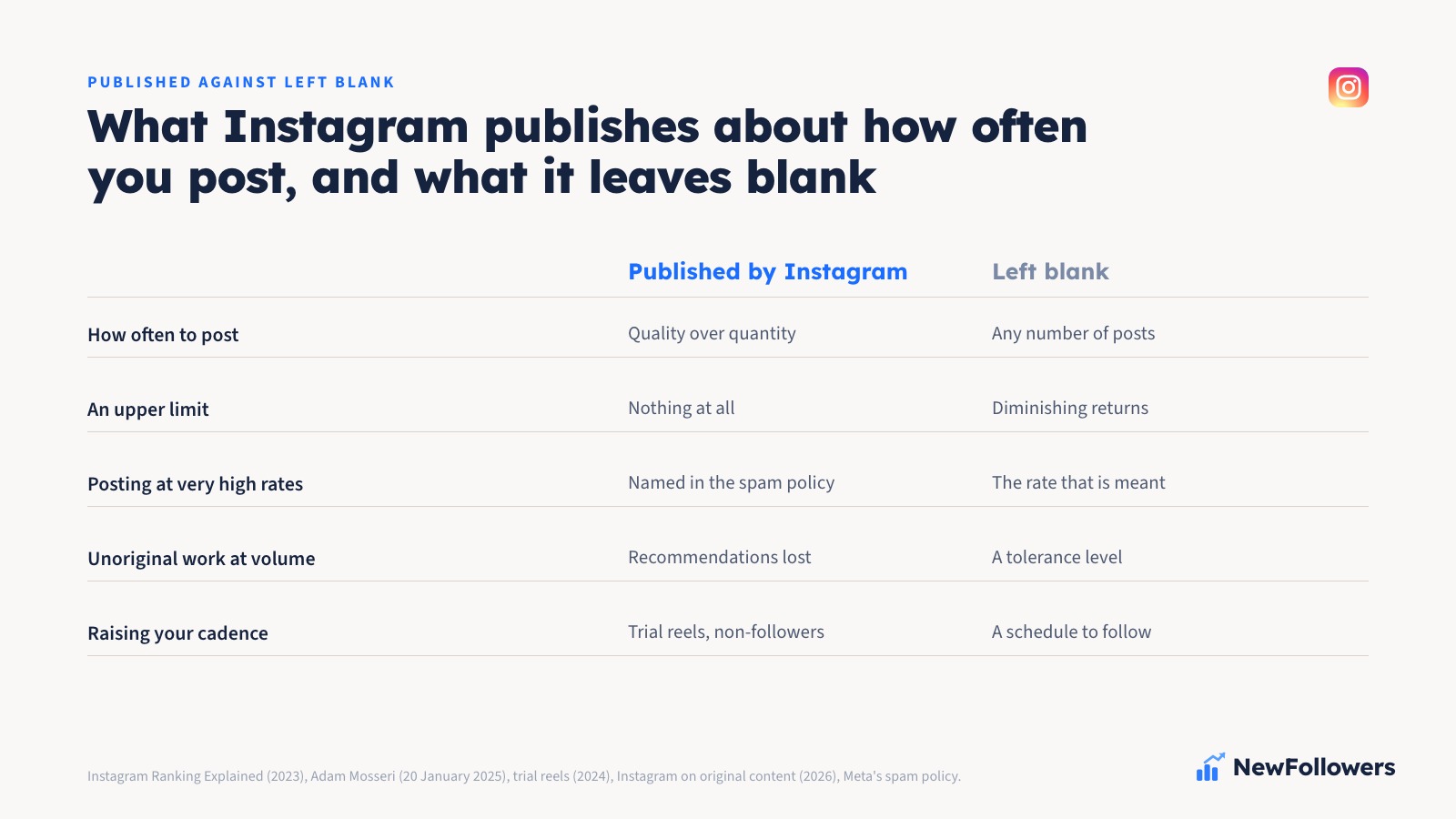
As often as you can keep going without the posts getting worse. That is duller than the answers you have been reading, and the reason is that Instagram has never published a recommended posting frequency — not in its ranking documentation, not anywhere. The one time the head of Instagram answered this question in public, the answer contained no number and no ceiling, which should bother anyone who has read that three to five posts a week is where returns start diminishing.
One scope note. This page is about how often, not when. If you came for the hour of the day, timing has a free calculator and a post of its own here, and there is not one clock hour or day of the week below.
Every Number You Have Read Is Somebody Counting Other People's Accounts
Search the question and the confidence is remarkable. On the day this was written Google's AI summary opened with "three to five times per week" and credited it to Buffer. Shopify said three to five times per week. Dash Social said two to three a week "drives the highest engagement". Adobe said one to two Reels a day alongside a feed post a day. A creator blog in the top ten said every day, or at least six days a week. Five publishers, four incompatible answers, on one first screen.
They are not lying, and that is the important part. Most of those figures are real measurements: scheduling companies can see how often their customers post and how those accounts did, and publishing what they find is legitimate research. The distortion comes afterwards, when a description of what some accounts did is repeated as a prescription for what you should do. The sample vanishes, the hedging falls off, a median becomes a rule. So the useful question is not which number is right, but what the platform itself has said.
What Instagram Has Actually Said About How Much You Post
Less than you would expect, and the actual words beat the summaries of them.
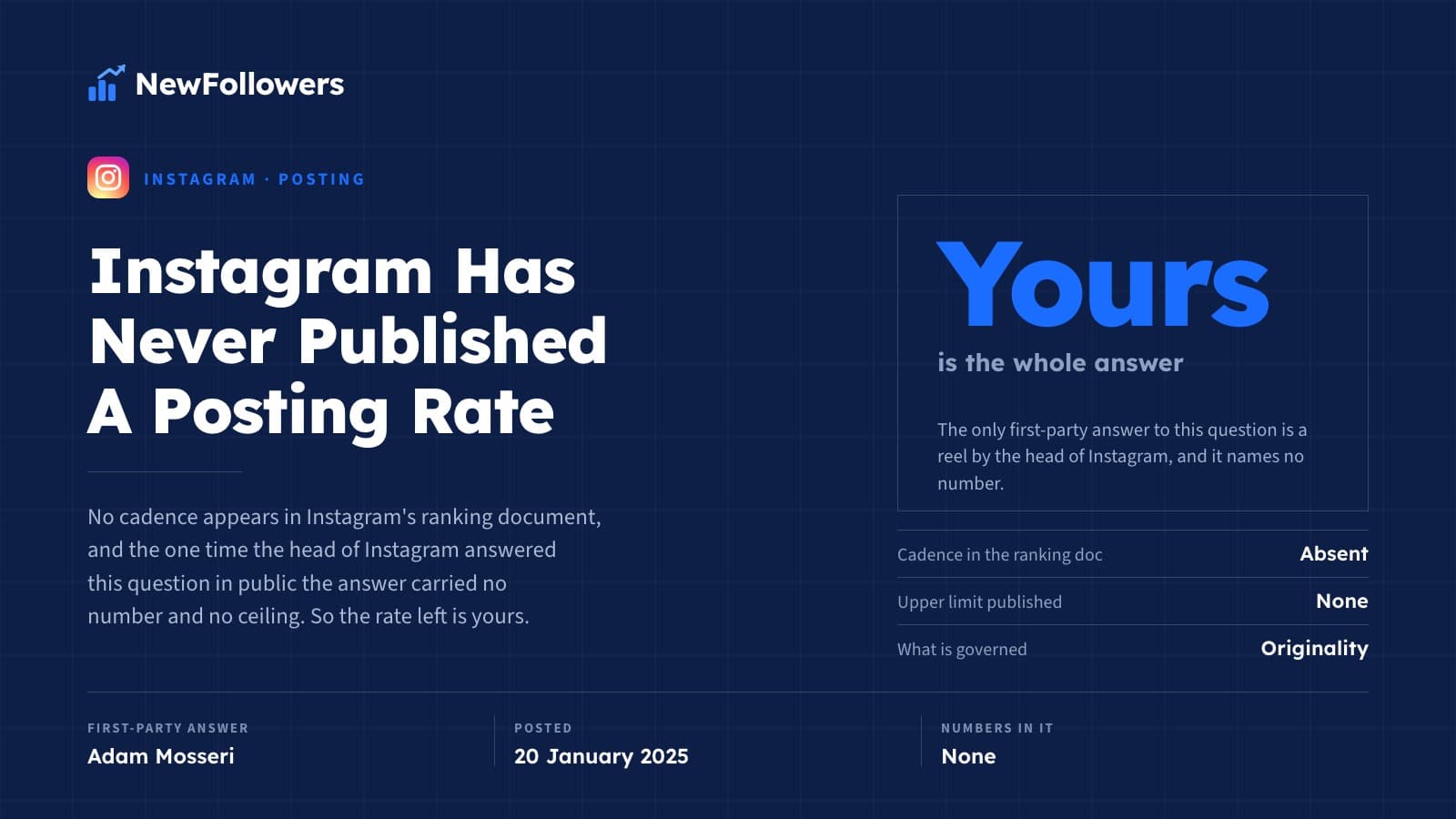
The closest thing to an official answer is a video. On 20 January 2025 Adam Mosseri, the head of Instagram, posted a reel on his own account addressing this exact question. The caption, in full:
"I've been getting questions on how often you should post on Instagram. Prioritize quality over quantity, but in general, the more you post the more people you'll reach. If you post infrequently now and want to really ramp up your posting, try out Trial Reels - that way you can share with accounts who don't yet follow you, and then decide later which posts perform best to share with your followers."
That is a video post, not documentation, and presenting it as more would be dishonest. But it is first-party, dated, still up, and it answers the question people type. So read what is not in it. No posts per week, no reels per day, no minimum, no schedule — and no ceiling. Nothing about overwhelming your audience, nothing about diminishing returns. The most repeated idea in the advice on this subject is a maximum, and the head of the platform did not mention one.
The written record says even less. Instagram Ranking Explained, Mosseri's breakdown published 31 May 2023, is the most detailed public account of how Instagram ranks anything, and it opens by saying there is no singular algorithm at all — Feed, Stories, Explore, Search and Reels each run their own. Posting frequency is named as a signal for none of them, and there is no cadence guidance in it anywhere.
The absence is worth one test. Meta does publish a posting-frequency signal — for Facebook: its Transparency Center names "How many posts (videos, links, photos, etc) the actor has shared, during a certain period of time" among the signals Facebook Feed uses on connected content. There is no Instagram section on that page, and no Instagram equivalent turned up anywhere in Meta's documentation. A Facebook signal is not an Instagram mechanic, so it proves nothing about Instagram. It does establish that nobody outside Meta can answer this.
The Two Published Rules That Do Attach to Cadence
Two, and neither is the one you expected.
Very high frequencies are a spam behaviour. Meta's spam policy prohibits "posting, sharing, engaging with content or creating accounts, Groups, Pages, Events or other assets, either manually or automatically, at very high frequencies", and adds that restrictions may reach accounts "acting at lower frequencies when other indicators of Spam (e.g., posting repetitive content) or signals of inauthenticity are present". No rate is attached to "very high", so this is a rule you can read rather than a threshold you can clear. What it tells you is the shape of the concern: automation and repetition, in a policy that also covers fake accounts and bought engagement. A person posting their own work more often than they used to is not what that sentence is about.
What you fill the schedule with is governed. How much of it is not. On 30 April 2026 Instagram published an update on original content stating that "accounts that primarily post unoriginal content in photos or carousel posts, in addition to reels, will no longer be shown in places where we recommend content". Original means "work that you wholly created or reflects your unique perspective"; re-uploading somebody else's work with a border, watermark or credit added does not qualify. Such an account keeps its followers — "this update does not impact how we show people content from accounts they follow" — and becomes eligible again "when most of their recently posted photos, carousels, and reels are considered original in a 30-day period". Instagram says 75% of US recommendations now come from original posts.
So the only published rule where a schedule carries a documented consequence is not about how much you post. It is about what you post at volume — which matters, because "post more" is usually answered by reposting.
The Feature Instagram Built for People Who Want to Post More
If posting more carried a reach penalty, the platform would be unlikely to ship a tool for doing more of it. It has.
Trial reels, announced on 10 December 2024, are "a new way to try out content and see what performs best, by giving you the option to share reels with people who don't follow you". A trial reel "will not appear in your profile's reels tab or your main grid unless you later decide to Share to everyone". Instagram says engagement metrics arrive "approximately 24 hours after you share a trial reel", and that it can share the reel with your followers automatically "if we determine it's performing well based on the views it receives within the first 72 hours".
This is the feature Mosseri named in that caption, for exactly this case: someone who posts rarely and wants to ramp up. The anxiety behind most frequency questions is that posting more will irritate the people who already follow you, and Instagram's answer to it is a toggle that keeps the extra posts away from them until one works.
One caveat. The announcement says the feature is for "all eligible creators" and never lists the conditions, so anyone quoting you a follower count or an account type is quoting something Instagram has not published. Look for the toggle rather than for a number somebody else published.
Picking a Rate You Can Hold
With no number to aim at, the constraint left is yours — a real one, not a consolation prize.
Where Buying Followers Fits, and Where It Does Not
NewFollowers sells Instagram followers, which makes this the section to distrust. It is kept to what you can check.
A follower package changes the number on a profile and nothing else. The smallest one here is 1,000 followers at $9.99, bought against a public username with no password, delivered gradually rather than in a block, with a 30-day refill. Prices are in US dollars; tax may be added at checkout depending on where you buy from. The packages sit here; what an order contains is in can you buy Instagram followers.
What it cannot do is post anything. A follower count is not what a posting schedule produces and not a substitute for one, and there is no arrangement under which buying a number lets you post less. It also sits in the same policy as the other half of this page: Meta's spam rules cover "selling, buying, or exchanging for engagement, such as likes, shares, views, follows, clicks" in the document that also covers posting at very high frequencies. One policy, both ends of the instinct to do more and faster.
What You Will Not Find Here
No posts per week, no reels per day, no stories per day, no minimum and no maximum, because Instagram publishes none of them and this page is not going to be the sixth incompatible answer on that first screen. And no mechanism by which posting more or less changes how you are ranked, because the document that would carry one does not.
What is left is smaller and true. There is no schedule you are failing to meet. The published rules are about what you post rather than how much, the only real limit is the one your own output imposes, and the head of the platform, asked this exact question, answered with a preference and no number. If the question is really about several platforms and not Instagram alone, how to get followers fast is the cross-platform version of it.
Frequently Asked Questions
How often should I post on Instagram?
As often as you can keep going without the posts getting worse, because Instagram has never published a recommended frequency. There is no cadence guidance in Instagram Ranking Explained, and when Adam Mosseri, the head of Instagram, addressed the question directly in a reel on 20 January 2025, his answer contained no number: prioritise quality over quantity, but in general, the more you post the more people you will reach. The practical constraint is therefore your own production method rather than a schedule somebody published. Pick the rate you could hold in a bad month, count reels, feed posts and stories separately because Instagram ranks them with different systems, and judge a change over weeks rather than over single posts.
Does Instagram say how often you should post?
No. Instagram Ranking Explained, published 31 May 2023, is the most detailed public account of how Instagram ranks content, and it names no posting frequency for Feed, Stories, Explore, Search or Reels. The only first-party answer that exists is a reel by the head of Instagram from January 2025, which gives a preference and no figure. Worth knowing for contrast: Meta does publish a frequency signal for Facebook Feed, listing how many posts an account has shared during a certain period of time among the signals it uses on connected content, and no Instagram equivalent appears in Meta's published documentation. That does not mean Instagram ignores frequency, only that nobody outside Meta can tell you.
Where do numbers like three to five posts a week come from?
From companies counting accounts, not from Instagram. Scheduling tools can see how often their customers post and how those accounts performed, and publishing what they find is legitimate research. The distortion happens afterwards, when a description of what some accounts did is repeated as a prescription for what you should do and the sample disappears. The clearest evidence that these are measurements rather than rules is that they disagree: on one search on 22 September 2026 the first screen carried three to five feed posts a week, two to three a week, one to two reels a day, and every day or at least six days a week, from four different publishers.
Is posting every day on Instagram too much?
Instagram publishes no maximum, and the one first-party answer to the frequency question mentions no ceiling at all. What Meta does publish is a spam rule covering posting at very high frequencies, manually or automatically, with no rate attached to the phrase and with automation and repetitive content named alongside it. A person posting their own work once a day is not what that rule describes. The real risk in daily posting is not a penalty but a supply problem: schedules that outrun what someone has to say tend to get filled with other people's content, and that is the one thing on this subject Instagram has committed to penalising.
Does posting more get you more reach on Instagram?
Each post is a separate chance to be distributed, so more posts mean more chances, and the head of Instagram has said that in general the more you post the more people you will reach, with quality prioritised over quantity. What nobody has published is any mechanism by which your posting rate itself changes how a given post is ranked. No Instagram document lists frequency as a signal on any surface, so claims that the algorithm forgets inactive accounts or rewards consistency with wider distribution are not sourced to Instagram. More chances is arithmetic; a cadence multiplier is a mechanic, and only the first one has anything behind it.
What is the 5-3-1 rule on Instagram?
Not an Instagram rule. Instagram has never published a posting formula by that name or any other, and no numbered rule of that kind appears in its ranking documentation or in any statement by the head of the platform. Formulas like this come from marketing writing, where they are usually a suggested mix of content types per week rather than anything the platform measures. Treating one as a requirement means optimising against a number with no source. The two published rules that do attach to a posting schedule are Meta's spam policy on very high frequencies and Instagram's originality rules on recommendations.
How can I post more without annoying my existing followers?
Instagram built a feature for exactly that. Trial reels, announced on 10 December 2024, let you share a reel with people who do not follow you; the reel does not appear in your profile's reels tab or main grid unless you later choose to share it with everyone. Instagram says engagement metrics appear roughly 24 hours after posting, and that it can share the reel with your followers automatically if it determines the reel is performing well based on the views it receives in the first 72 hours. Mosseri named this feature specifically for creators who post infrequently and want to ramp up. Instagram describes it as available to eligible creators and does not publish the eligibility conditions, so look for the toggle rather than trusting a follower count quoted by a third party.
Ready to Grow Your Social Media?
Real followers, instant delivery, 30-day refill guarantee. Pick your platform: