Can You Buy Pinterest Followers? Yes, and It Is the Least Useful Count in the Category
Can You Buy Pinterest Followers?
Yes, they are sold, though not by this site. The answer underneath is the one worth having: Pinterest hands out reach through the pin rather than through the follower graph, so a follower count does less here than on any platform where one is for sale.
NewFollowers sells followers on eleven platforms and Pinterest is not one of them. No supplier, no Pinterest page, and nothing below links to a checkout, because there is nothing to check out. Said at the start rather than buried at the end, because it is the only reason to trust the rest: a page about buying something, written by a shop that does not sell it, is the one version of this page with nothing riding on your answer.
Pinterest Is a Search Engine With Pictures In It
Start with where a pin's audience comes from, because everything else here follows from it.
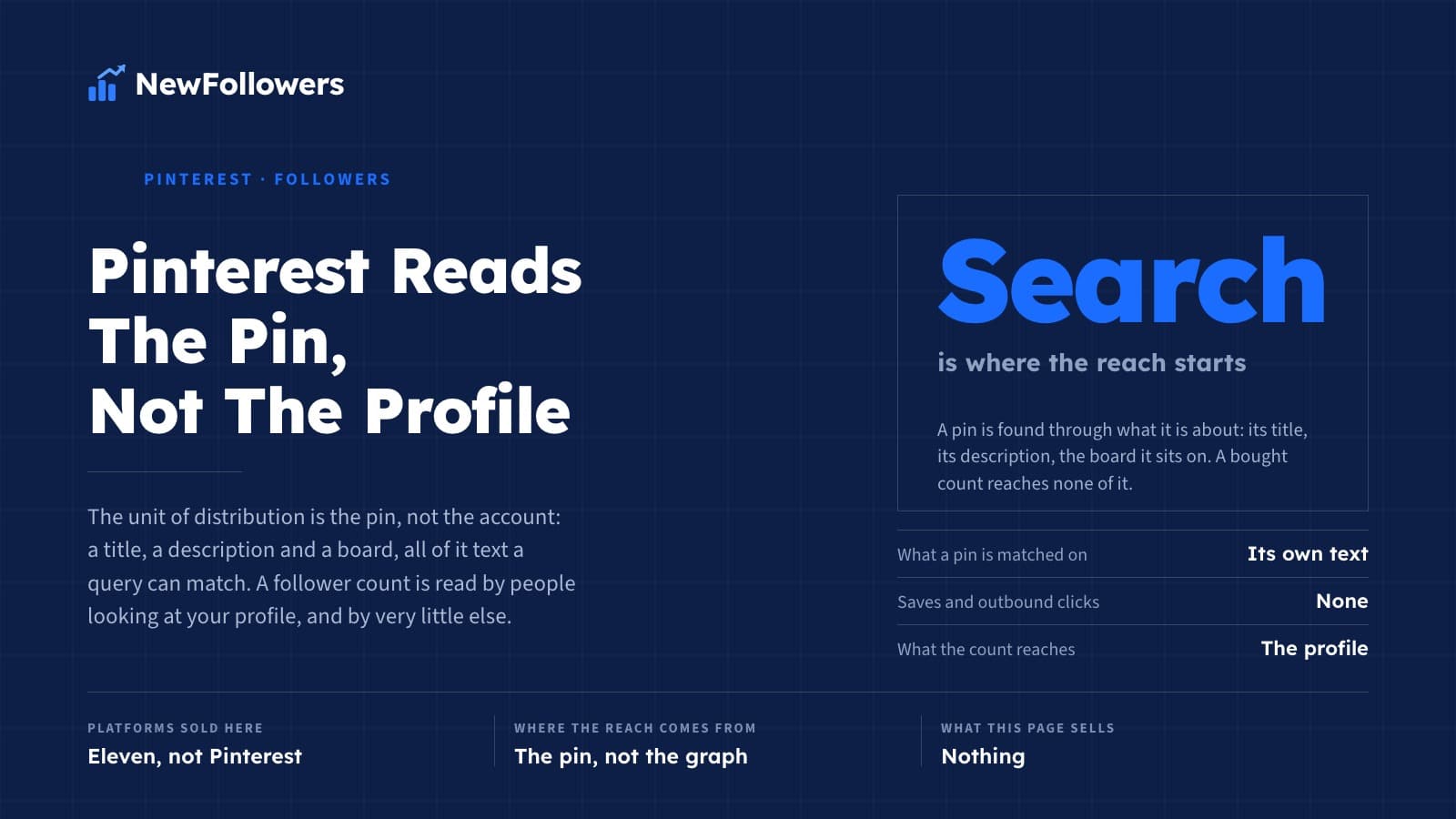
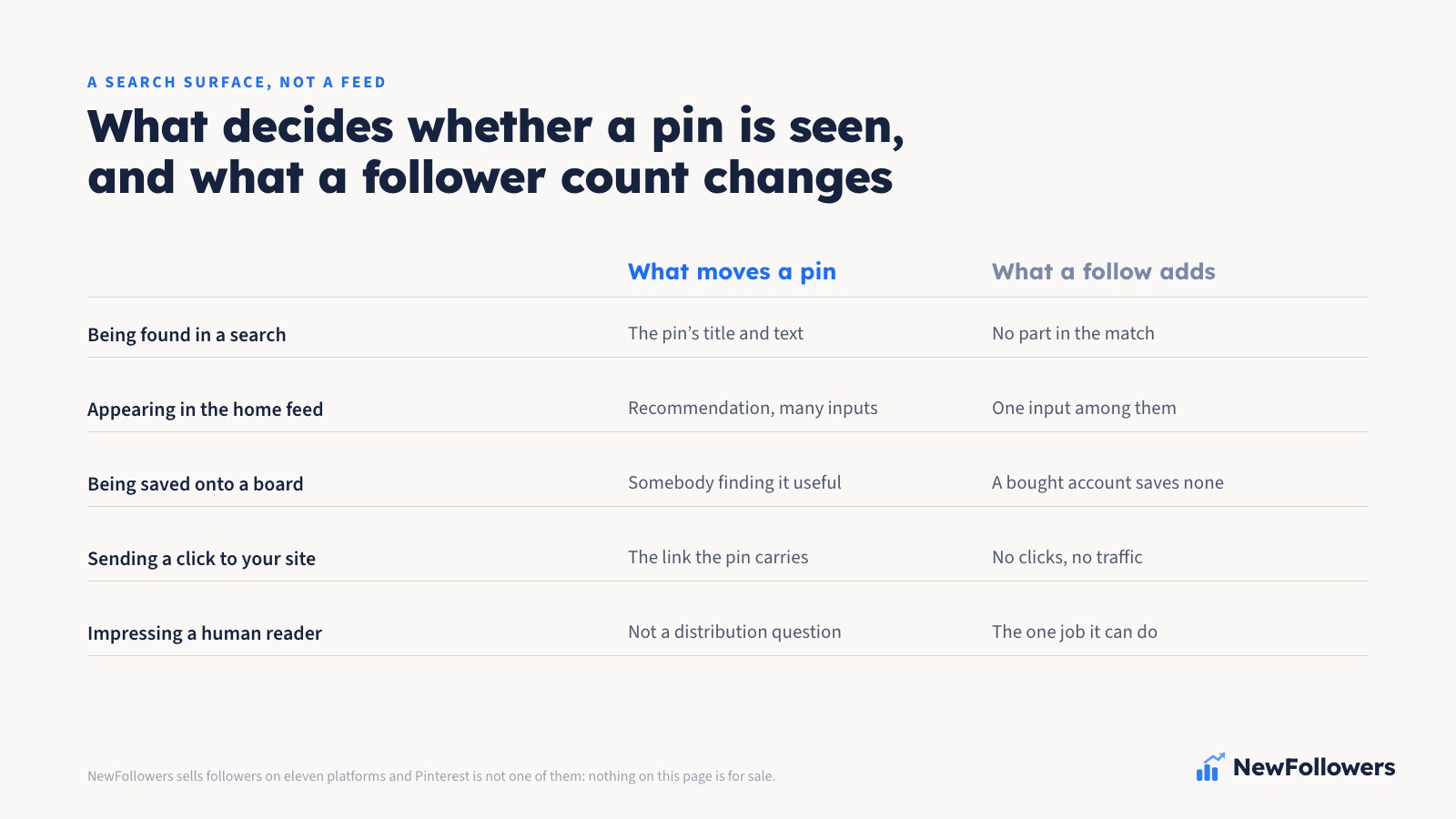
On a feed platform the unit of distribution is the account. You follow somebody, their posts become eligible to reach you, and the follower graph is the pipe every post travels down. Pinterest is built the other way round. The unit is the pin: an image carrying a title, a description and a board it was saved to, all of which is text that a query can match. People arrive with something already in mind — a kitchen, a haircut, a tattoo, a colour of paint — type it, and get pins back. The home feed is assembled by recommendation out of what you have searched and saved, and pins from accounts you follow are one input into that rather than the whole of it.
So "how many followers does this account have" is not the question Pinterest is answering when it decides what to put in front of somebody. It is answering what this pin is about and whether that matches what this person is looking for. A pin from an account with forty followers is eligible to be served to somebody searching the term. A pin from an account with forty thousand still has to match the query.
A second mechanism compounds on top of that one. When somebody saves a pin to a board of their own, it sits there in front of their audience and in front of anyone who finds that board later. A saved pin keeps moving, sometimes long after the person who made it stopped thinking about it. That is how reach accumulates here, and it begins with a person deciding the thing was worth keeping.
None of that is a moral argument. It is a description of the machinery, and the machinery is why this page cannot give you the flattering answer.
What a Pinterest Follower Count Is Still Worth
One thing, and it deserves to be said plainly rather than waved away.
It is a public number on a profile. A brand weighing a collaboration, a client deciding whether you are serious, an editor deciding whether to reply — these are people reading a page, and people read the number before they read anything else. That is a real function and it is the same function a follower count performs on every platform.
What differs on Pinterest is that the function stops there. Elsewhere the count is two things at once: a credential that humans read, and a distribution asset that the platform reads. Here it is only the credential. Everything that actually puts your work in front of strangers is happening one level down, at the pin.
Buying the credential with your eyes open — a number in front of a particular human being next week, and no illusions about the rest — is a coherent thing to want. It is a much smaller thing than the page selling it will say.
The Four Things a Bought Pinterest Follower Does Not Do
Worth having in one place, because no storefront will put them there.
What the Sellers Are Actually Delivering
The market is real even where the product is thin. Panels list Pinterest followers next to repins, saves and likes, and they fill an order the ordinary way: you hand over a public profile name, a set of accounts is instructed to follow it, the number moves.
Four things are worth checking before paying anybody for any of it, and they are the same four on every platform:
Pass all four and you are looking at a shop that exists. It is still selling something Pinterest's rules do not permit, and here it is also selling a number the platform barely consults — which is the part neither the storefronts nor the listicles about them will put in front of you.
The Penalty Story, and Why This Page Will Not Tell It
Search this question and you will be told that a bought follower count drags your reach down: engagement rate falls, the system reads it as weak material, distribution is throttled. It is in every listicle on the subject and in the summaries assembled out of them.
It might be true. Nobody outside Pinterest can show that it is. It is a claim about how a ranking system weighs one number against another, and that system is not published, does not hold still, and is not something a seller — or a blog run by a seller — has any means of testing. Repeating it confidently would be the same failure as the storefronts promising the opposite, aimed in a more respectable direction.
The duller statement is better supported and lands in the same place anyway. Reach here starts at the pin. The follower count was never carrying much of the load, so the interesting question is not whether buying it damages you. It is why you would pay for a lever that is not connected to anything.
What Pinterest's Own Rules Say
In general terms, because these documents move and a page that quotes a version of them is a page that goes wrong later.
Pinterest, like every platform in this category, treats artificially inflating engagement and metrics as spam, and those policies reach a bought count as readily as a do-it-yourself one. Buying accounts to follow you sits inside that, not outside it. A seller describing Pinterest followers as safe or compliant is announcing a permission only Pinterest could grant, and Pinterest has granted nothing to anybody.
Read the current version yourself before deciding anything on the strength of a sentence in a blog post, this one included.
What Moves a Pin Instead
None of it is for sale, which is exactly why it is the part worth having.
Write the pin for the query
The title and the description are what a search has to match. "Blue" is not a query. "Navy blue bedroom wall" is. This is the highest-leverage thing on the platform, it costs a couple of minutes per pin, and that is roughly why so few people bother.
Put the pin on a board that means something
A board is context, and a pin about slow-cooker recipes sitting on a board called "Stuff" has thrown away half of what Pinterest could otherwise have known about it. Boards cost nothing. Make the specific one.
Publish new images rather than the same one again
Every new pin is another title, another description and another board, which is another set of queries it can turn up for. The same image posted five times is one idea filed five ways, and the words on it are the words you already wrote.
Point the pin somewhere worth arriving at
The click is the product. A pin landing on a slow page, a dead link, or a page that does not deliver what the image promised turns the one metric that matters into nothing at all.
Give it longer than a week
A pin can keep surfacing through search well after it was published, which is the opposite of how a feed post behaves. So the first week tells you very little, and judging pins by their first week is the commonest route to deciding that Pinterest does not work.
Do those five and followers arrive as a by-product, in the only order that makes sense here: somebody finds the pin, the pin is good, they go looking for whoever made it. The follow is downstream of the work rather than upstream of it, which is the whole reason it cannot usefully be bought.
If What You Wanted Was Visual Reach From a Follow Graph
Worth checking what you actually came for, because a fair number of people arrive at "buy Pinterest followers" describing a platform that is not Pinterest.
If the plan is a visual feed where the follower count genuinely feeds distribution — where the people who follow you are the people your work is shown to first — that is Instagram. Different machine, different pipe: there the count is a credential and a distribution asset at once, which is the double duty Pinterest never asked it to do. Instagram is also one of the platforms this site does serve, and that is the only link on this page pointing at anything for sale.
If the plan is traffic to a website, Pinterest is genuinely the better of the two — and the follower count is still not the route. The route is the pin, the words on it, and the link it carries.
Where That Leaves the Search
"Buy Pinterest followers" has an answer, and the answer is yes, elsewhere, for money, with very little attached. The accounts will exist. The number on the profile will move. No pin will be found more easily, nothing will be saved, nobody will click through to whatever you were hoping they would click through to, and the thing you were trying to grow will be exactly where you left it.
The count is worth something as a credential and close to nothing as a distribution asset, and Pinterest is the platform where those two values come furthest apart. That is the case in full, and it is why this page has nothing to sell you at the end of it.
Frequently Asked Questions
Can you buy Pinterest followers?
Yes, they are sold, though not by NewFollowers, which has no Pinterest supplier and no Pinterest page. The more useful answer is what the purchase gets you. Pinterest hands out reach through the pin — its title, its description, the board it sits on — rather than through the follower graph, so a follower count does less here than on any platform where one is for sale. The number on the profile moves. The pin is found no more easily than it was before.
Does NewFollowers sell Pinterest followers?
No. NewFollowers sells followers on eleven platforms — Instagram, TikTok, YouTube, Facebook, Twitter/X, Telegram, Spotify, LinkedIn, Snapchat, Twitch and Discord — and Pinterest is not one of them. There is no supplier behind it, there is no Pinterest page on the site, and there is no checkout at the end of this article. That is worth knowing before you weigh anything else on the page, because it is the reason the page can afford to answer the question straight.
Will buying Pinterest followers get my pins seen by more people?
No. Search matching runs on what the pin says it is about, and a number attached to the profile is not part of that description. The other route a pin travels is the save: somebody decides the thing is worth keeping, puts it on a board of their own, and it carries on from there in front of their audience and anyone who finds that board later. Bought accounts make no such decision, so the purchase opens neither route.
Does Pinterest allow buying followers?
No. Pinterest, like every platform in this category, treats artificially inflating engagement and metrics as spam, and those policies reach a bought count as readily as a do-it-yourself one. A seller describing Pinterest followers as safe or compliant is announcing a permission only Pinterest could grant. These documents change, so read the current version rather than relying on a sentence in a blog post, this one included.
Will a bought follower count hurt my reach on Pinterest?
Nobody outside Pinterest can show that it will. The claim repeated everywhere is that a low engagement rate against a high follower count reads as weak material and gets throttled. It might be right. It is also a claim about how a ranking system weighs one number against another, and that system is not published, does not hold still, and is not something a seller or a blog has any means of testing. The better-supported statement is duller and lands in the same place: reach here starts at the pin, so the follower count was never carrying much of the load either way.
What actually gets you more Pinterest followers?
The pin does, and the follow arrives downstream of it. Write the title and description for the query somebody would actually type, put the pin on a board specific enough to mean something, publish new images rather than re-uploading one across five boards, point the pin at a page worth arriving at, and give it longer than a week — a pin can keep surfacing through search well after it was published, which is the opposite of how a feed post behaves. People find the pin, then go looking for whoever made it.
If I buy anyway, how do I tell a real seller from a scam?
Four checks, and they are the same on every platform. Is the whole ladder readable without an account, or is there only a quote on request? Is the delivery window written down rather than described as instant? Does the refill carry a stated length, and does the page admit it covers a count that drops rather than anything the platform does to an account? And is a password, an authorisation screen or a verification code asked for anywhere — a follow on a public profile needs none of them, so that last one ends the conversation rather than lowering the score.
Is Pinterest a social network or a search engine?
In practice it behaves much more like a search engine. People arrive with something already in mind and type it, the home feed is assembled by recommendation out of what they have searched and saved, and the unit that travels is the pin rather than the account. Follows exist and a follower count sits on every profile, but pins from accounts you follow are one input into that feed rather than the whole of it. That single fact is what decides what a bought follower count is worth here, which is much less than it is worth elsewhere.
Ready to Grow Your Social Media?
Real followers, instant delivery, 30-day refill guarantee. Pick your platform: