Buy Facebook Shares For Your Posts
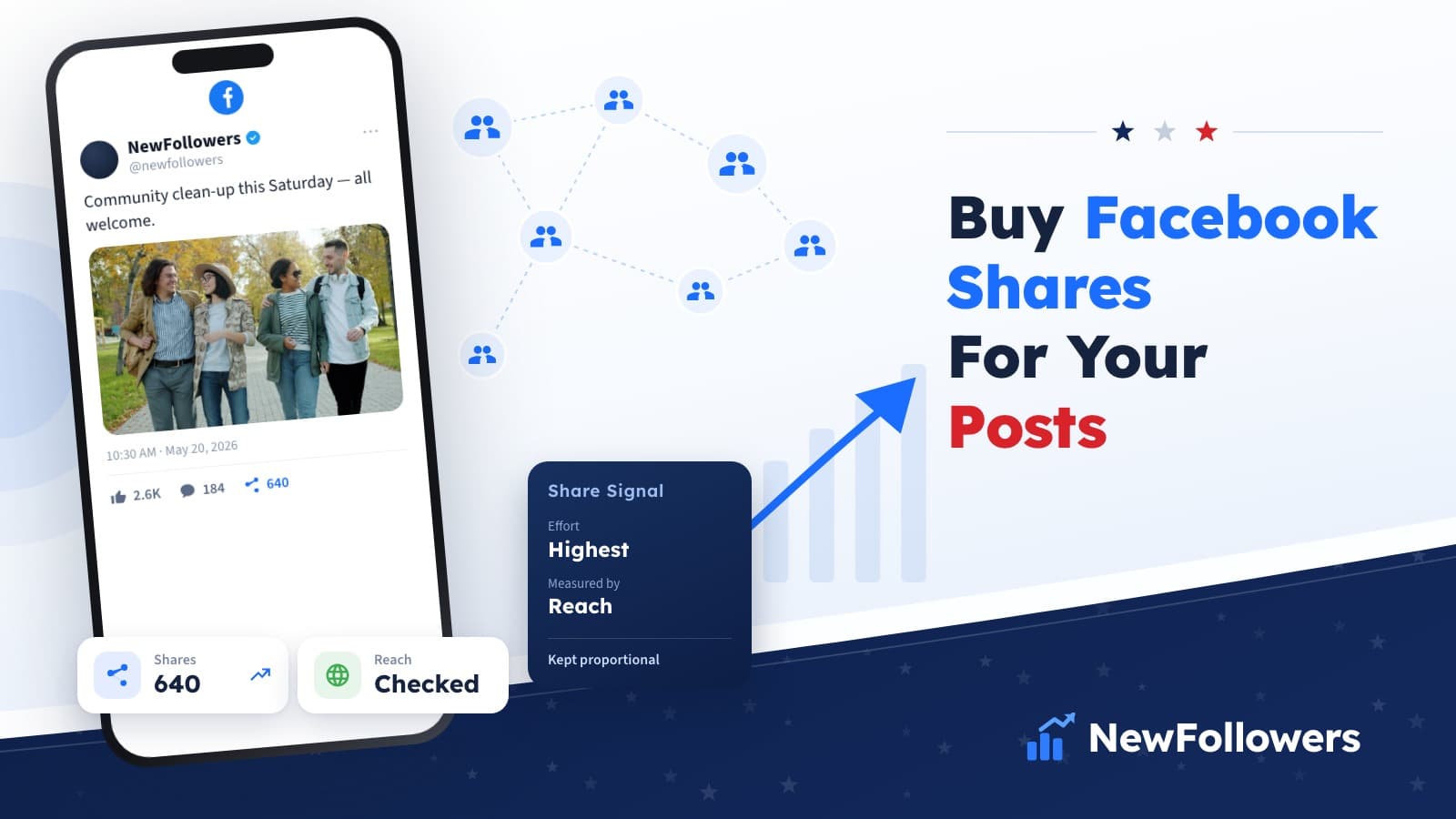
A share is the most demanding thing you can ask of a Facebook user, which is exactly why people consider whether to buy Facebook shares for your posts. Reacting takes a tap. Commenting takes a sentence. Sharing means putting your content in front of someone else's friends under their own name — and that difference shapes everything about how share promotion works and where it breaks down.
For Page owners, local businesses, and marketers in the United States, a service such as NewFollowers can supply one promotional input. But shares carry constraints that likes and views do not, and understanding them before ordering prevents paying for something that will not do what you expect.
What Does It Mean to Buy Facebook Shares For Your Posts?
Buying Facebook shares means paying a third-party service to have accounts share a specific public post. The share count displayed under the post increases, and in principle the post is reposted to those accounts' own audiences.
The important qualifier is in principle. A share to a private profile with no friends, or to an account whose posts are visible to nobody, increments the counter without distributing anything. This is the central thing to understand about purchased shares: the visible number and the actual reach can be entirely disconnected.
A share count measures how many times a button was pressed. It does not measure how many people saw the result.
How Shares Differ From Other Facebook Engagement
The verifiability row is the practical catch. Facebook restricts who can see the list of accounts that shared a post based on each sharer's privacy settings, so you often cannot inspect what you bought the way you can inspect purchased comments.
Why Share Counts Carry Weight
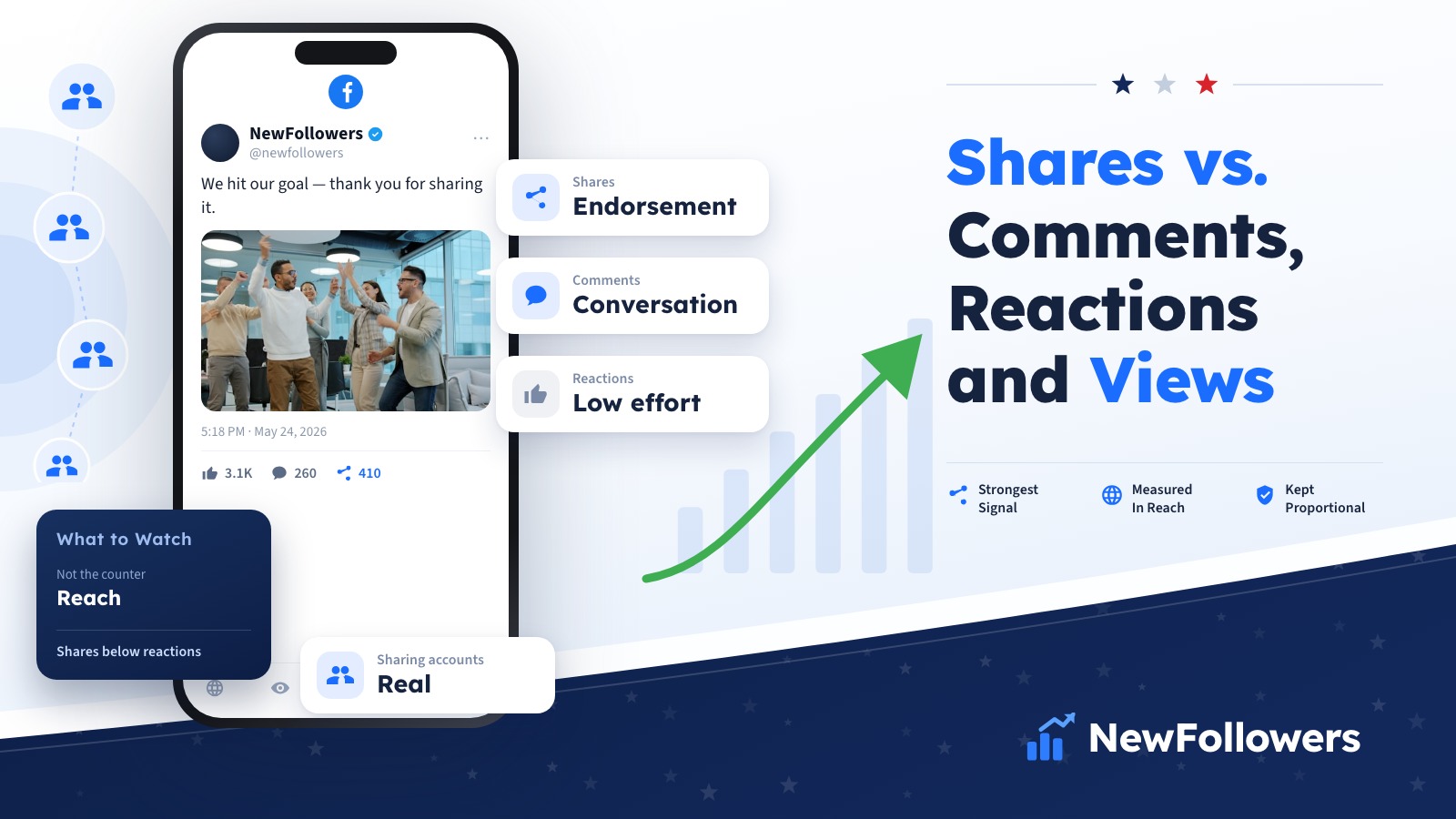
Because a share requires genuine endorsement, people read it as a stronger signal than a reaction. A post with 200 reactions and 3 shares tells a different story from a post with 200 reactions and 60 shares — the second suggests something people wanted to pass on.
That perceived weight is also the risk. A share count wildly out of proportion to the rest of the engagement is more conspicuous than an inflated like count, precisely because everyone understands sharing is harder to earn.
Reasons Page owners look at share promotion:
The Constraints Nobody Mentions Before You Pay
The Post Must Be Public
A post limited to friends, or to a custom audience, cannot be shared by external accounts. This is a hard technical limit, not a provider limitation.
Some Post Types Cannot Be Shared Normally
Certain formats and placements do not carry a standard share action. Confirm the specific post type is shareable before ordering.
Shares May Not Distribute Anything
If sharing accounts have no audience or restrictive privacy settings, the count rises and nothing reaches anyone. Ask the provider directly what audience the sharing accounts have.
Shares Can Be Undone
An account can remove a share at any time, and Meta removes inauthentic accounts on an ongoing basis. The count can fall.
You Often Cannot Audit the Result
Privacy settings limit visibility into who shared. Plan for the possibility that you cannot verify what was delivered.
What to Check Before Buying Facebook Shares
1. Whether the Sharing Accounts Have Audiences
This is the question that separates a share that does something from a number that does not.
2. Proportion to Existing Engagement
Shares should sit below reactions and roughly in line with, or below, comments. A post with more shares than reactions describes behaviour that does not occur.
3. Delivery Pacing
Shares accumulating over a day resemble organic spread. Sixty appearing in two minutes do not.
4. What Access Is Required
The public post URL and nothing more. Never login credentials or Page admin rights.
5. Removal Terms
Ask what happens if the count drops, and get the answer before paying.
How to Buy Facebook Shares More Carefully
How Shares Fit Into a Facebook Strategy
Share promotion touches one signal on one post. What actually earns shares is content people want to be seen passing on:
A post no one wants to be associated with will not be shared regardless of what the counter says.
What Meta's Policies Say
Meta's inauthentic behaviour policy covers misleading engagement and accounts misrepresenting who is behind them. Enforcement can include content removal, account removal, and reduced distribution.
Read the current policy directly rather than a provider's summary, since it changes. And treat any assurance that a method is undetectable as a claim about Meta's systems that the provider cannot substantiate.
U.S. businesses should also be aware of the Federal Trade Commission's rule on consumer reviews and testimonials, which addresses deceptive indicators of social media influence in commercial contexts. A share is an implied endorsement, which places it closer to that territory than a passive metric.
Common Mistakes When Buying Facebook Shares
Ordering Shares Out of Proportion
More shares than reactions is the clearest possible signal that the numbers were purchased.
Assuming Shares Equal Reach
They are different metrics. Check reach in Insights before and after, and judge on that.
Buying Shares on a Post With Nothing to Share
Shares amplify. If the post is not worth passing on, amplification does nothing.
Not Checking Whether the Post Is Shareable
Paying for shares on a post that cannot be shared is a wholly avoidable error.
Expecting Auditability
Privacy settings may prevent you from seeing who shared. Decide whether you accept that before paying, not after.
Are Purchased Shares Enough to Spread a Post?
No. A share only spreads a post if it lands in front of an audience that reacts to it. Purchased shares frequently satisfy neither condition, which is why the share count and the reach figure so often move independently.
Judge share promotion by what happens to reach, not by what happens to the counter.
Final Checklist Before You Place an Order
Conclusion
Anyone deciding to buy Facebook shares for your posts should be clear that a share count and actual distribution are separate things, and that purchased shares often deliver the first without the second. Shares are also the metric where disproportion is most visible, because everyone understands how much harder a share is to earn than a reaction.
For U.S. Page owners and businesses, the durable route to shares is content with specific, local, practical value — the kind people pass on because it makes them useful to their own friends. Promotion can support a launch, but it belongs alongside that work.
If you want to explore the options, review the current packages from NewFollowers, keep the quantity proportional to the post's other engagement, and measure the outcome in reach rather than in the counter.
Frequently Asked Questions
Can I buy Facebook shares for my posts?
Third-party services do offer Facebook share packages. The post must be publicly visible and of a type that supports sharing, and you should ask whether the sharing accounts have any audience of their own.
Do purchased Facebook shares increase reach?
Not necessarily. A share to an account with no audience or restrictive privacy settings increments the counter without distributing anything. Judge the result by reach in Insights, not by the share count.
How many shares should a post have relative to likes?
Shares should sit below reactions and roughly in line with or below comments. A post showing more shares than reactions describes behaviour that does not occur naturally.
Can shares be added to a private Facebook post?
No. This is a technical limit rather than a provider limitation. Check the audience selector and confirm the post is public before ordering.
Can I see who shared my post?
Often only partially. Facebook restricts visibility of the sharer list according to each sharer’s privacy settings, so purchased shares may not be auditable the way purchased comments are.
Can purchased Facebook shares disappear?
Yes. An account can remove a share at any time, and Meta removes inauthentic accounts on an ongoing basis. Ask the provider about removal terms before paying.
Does a share service need my Facebook password?
No. It should require only the public post URL. Decline any provider requesting login details, Page admin rights, or Business Manager access.
Why are shares considered a stronger signal than likes?
A share means putting your content in front of someone else’s friends under their own name, which is a genuine endorsement. That is also why a disproportionate share count is more conspicuous than an inflated like count.
What actually earns organic Facebook shares?
Content with specific, practical, often local value — announcements that affect people directly, information useful to a defined community, and posts that make the sharer look helpful or informed to their own friends.
Why consider NewFollowers for Facebook engagement?
NewFollowers offers social media engagement options that can form one part of a broader Page strategy. Review the current package details and keep any order proportional to the post’s existing engagement.
Ready to Grow Your Social Media?
Real followers, instant delivery, 30-day refill guarantee. Pick your platform: