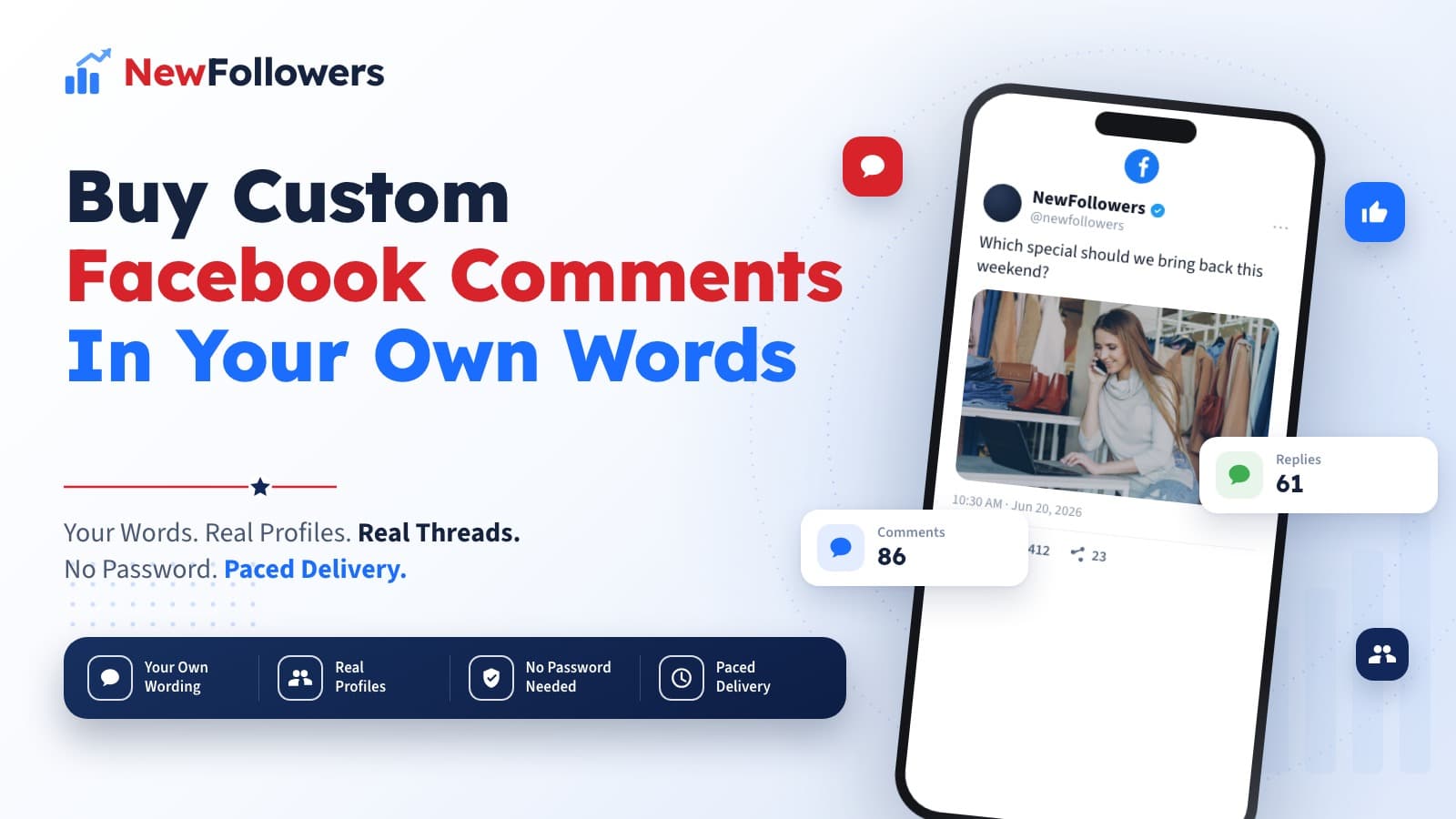
Buy Custom Facebook Comments in Your Own Words
Quick Answer
Custom Facebook comments are comments you write that a service posts from its own accounts under your post, so they can mention your opening hours, the dish in the photo or the exact offer in the caption. They read naturally only in proportion to the post's likes and shares and on posts real customers are seeing. Meta's Spam standard prohibits buying engagement, and purchased comments that praise a product are fake testimonials under the FTC's rule, so keep them factual.
If you want to buy custom Facebook comments, you are buying a different product from the generic comments most engagement services sell. Custom means you write the words. Instead of a stranger's "great post" under your announcement, the comment can ask what time you open on Saturday, mention the dish in the photo, or react to the exact offer in the caption. That makes custom comments the most natural-looking engagement a Page can buy, and it also makes them the closest thing to a fabricated review, which is why they deserve more thought than a like package.
For local businesses, restaurants, salons, real-estate agents, community pages, authors and ecommerce brands whose posts collect reactions but never conversation, the appeal is obvious. NewFollowers is one social media growth provider people encounter while researching Facebook engagement services. Custom comments should still be judged carefully, because writing the words yourself changes what the comments are, and a scripted comment section should never replace the real one.
What Does It Mean to Buy Custom Facebook Comments?
Buying custom comments means paying a provider to have a set number of accounts post comments on a chosen Page post, using text you supply. You typically submit a list, one comment per line, and the service distributes those comments across its accounts, sometimes in the order given and sometimes shuffled, over a delivery window that ranges from minutes to days.
The phrase to interrogate is custom. It describes the wording, not the accounts. The comments may be yours, but the profiles posting them belong to the provider, and they may be operated by real people paid to post whatever they are given, by dormant accounts, or by automation. On Facebook, where names and profile photos sit beside every comment and customers expect to recognize local faces, that matters more than on any other platform. The generic version of this product, comments from real accounts, is covered in its own guide.
A comment you wrote and paid a stranger to post is not a customer speaking. It is a script performed under a name your community does not know, and one curious click on that name is all it takes to notice.
Why Do Facebook Pages Care About Comment Quality?
Comments are the most visible engagement a Facebook post carries. Reactions are a number; comments are words, with names and faces attached, that every customer scrolling past can read. A post with specific questions and answers underneath looks like it reached a community. One with a row of "nice!" looks like something arrived on a schedule.
That gap is what custom comments are sold to close. Generic purchased comments are easy to spot because they could sit under any post on the platform. A custom comment that asks about parking or the price of the special reads like a person who looked. The catch is that the same specificity is what makes a custom comment persuasive, and persuasion without a real person behind it is the problem, both for customers and, for businesses, for the law. Our guide to likes on Facebook posts covers the companion metric.
Custom comments may be especially relevant when:
Can You Buy Facebook Comments From Real Users With Your Own Wording?
Providers advertise custom comments from real profiles, and some deliver them from accounts with real names, photos and histories, but the claim has to be examined rather than accepted. A real account that posts whatever text it is handed is still coordinated engagement. It has a face and a friends list, but its words on your post were written by you.
NewFollowers publicly offers growth services across several platforms and states on its website that customers never need to share their account passwords. That is the correct arrangement for comments, because commenting on a public post needs only the link and the text. Whether custom comments are currently available for Facebook, how the wording is submitted and what kind of profiles post it should all be confirmed before ordering, and the question of reactions delivered instantly is covered separately.
What Makes a Custom Comment Look More Natural?
The wording is only part of it. A natural Facebook comment section has variety in length, tone and punctuation, staggered timing, and, above all, commenters who plausibly belong to the Page's community.
If every comment is a complete, well-punctuated sentence praising a different feature of the business, the section reads like copy, because it is. Real comment sections have questions, tagged friends, a complaint, a lowercase one-liner, an emoji, and replies from the Page that go somewhere. And on a local business post, the names should look local. Twelve polished compliments from profiles in other countries is a pattern any regular can see.
Useful characteristics to look for include:
The aim should never be to make customers believe that independent people are describing experiences they never had. That is the line between an engagement tactic and a fabricated testimonial, and for businesses it is a legal line, as discussed below.
Custom Comments vs. Organic Comments
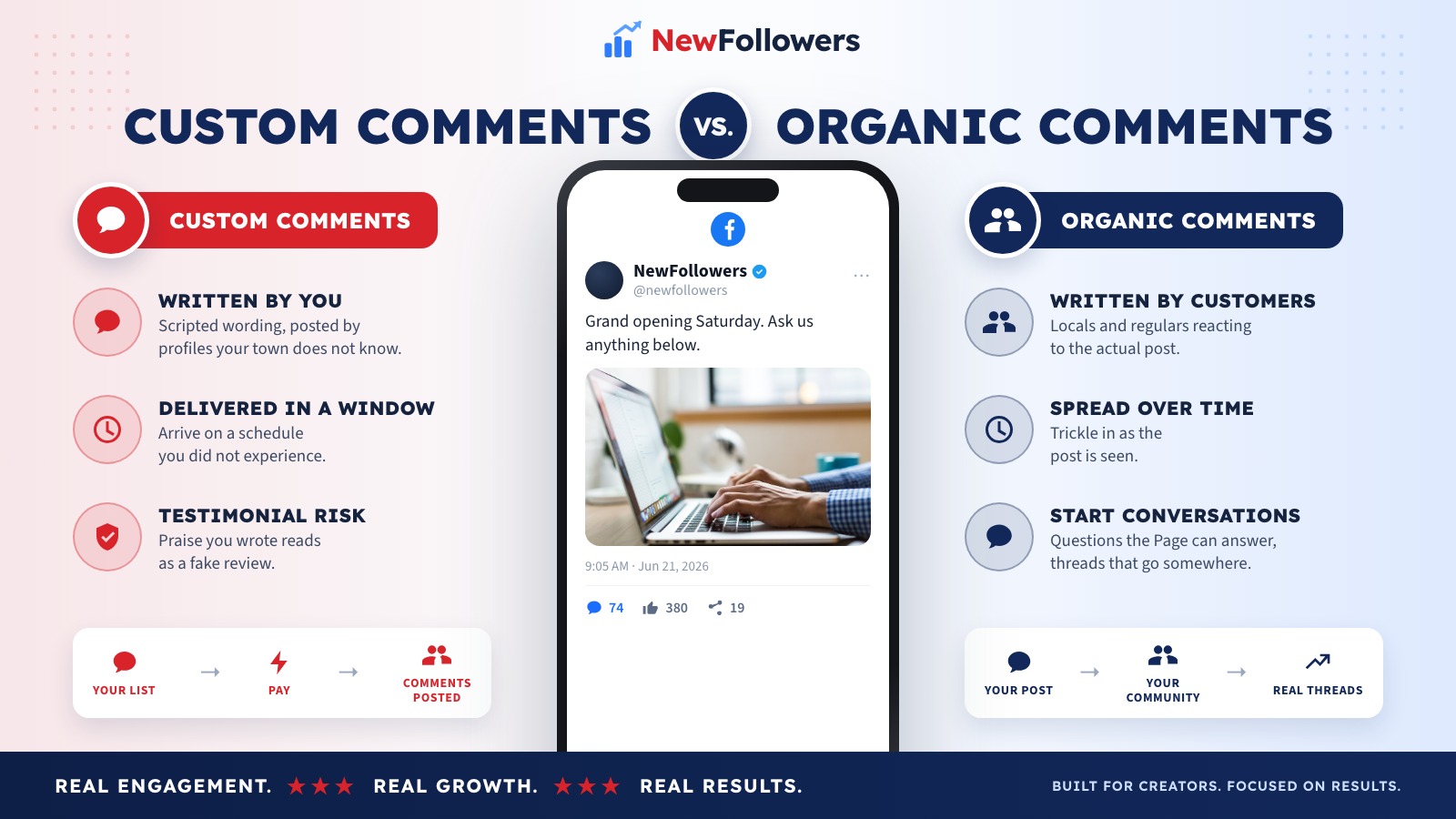
The strongest Facebook strategy remains posts that give your community something to say. A comment section you wrote yourself is a script, not a conversation.
Does Buying Custom Comments Violate Facebook's Rules?
Meta prohibits buying or selling engagement. Its Community Standards, which cover Facebook as well as Instagram, Messenger and Threads, include a Spam policy that lists attempting to sell, buy or exchange engagement such as likes, shares, views and follows among the things it does not allow, alongside posting or engaging at very high frequencies. A separate Inauthentic Behavior policy covers fake accounts used to deceive people about the origin of an audience. Comments are engagement, and supplying the wording does not change how they were obtained.
Enforcement usually takes the form of removed comments and reduced distribution, and profiles used to deliver bulk engagement are frequently disabled, which removes their comments with them. Because comments are public text attached to a named profile, a set of them arriving together from unrelated accounts is comparatively easy to identify. For the current wording, read Meta's Spam policy directly rather than relying on a provider's summary.
None of this changes because the commenting profiles are described as real or because the words were carefully written. The rule concerns how the engagement was obtained.
Policies and enforcement practices change, so review Meta's current standards before using any third-party engagement service.
U.S. Businesses Should Also Understand FTC Considerations
This is where custom comments differ most from every other engagement product, and Facebook Pages are overwhelmingly business Pages. A generic "great post" is a weak signal. A comment you wrote that says the food was excellent, the service was fast and the price was fair is a review, and if nobody actually experienced those things, it is a fake one.
The Federal Trade Commission's rule on consumer reviews and testimonials prohibits creating, buying or selling fake reviews and testimonials, including ones attributed to people who do not exist or who did not have the experience described, and it separately addresses the purchase of fake indicators of social media influence. The FTC's rule on the use of consumer reviews and testimonials is the authoritative text.
A custom comment that asks a question or reacts to the photo is a smaller matter than one that describes a customer experience that never happened. Businesses should understand that difference before writing a single line, and should keep anything resembling a review out of a purchased comment list entirely.
For commercial Pages, honesty about what is paid and what is voluntary matters more than a lively comment section.
What Should You Check Before Buying Custom Facebook Comments?
Anyone considering a custom comment service should evaluate it carefully before submitting a post link, a comment list or payment.
How Many Custom Comments Should You Buy?
There is no number that works for every Page. The appropriate level depends on your follower count, your usual engagement and what the post is for.
Comments are rarer than reactions. A Page whose posts normally earn one or two comments will not look more popular with forty specific ones on a single post while the reaction count barely moves; it will look staged, because the ratio of comments to reactions is far outside what real audiences produce, and because regulars can scroll back and compare with every other post. Proportion is what people notice, and comments, being words, are noticed more than any other metric.
Facebook does not publish a formula linking comment counts to distribution. Comments are one signal among many, and artificially generated signals should not be treated as a route to reach.
Do Comments Help a Post Reach More People?
Genuine comments can matter more than reactions. Facebook weighs how the people who see a post respond, and a comment is a stronger response than a tap, especially when the Page replies and a thread forms. Real conversation in the first hours is worth working for.
Purchased comments only imitate that signal if Facebook's systems treat them as genuine, and they are designed not to. Comments from profiles that do not follow the Page, that are outside your region and that post on hundreds of unrelated posts a day are the kind of signal those systems are built to discount or remove. The section looks fuller; the reach may not change.
Judge results by broader indicators such as reach, shares, messages, event responses, calls, visits and sales rather than by the comment count alone.
How to Combine Comments With Organic Growth
A durable Facebook presence is built on posts your community wants to talk about. Rather than writing the conversation yourself, structure your posting so that customers supply it.
Ask one specific question in the post
"Which of these two should we bring back this weekend?" produces answers. "Thoughts?" produces silence. Specific questions with easy answers earn the first comments that make others comfortable joining.
Reply to every comment in the first hour
Replies double the comment count on their own, keep the post active while distribution is decided, and show customers that commenting gets a response from a real person.
Post content that invites a choice or a story
Before-and-afters, staff picks, "guess the price" posts and mild polls give people a reason to weigh in. Pure announcements do not.
Treat the comment section as research
The questions customers ask under a post are your next FAQ, your pinned reply and your ad copy. Purchased comments cannot tell you any of that.
Build recurring posts people expect to answer
A weekly special vote, a regular behind-the-counter photo or a monthly customer photo thread trains your audience to arrive ready to respond.
Why Consider NewFollowers?
NewFollowers is a social media growth provider serving people who are researching engagement services across platforms including Facebook, Instagram, TikTok, YouTube and X. Its website presents multiple growth options and states that orders can be placed without handing over an account password.
For someone specifically searching to buy custom Facebook comments, NewFollowers can be included in the comparison process, but the important step is confirming whether a custom-wording option is currently available for Facebook and exactly how it works before ordering.
Buyers should verify:
No provider should be chosen because it promises the largest number. Clarity about what is actually being delivered, and by whom, is worth more than any headline figure.
Common Mistakes to Avoid When Buying Custom Comments
Writing reviews instead of reactions
A comment that describes a customer experience nobody had is a fake testimonial. Keep purchased comments to questions and reactions, or do not buy them.
Ignoring where the profiles are from
Twelve compliments from profiles in other countries under a neighborhood bakery's post undermine the very credibility they were meant to create.
Making every comment perfect
A dozen polished sentences that each praise a different feature read like copy. Real sections are uneven.
Ignoring the reaction count
Forty comments on a post with fifteen reactions is a ratio that does not occur naturally, and it is visible at a glance.
Replying to yourself
Answering comments you wrote is a conversation with nobody, and regulars who notice will reread the whole section.
Sharing account credentials
A comment service needs a link and a list. Any request for a password is a security risk and a warning sign.
Is Buying Custom Facebook Comments Worth It?
It depends on what you expect the comments to do. If the goal is real conversation, questions you can answer and posts that perform on their own, only organic comments deliver any of that, and a scripted section can actively discourage the real ones.
If you are researching third-party Facebook engagement services anyway, focus on the profiles behind the comments and whether they fit your community, keeping anything review-like out of your list, proportion to your reactions, delivery pacing, account security and Meta's current rules rather than on the cheapest package or the biggest number.
A few specific comments can make a new Page's posts look less empty, but the value stops there unless the content earns the next comment from a real customer.
Final Thoughts
People searching to buy custom Facebook comments usually want a comment section that looks like a conversation, with words that fit the post instead of emoji that fit anything. That is an understandable goal, but writing the comments yourself changes what they are.
Meta's standards prohibit bought engagement regardless of wording, a scripted section reads as scripted the moment a regular clicks a name, and a purchased comment that describes a customer experience is a fake testimonial under the FTC's rule. Businesses in particular should keep anything resembling a review out of any comment list they pay to have posted.
The strongest strategy is to ask specific questions, reply fast, post content people want to weigh in on, and treat the comment section as research rather than decoration. If you are comparing providers, NewFollowers can be reviewed as part of that process. Confirm whether custom comments are available, how wording is handled, the nature of the commenting profiles, delivery conditions and service terms before making a decision.
Ready to explore your options? Visit NewFollowers to review the currently available Facebook growth services and choose an approach that fits your audience, your goals and your appetite for risk.
Frequently Asked Questions
What are custom Facebook comments?
Comments whose wording you supply. Instead of a provider posting generic reactions, you submit a list of comment texts and the service arranges for accounts to post them on your chosen Page post.
Are custom comments better than generic ones?
They read more naturally because they can refer to the actual post, but they are still purchased engagement. The words are yours; the accounts and the motive are not organic.
Are purchased Facebook comments against Meta's rules?
Meta's Community Standards list buying, selling or exchanging engagement among the things they do not allow, and comments are engagement. There is platform-policy risk regardless of who wrote the text.
Can I write comments that praise my business?
You can, but you should not present them as customer opinions. Purchased comments that read as reviews or testimonials fall under the FTC's rule on fake reviews and testimonials.
How many custom comments should I buy?
There is no correct number. Comments are rarer than reactions, so a comment count far above what your posts normally earn, with reactions that have not moved, is the pattern that stands out.
Do custom comments require my Facebook password?
No. Commenting on a public Page post needs only the post link and your comment list. Requests for login credentials are a security risk, not a requirement.
Should I reply to purchased comments?
Replying to comments you wrote yourself is a conversation with nobody, and a customer who notices the pattern will read the whole thread differently. Save replies for real comments.
Do comments from real accounts count as organic?
No. A comment arranged through payment is coordinated engagement even when the account belongs to a real person and even when the wording was carefully written.
Can purchased comments be removed?
Yes. If Meta disables the commenting accounts or judges the activity inauthentic, the comments disappear with them, and most providers exclude that from any guarantee.
Why consider NewFollowers for Facebook growth?
NewFollowers offers social media growth services across several major platforms and states that customers never need to hand over a password. Confirm whether custom comments are currently available for Facebook, and on what terms, before ordering.
Ready to Grow Your Social Media?
Real followers, instant delivery, 30-day refill guarantee. Pick your platform: