Buy Cheap Facebook Likes for Pages, Posts and Photos
Quick Answer
Cheap Facebook likes, whether for a Page, a post or a photo, come from bot pools at the lowest prices, often from the wrong country for a local business, and are removed by Meta's sweeps. A small paced order from existing accounts, ideally located where your customers are, costs more per like but holds. Meta's Spam standard prohibits buying engagement, and U.S. businesses should keep purchased likes out of any claim made to customers.
People who want to buy cheap Facebook likes are usually a small business or a Page admin with a modest budget and a Page that looks emptier than the business behind it. The search covers three different products, Page likes, post likes and photo likes, and one economic fact that applies to all of them: the price tells you where the likes come from. At the bottom of the list, a like comes from an automated or inactive account, lands within minutes alongside hundreds of others, and is the first kind of engagement Meta's systems remove. A little higher up, a like comes from an existing account, arrives on a schedule, and stays.
This guide is written for the shop, the restaurant, the service business and the creator who have looked at a bulk price and wondered what the catch is. NewFollowers is one social media growth provider you will see while researching Facebook engagement, and it sells paced delivery rather than bulk dumps, so it has a position in this comparison. The guide still aims to be useful whichever way you decide: what cheap actually buys for each kind of like, what to check, and how to make a small budget do something.
What Does "Cheap" Mean When You Buy Facebook Likes?
In this market, price is a proxy for source, and that holds whether the product is a Page like, a post like or a photo like.
At the lowest prices, a seller is reselling access to a pool of accounts it controls: automated, created in bulk, or recycled from previous jobs. Having such an account like a Page costs almost nothing, so the price can be almost nothing. Delivery is instant because nothing is scheduled.
At a higher price, a seller is delivering likes from existing accounts with a history, spread over hours or days so the growth looks like interest. That costs more because accounts with a history are scarcer and pacing takes infrastructure.
Cheap also has a third meaning: a small order. A modest package from a paced service can be inexpensive in total while still being the better product per like. Much of the confusion in this search comes from conflating cheap per like, which points at bot pools, with cheap in total, which can mean ordering sensibly for a small Page.
The three products differ in where the like lands. Page likes sit on the Page itself and are covered in depth in the guide to buying Facebook Page likes. Post likes sit on a single post; photo likes on a photo or profile picture. Each has its own guide. This one is about the price question they share.
Why Do Facebook Pages Look for Cheap Likes?
Because a Page with a few dozen likes reads as new or abandoned, whatever the business behind it is like, and because Facebook's own paid tools can feel expensive for a small operation.
There is a rational core. A customer who finds a Page decides in a few seconds whether it looks active and trusted, and the like count is part of that. Page admins also believe, with some basis, that early engagement affects how far a post travels, and they want to prime it without spending much.
Cheap likes tend to look attractive when:
Each of these is a real situation. What none of them needs is a burst of bot likes that Meta removes a week later, which is what the lowest price usually delivers.
Can Cheap Facebook Likes Come From Real Accounts?
Yes, but not at the very bottom of the price list.
A like from an existing account means a person holds that account, it has a history, and it is used for other things. Delivering likes from such accounts on a schedule has a real cost, and a seller pricing below that cost is not delivering that product, whatever the listing says.
Bot-pool likes can be dressed up. The profiles may have a photo, a hometown and a few posts. What they lack is behavior: they never comment, share or come back, and they like the same Pages at the same time. Those are the patterns Meta's systems look for, which is why bulk likes drop.
For a local business the mismatch is especially visible. A bakery in one town with a thousand Page likes from profiles scattered across other continents is telling its actual customers something. The USA-targeted version of the product, covered in the guide to Facebook Page likes from USA users, exists precisely because location is part of what makes a like count believable.
What Makes a Like Count Look Natural?
Meta's systems, your customers and anyone comparing your Page with a competitor's read the same signals, and cheap bulk likes contradict them.
Characteristics that make a like count credible include:
Proportion is where the cheapest orders fail first. A bulk package sized by price rather than by the Page produces a count that argues with everything around it.
Cheap Bulk Likes vs. Paced Real Likes
Two products, one name.
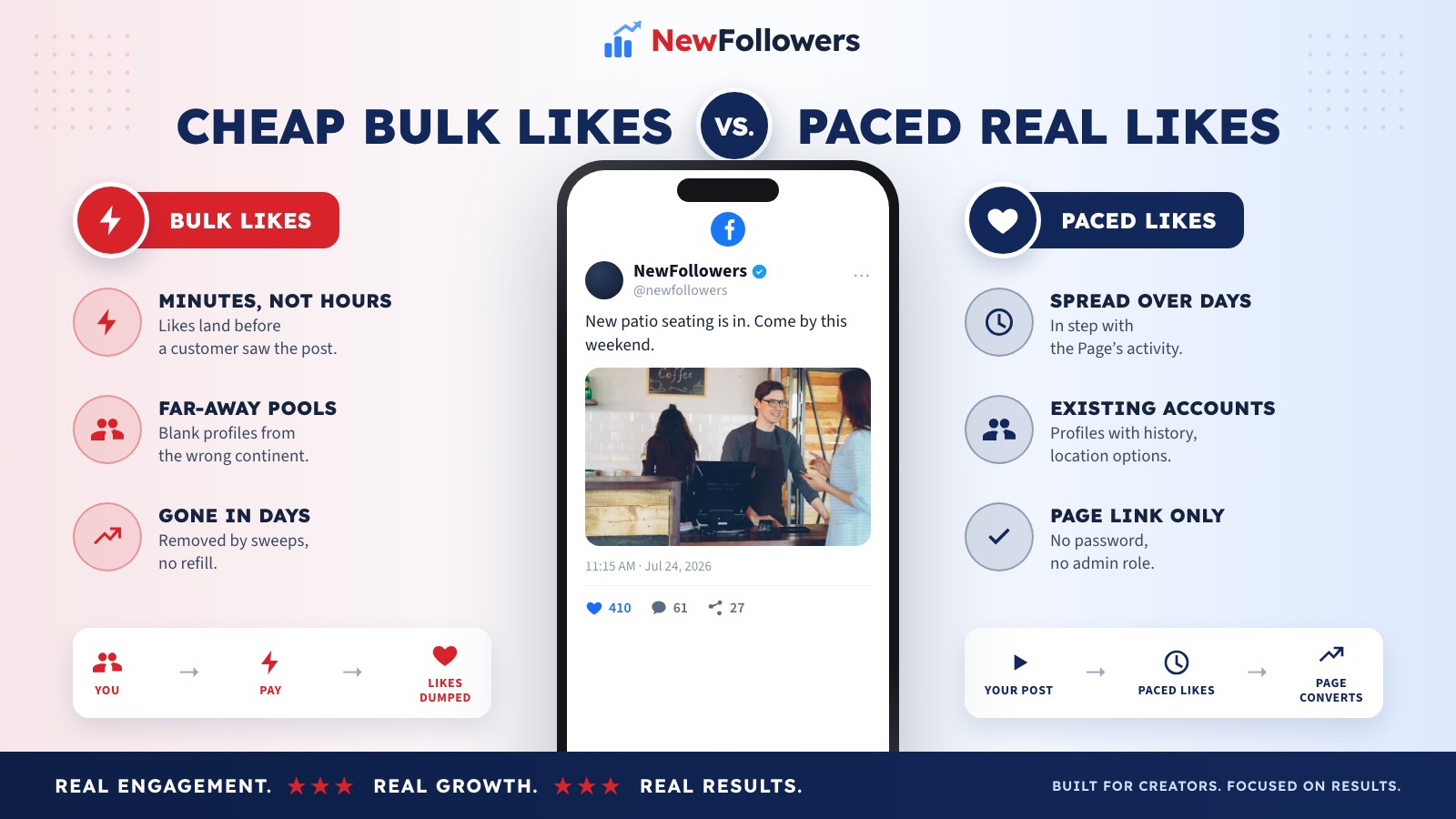
Cheap bulk likes
Paced likes from real accounts
The right-hand column is not organic growth. It is the version of purchased likes that does not announce itself and does not vanish, and it costs more per like for exactly those reasons.
Does Buying Cheap Facebook Likes Violate Meta's Rules?
Meta's Spam Community Standard prohibits attempting to or successfully selling, buying or exchanging engagement such as likes, shares, views and follows, and it also prohibits attempting to sell, buy or exchange platform assets such as accounts, groups and Pages. It separately bars posting, sharing, engaging with content or creating accounts at very high frequencies, manually or automatically, which describes what a bot pool does when it fires at a Page.
Price does not change the category. Purchased likes from real accounts are still purchased engagement under the standard, so a paced order carries platform-policy risk too. The difference is in what tends to happen: with a bot dump, the likes are removed and the Page's engagement is flagged as inauthentic; with a paced order, the risk is that some likes are trimmed. Neither is zero, and this guide does not pretend otherwise.
For a business Page there is a second consideration. A Page's reach depends on how its audience behaves, and an audience padded with accounts that never react lowers the share of followers who engage. That is a practical cost of cheap likes that has nothing to do with enforcement.
U.S. Businesses Should Also Understand FTC Considerations
Facebook Pages are disproportionately run by businesses, which makes this section more than a footnote.
The Federal Trade Commission's rule on consumer reviews and testimonials prohibits buying or selling fake indicators of social media influence when the buyer knows or should know they are fake and uses them to misrepresent influence for a commercial purpose. Likes and follower counts are among the indicators it contemplates.
The cheap end of the market is the part most clearly described by the rule, because bulk bot likes are fake indicators by construction. A business that adds them to a Page and then treats the count as evidence that customers love the business, in a pitch, a proposal or a sign in the window, has done the thing the rule targets. Keep purchased engagement off product content and out of your claims, and never point to a purchased count as proof of anything.
What Should You Check Before Buying Cheap Facebook Likes?
A low price removes your margin for error, so check more, not less.
Login requirements. If the seller wants your Facebook password or admin access to the Page, stop. Liking a public Page, post or photo needs the link and nothing else.
Which like you are buying. Confirm whether the package delivers Page likes, post likes or photo likes. Sellers conflate them, and the wrong one on the wrong target is wasted money.
Source and location. Ask where the accounts are and whether location targeting is offered. For a local business, likes from the wrong continent are worse than none.
Delivery speed. Likes that land within minutes are a bulk dump. Ask whether delivery can be spread over hours or days.
Package sizes. A service whose smallest package is larger than your Page can plausibly carry is not selling to your business.
Handling of drops. Find out whether removed likes are replaced, for how long, and how you request it.
Payment protection and reviews. Use a method that lets you dispute a charge, and weigh testimonials on the seller's site as marketing rather than evidence. The guide to buying likes on Facebook posts applies the same checks to the post-likes product specifically.
How Many Likes Should a Small Page Buy?
Fewer than the largest package the budget allows, because proportion is what makes the purchase invisible or obvious.
Look at what the Page's posts normally earn in reactions, comments and shares, and at how many people actually visit. Anything you add should sit inside that pattern. A Page whose posts earn a dozen reactions can carry a modest addition to a launch post without looking odd. It cannot carry a thousand Page likes overnight, and no price makes that a good purchase.
On a small budget, the best use of money is a small paced order on a post that is already reaching people, or a modest Page-likes order spread over weeks while the Page posts regularly. The worst is a large bulk order on a Page nobody visits. If reactions rather than plain likes are what a post needs, the guide to Facebook post reactions with instant delivery covers that product and its own proportion problem.
Do Cheap Likes Help a Post Reach More People?
Not by themselves, and the cheapest ones can hurt.
Facebook decides how far to distribute a post by what people do with it: whether they stop, react, comment, share, click and come back, read together. A like from a bot account arrives with none of the surrounding behavior. A post with a suddenly large like count and no comments or shares is not the pattern the system rewards, and a Page whose audience is padded with inert accounts engages at a lower rate across every post. The guide on growing a Facebook Page covers what actually moves reach.
Where paced likes on a post with real reach can help is at the human level. A visitor who finds the Page and sees plausible numbers is more inclined to trust it, to read the post and to react themselves. That effect is small and depends entirely on the Page being worth the visit.
How to Combine a Small Likes Order With Organic Growth
Any likes you add do their best work on top of habits that cost nothing.
Post what a customer would share
Openings, menus, before-and-after photos, local news, staff, behind the counter. Posts that a customer would send to a friend earn shares, and shares are the engagement that carries a Page.
Reply to every comment as the business
A Page that answers is a Page that looks open. Replies are engagement Facebook weighs and the clearest signal to a visitor that the business is real.
Keep a cadence the business can sustain
Two or three posts a week, every week, beats a burst around a launch and silence afterward. Consistency gives you a baseline so you can tell what an added order actually did.
Invite your actual customers
A sign at the register, a line on a receipt, a mention at checkout. Real customers who like the Page are the followers who react, and they cost nothing.
Watch the numbers after any order
If added likes are followed by a dip in reach, the order was too large or the source was poor. If reach holds, the next order can match it. Let the data set the pace, not the price list.
Why Consider NewFollowers?
NewFollowers is a social media growth service that sells Facebook followers, along with services for several other platforms. It does not compete at the bottom of the price list, and this guide has explained why a business that cares about its Page should not want a provider that does.
Three things distinguish its approach. Delivery is paced, so growth stays in proportion to the rest of the Page. No password or admin access is requested; orders are placed with a Page or post link. And prices and quantities are stated before payment, with support available if delivery does not match the description. The current Facebook follower packages, including the smallest starter option, are listed on the Facebook page, and the cheap followers page explains how low-cost delivery is paced rather than dumped.
For Page, post or photo likes specifically, check the Facebook page for what is currently available, how it is paced and on what terms before ordering. Buying any metric is a platform-policy risk under Meta's spam standard, and NewFollowers does not pretend otherwise. Its position is that if a business is going to spend a small amount on likes, it should spend it on a paced order from existing accounts rather than on the cheapest bulk package, and keep the order in proportion to the Page.
Common Mistakes to Avoid When Buying Cheap Likes
Sorting by price and buying the cheapest
The cheapest listing is the one most likely to be a bot pool. Price is information; read it.
Buying Page likes when the problem is a post
A launch post with three reactions is not fixed by a thousand Page likes. Match the product to the problem.
Ignoring where the accounts are
A local business with likes from the wrong continent has bought a visible contradiction. Ask about location.
Ignoring delivery speed
Likes that land in minutes announce themselves. If pacing is not offered, the product is a dump.
Handing over admin access
Liking a public Page or post needs the link. Any request for a password or Page role is a security risk, whatever the price.
Citing a purchased count as proof
For a U.S. business this is where the FTC rule becomes relevant. Keep purchased engagement out of pitches, proposals and signage.
Are Cheap Facebook Likes Worth It?
It depends on which meaning of cheap you have in mind.
Cheap per like, from the bottom of the price list, is rarely worth it. The likes come from pools Meta's systems are built to find, they arrive without any of the behavior that accompanies real interest, they pad the audience with accounts that never react, and they are often gone within days with no recourse. A business pays a small amount for a number and a set of new problems.
Cheap in total, meaning a small paced order from existing accounts, sized to a Page that is already active and, where possible, located where the customers are, is a different calculation. It still carries platform-policy risk. In exchange, the likes hold, the pattern stays plausible, nothing touches the Page's admin access, and an empty-looking Page stops undercutting a business that deserves better. For a small business on a budget, that can be a reasonable trade.
What no price buys is a substitute for the Page itself. Likes change how a Page reads at a glance. Only what customers do decides whether it grows.
Final Thoughts
People searching to buy cheap Facebook likes usually run a Page that looks emptier than the business behind it and want to fix that without spending much. That is a sensible goal. What the cheapest listings deliver is bot-pool likes that arrive in a burst, break the pattern and disappear, and what a small paced order delivers is a modest, believable lift that holds.
Meta's spam standard prohibits buying engagement and high-frequency automated activity, so any purchased likes carry platform-policy risk, with bulk bot likes carrying the most. U.S. businesses have the FTC to consider on top, and Pages are where that matters most. Spend a small budget on pacing, proportion, location and a provider that never asks for admin access, not on the lowest price per thousand.
The strongest strategy is still the plain one: post what a customer would share, reply as the business, keep a cadence, invite your actual customers and watch the numbers. If you are comparing providers, NewFollowers can be reviewed as part of that research. Confirm what is currently available for Facebook, how it is paced and what the terms are before making a decision.
Ready to explore your options? Visit NewFollowers to review the currently available Facebook growth services and choose an approach that fits your audience, your goals and your appetite for risk.
Frequently Asked Questions
How cheap can Facebook likes be?
As cheap as a bot pool makes them. The lowest prices are only possible when the likes come from automated or inactive accounts delivered in a burst. Likes from existing accounts, paced over time, cost more per like because someone maintains those accounts and schedules the delivery.
Is there a difference between cheap Page likes, post likes and photo likes?
The product differs, the economics do not. Page likes attach to a business Page, post likes to a single post, photo likes to a photo or profile picture. At the bottom of the price list all three come from the same kind of pool and behave the same way: fast, silent and short-lived.
Are cheap Facebook likes real?
At the bottom of the price list, usually not. The profiles may have a photo and a few posts, but they never comment, share or return, and they like the same things at the same time. Cheap in total, meaning a small paced order from existing accounts, is a different and more expensive product per like.
Do cheap Facebook likes disappear?
Bot-pool likes are the kind Meta's systems identify and remove most readily, so often yes. Likes from existing accounts delivered at a natural pace hold far better. A stated refill policy is worth more than a low headline price.
Are cheap Facebook likes against the rules?
Meta's Spam standard prohibits attempting to or successfully selling, buying or exchanging engagement such as likes, follows and shares, and bars engaging with content at very high frequencies manually or automatically. Purchased likes at any price carry platform-policy risk; bulk bot likes carry the most.
Will cheap likes make my Page look fake?
If a Page has thousands of likes and posts that earn nothing, or a post has hundreds of likes and no comments or shares, the pattern is one real audiences do not produce. Proportion, not price, decides whether a like count is believable.
How many likes should a small business buy?
Fewer than the biggest package the budget allows. Size the order to what the Page's posts normally earn so the pattern stays plausible. A small order on a post that is already reaching people does more than a large order on a Page nobody visits.
Do cheap likes help a Facebook post reach more people?
No. Facebook distributes posts on what people do with them: reading, reacting, commenting, sharing and clicking. A like with none of that behind it supplies nothing, and a distorted pattern can hurt.
Should a cheap likes seller ask for my Facebook login?
Never. Liking a public Page, post or photo needs only the link. A request for login credentials is a security risk, not a requirement, whatever the price.
Why consider NewFollowers for Facebook growth?
NewFollowers sells Facebook followers with paced delivery, needs no password, and lists prices and quantities before payment. For Page, post or photo likes, confirm current availability, pacing and terms on the Facebook page before ordering.
Ready to Grow Your Social Media?
Real followers, instant delivery, 30-day refill guarantee. Pick your platform: