Buy YouTube Shares: The Signal That Costs a Viewer the Most
Quick Answer
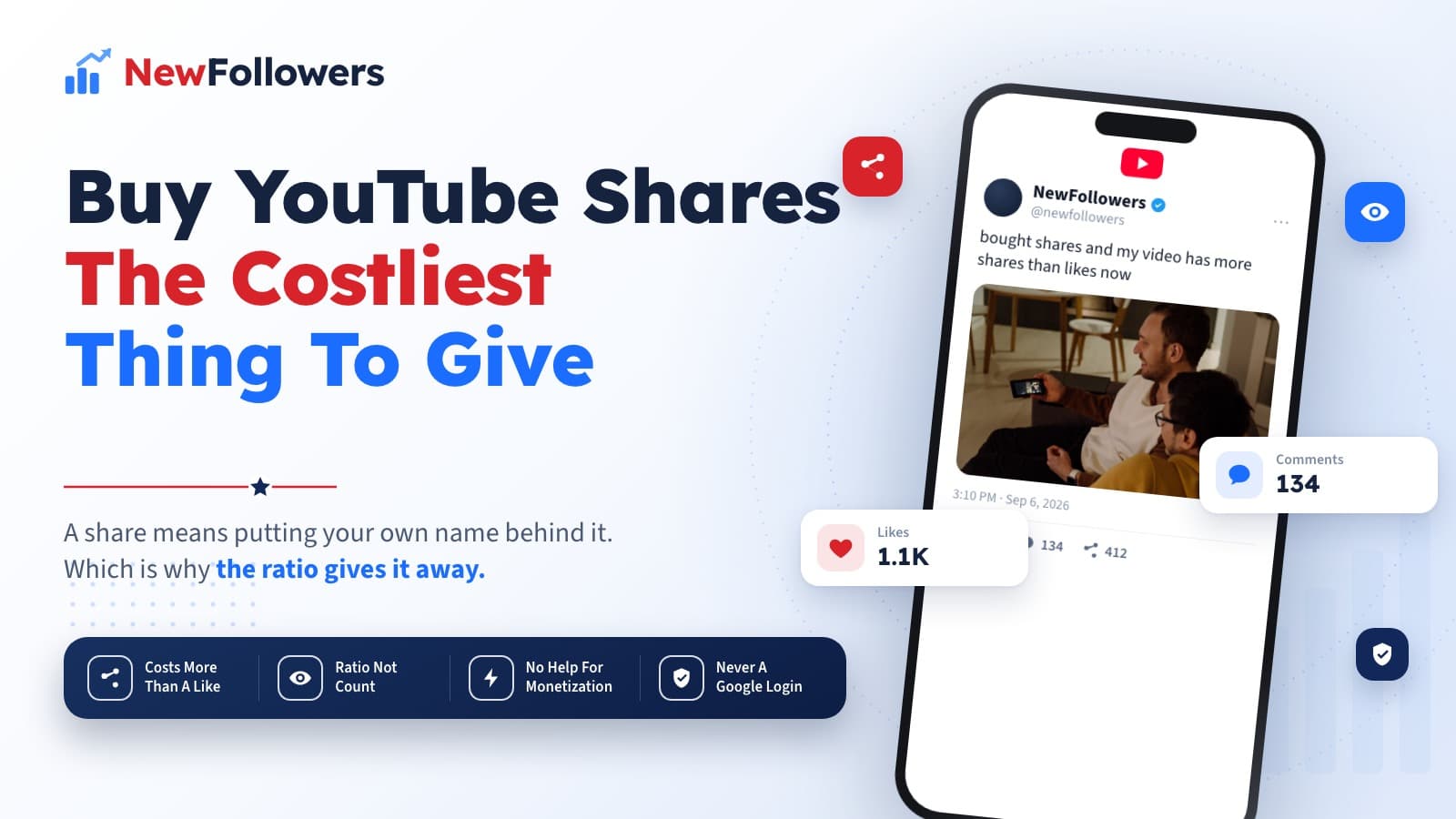
Buying YouTube shares means paying for the Share button to be pressed on your video. It is an unusual thing to buy because a share is the most expensive action a viewer can take: they have to decide your video is worth putting their own name behind. That is exactly why it carries weight in YouTube's analytics, and why a share count that runs ahead of views and comments reads as wrong rather than impressive. YouTube's fake-engagement policy prohibits anything that artificially inflates views, likes, comments or other metrics, and three strikes in 90 days ends a channel. If you buy anyway, keep the count below what your best organic video earned and never hand over a Google login.
Most people who buy YouTube shares arrive at it after buying something else first. Views did not move the channel, likes looked thin, and shares are the next box on the provider's menu.
It is worth understanding what that box actually contains, because shares behave differently from every other metric on this list.
What a Share Actually Is
The Share button under a video, and what happens when someone presses it.
YouTube counts the press. It appears in Studio under the analytics for that video, next to views, watch time, likes and comments. Whether the person then sends the link anywhere is not tracked, but the intent to send is.
That distinction matters. A like is a reaction to the video. A share is a decision about somebody else: this is worth their time, and I am willing to be the person who sent it.
Where shares sit among the signals:
Shares sit near the expensive end, which is why they are read as a quality signal and why buying them is conspicuous.
The Ratio Problem
Every purchased metric has a ratio that gives it away. For shares the ratio is unusually unforgiving.
On a normal video, shares are a small fraction of likes, which are themselves a small fraction of views. The exact numbers vary enormously by topic, but the ordering does not: views, then likes, then comments, then shares, in descending size, almost always.
A purchased share count breaks that ordering. Nine hundred views and three hundred shares describes a video that a third of its audience recommended to someone, which does not happen. The number is not impressive, it is arithmetic that does not work.
This is the opposite of how buying views behaves, where a large number is at least internally plausible.
Share Count Against Share Ratio
The same purchase seen two ways.
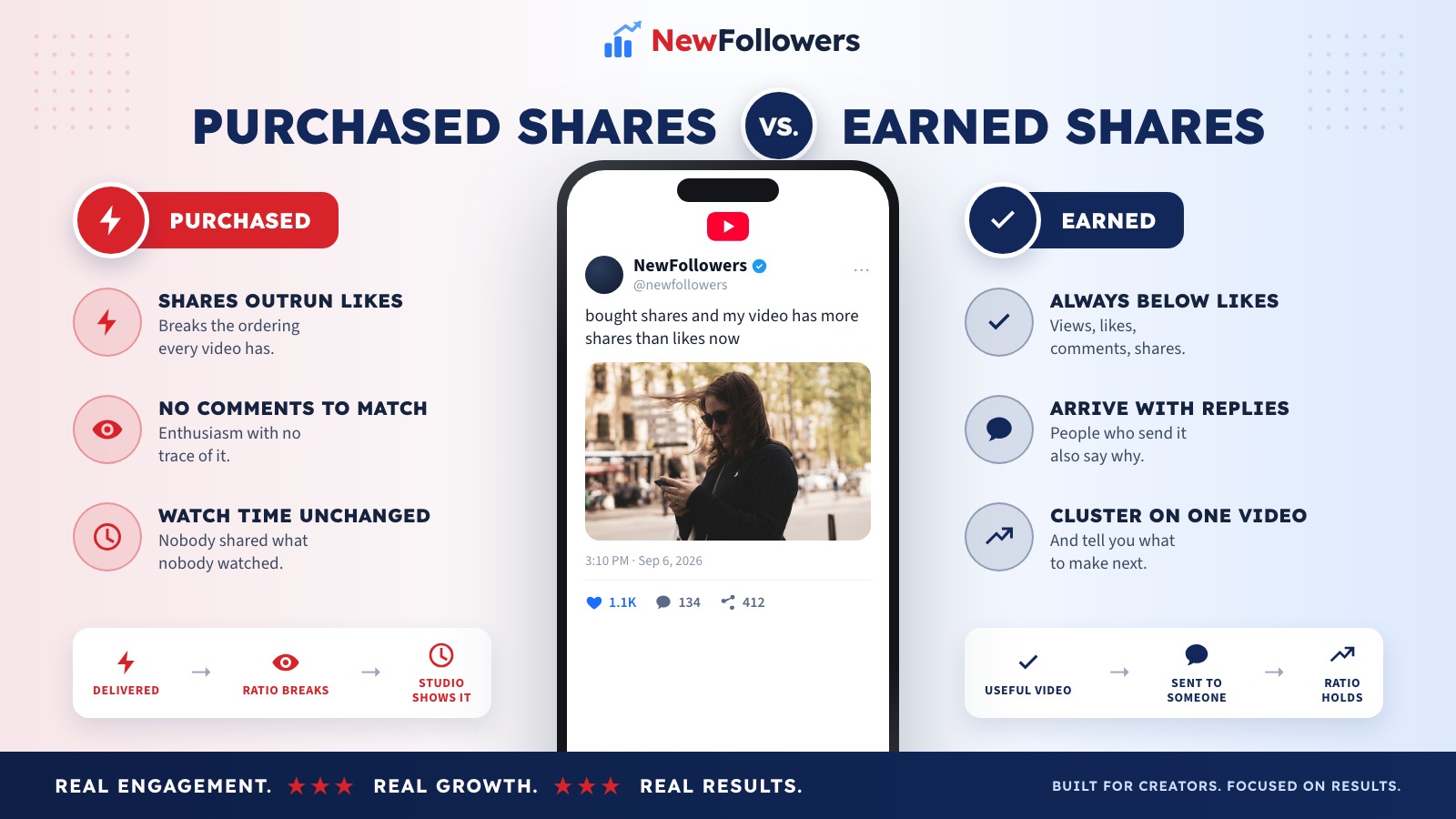
What a purchased share count looks like
What an earned share count looks like
The right-hand column is also the only version that tells you anything useful, which is the practical argument against the left.
What YouTube's Policy Says
The fake-engagement policy prohibits anything that artificially increases views, likes, comments or other metrics, including automated systems and services that deliver such interactions. It names the strike system as a consequence, and three strikes within 90 days ends a channel.
The more common outcome is quieter. The engagement is discounted or removed, the count falls, and nothing is announced.
Other platforms word it the same way. Meta's Spam standard prohibits buying, selling and exchanging engagement including shares, TikTok's guidelines prohibit trading in services that inflate metrics, X's Authenticity policy prohibits inauthentic use of engagement features to artificially impact traffic, and Twitch's guidelines prohibit viewership tampering.
Shares Do Not Help Monetization
Worth stating because it is a common assumption.
The Partner Program requires 1,000 subscribers plus one of two things: 4,000 valid public watch hours in the last twelve months, or 10 million valid Shorts views in the last 90 days.
Shares appear in neither. A video with a thousand shares and no watch time is exactly as far from monetization as a video with none. If the goal is the Partner Program, shares are the wrong purchase entirely, and watch time is the wrong one for a different reason: it is the metric YouTube checks hardest.
How to Judge a Provider
Four checks, in order of how much they eliminate.
Does it ask for a login? Stop there. Delivery to a public video needs only the URL, and a YouTube login is a Google login, so the same password covers Gmail, Drive and Photos.
Is the price visible before checkout? A payment flow that hides the cost until after the card details tells you how the rest of the relationship will go.
Is delivery spread over time? Three hundred shares in an hour on a video with nine hundred views is a shape, not a number.
Is there a refill window with a date on it? Purchased engagement decays. A guarantee without a stated period is a slogan.
What Actually Earns Shares
The useful half, because shares are one of the few metrics where the organic route is learnable.
Solve a problem someone can name
A video that answers a specific question gets sent to the specific person who asked it. Broad, enjoyable videos do not, because there is nobody obvious to send them to.
Settle an argument
Comparisons, tests and side-by-sides get shared into group chats because they end a disagreement.
Make the result visible early
If someone has to watch eight minutes before knowing whether it worked, they will not send it to a friend who has not watched anything.
Give them a reason in one line
The sentence someone types when they paste your link matters more than the title. If your video hands them that sentence, sharing gets easier.
Ask, once, at the right moment
Not at the start, and not as boilerplate. Immediately after the moment that made the video worth watching.
Why Consider NewFollowers?
The only section here selling anything. Everything above applies to any provider, this one included.
NewFollowers sells growth services across six platforms. Orders take a video URL or username, never a password, which matters more than usual on YouTube because a YouTube login is a Google login. Delivery is spread over time rather than arriving in a block, prices are visible before checkout on the YouTube page, and losses are covered by a 30-day refill guarantee.
What is not claimed: that any of it is permitted. YouTube's fake-engagement policy is explicit, and this page has quoted it. On shares specifically the honest advice is narrower than usual: it is the metric where a wrong number is most visible, so if you buy at all, buy less than you think.
Common Mistakes
Buying more shares than the video has likes
The ordering is views, likes, comments, shares. Breaking it is the tell.
Buying shares on a video with few views
The ratio is worst exactly where the video is quietest.
Expecting shares to help monetization
The Partner Program counts subscribers and watch hours. Shares are in neither.
Handing over a Google login
It is not just YouTube. Gmail, Drive and Photos sit behind the same password.
Buying evenly across every video
Real shares cluster on specific videos. An even spread is a fingerprint.
Reading the count instead of the ratio
The number alone tells you nothing. Its relationship to views and likes tells you everything.
Final Thoughts
Buying YouTube shares targets the one metric that is expensive for a viewer to give, which is what makes it valuable and what makes a purchased version obvious. Shares sit below likes, which sit below views, and a count that breaks that ordering describes a video nobody actually recommended.
YouTube's fake-engagement policy prohibits artificially inflating any metric and backs it with a strike system that ends a channel at three in 90 days. Shares also contribute nothing to the Partner Program, which counts subscribers and watch hours only.
What earns shares is narrow and learnable: make something one person would send to one other person, and make the reason obvious in a single line. For the same metric on other platforms, the Instagram shares guide covers how the mechanics differ there.
Frequently Asked Questions
What is a share on YouTube?
A press of the Share button under a video, which copies a link or sends it to another app. YouTube counts these and reports them in Studio, so it is a real metric rather than something inferred.
Do shares affect YouTube reach?
They are one of the engagement signals YouTube can read, and a strong one, because sharing costs the viewer more than a like. What actually drives distribution is watch time and how long people stay, so shares support that picture rather than replace it.
Is buying YouTube shares against the rules?
Yes. YouTube's fake-engagement policy prohibits anything that artificially inflates views, likes, comments or other metrics, including automated systems and services that supply them. Three strikes within 90 days can end a channel.
How many shares is normal?
Far fewer than most people expect. On a typical video shares run well below likes, which run well below views. If a video has 900 views and 300 shares, the number is doing the opposite of what it was bought for.
Will the shares disappear?
Some will. When YouTube removes the accounts behind purchased engagement, the actions attributed to them go too, so a share count can fall back weeks after delivery.
Do shares help the Partner Program?
No. The Partner Program requires 1,000 subscribers plus 4,000 valid public watch hours in twelve months, or 10 million valid Shorts views in 90 days. Shares are not part of either threshold.
Where do I see my share count?
In YouTube Studio, under the analytics for an individual video. It sits alongside views, watch time, likes and comments, which is also where a mismatch between them is most visible.
Is this different from buying views?
Yes, in risk profile. Views are the most bought metric and the most watched by YouTube. Shares are rarer, cheaper and less scrutinized, but also far more conspicuous when the ratio is wrong, because nobody shares a video nobody watched.
Do I need to give a password?
No, and you should not. Delivery to a public video needs only the URL. A YouTube login is a Google login, so the same credentials cover Gmail, Drive and Photos.
What earns real shares?
Something a viewer wants to send to one specific person. A tutorial that solves a problem someone they know has, a comparison that settles an argument, or a result worth showing. Videos that are merely enjoyable get likes; videos that are useful to a third party get shared.
Ready to Grow Your Social Media?
Real followers, instant delivery, 30-day refill guarantee. Pick your platform: