YouTube Video Promotion: Ads, Promotion Services, View Sellers and What to Check
Quick Answer
YouTube video promotion covers four different things: Google Ads video campaigns, which are YouTube's own paid route and charge per view, click or impression; promotion agencies that run those ads for you or place your video in front of audiences they control; view and subscriber sellers, which range from paced delivery from existing accounts to outright bots; and organic promotion, which costs time. YouTube's fake engagement policy prohibits anything that artificially increases views, likes or subscribers and bars promoting third-party services that inflate metrics, so bought views carry a rules risk that ads do not. Ads have their own limit: the Partner Program page states that watch hours from ad campaigns do not count toward monetization thresholds. Before paying anyone, check whether they run ads in your own account, where views come from, how delivery is paced and what is written down.
Searching for YouTube video promotion puts you in front of four products that share a name and almost nothing else. Google's own ads manager will show your video to people it chooses and bill you per view or click. An agency will do the same for a fee, or promise placements on channels and playlists it controls. A view seller will raise the number under the video, by methods that range from a paced schedule to a bot farm. And a hundred articles will tell you the best promotion is a better thumbnail, which is true and does not help when the upload is tomorrow.
This guide is written for the creator whose videos stall at the subscriber count, the small business that has been quoted a promotion package and wants to know what it buys, and anyone comparing services and finding the promises interchangeable. NewFollowers is one of the services you will meet while researching, and it belongs to the paced-delivery kind, so it has a view on the others. The guide is still built to be useful whichever route you choose, or if you choose none: what each one does, how you pay, what YouTube's rules say, and how to promote a video without paying anyone.
What Does "YouTube Video Promotion" Actually Mean?
Four mechanisms, one phrase.
Google Ads video campaigns. YouTube's own paid route. Google's video ad formats page describes skippable in-stream ads, where you pay when a viewer watches 30 seconds of your video or interacts with it, whichever comes first; in-feed ads that appear as thumbnails in search, home and watch pages, where you are charged when someone clicks to watch; non-skippable and bumper ads paid on impressions, bumpers being between 5 and 6 seconds long; and Shorts ads that appear between organic Shorts. Campaign objectives include YouTube reach, views and engagements.
Promotion agencies and services. Companies that run those campaigns for you, or that promise placements: your video embedded on sites they control, added to playlists, mentioned by channels they work with. The legitimate version is an ads manager for hire. The vaguer version is a promise of "organic promotion" whose mechanism is never specified.
View and subscriber sellers. Services that raise the number under the video or on the channel. At one end, paced delivery from existing accounts over hours or days, ordered with a link. At the other, bots that generate plays in a spike. The guide to buying YouTube views covers this kind in depth.
Organic promotion. Titles, thumbnails, openings, community posts, Shorts cut from the long video, cross-posting and collaborations. It costs time and it is the mechanism every paid route is trying to imitate.
Why Do YouTube Creators Pay for Promotion?
Because YouTube recommends videos that already perform, because a video that stalls at the subscriber count never gets the chance to perform, and because the services promise to break the loop.
There is a rational core to the search. A new channel's uploads are shown mostly to its subscribers, so a channel with few subscribers has little to grow from. A business needs a video to be seen by the people it was made for, not by whoever the algorithm has to hand. A creator with a launch, a course or a sponsorship has a date. Paying to be seen is an honest answer to all three, as long as you know which product you are paying for.
Paid promotion tends to look attractive when:
Each of these is a real situation. What none of them tells you is which of the four mechanisms is being sold, and that decides both what you get and what YouTube's rules say about it.
What Does Each Kind of Promotion Actually Deliver?
Precision about the mechanism saves money and channels.
Ads deliver reach to real people you chose. Viewers who watch past the skip point, or click an in-feed ad, chose to. Some subscribe. It is the most expensive way to acquire a viewer and the only paid route YouTube operates itself. It has one limit creators often miss, covered below: watch hours from ad campaigns do not count toward the Partner Program.
Agencies deliver whatever they actually do. An agency running Google Ads in an account you control delivers ads, plus its fee. An agency promising placements delivers embeds and playlist slots, which produce plays of uncertain quality. An agency promising "organic promotion" without a mechanism usually delivers bought views under another name.
Paced view or subscriber delivery changes a number. Views or subscribers arrive from existing accounts on a schedule. They change how the video and channel read; they do not bring an audience that returns. The guide to YouTube views from real U.S. users is the honest account of what a paced order does and does not do.
Bots deliver a spike and a removal. Plays with no watch time arrive in hours, the retention curve collapses, and YouTube's systems remove the views and sometimes the video.
What Makes a Promotion Service Credible?
Whatever the kind, the same signals separate a service that does what it says from one that does not.
Characteristics of a credible promotion service include:
The second point is the one that separates real ad agencies from view sellers wearing an agency's clothes. Ads you paid for are visible in your own Google Ads account, with impressions and costs. If a service cannot show you that, it is not running ads.
View Bots vs. Paced Views
Both raise the number under the video. What they do to it is different in kind.
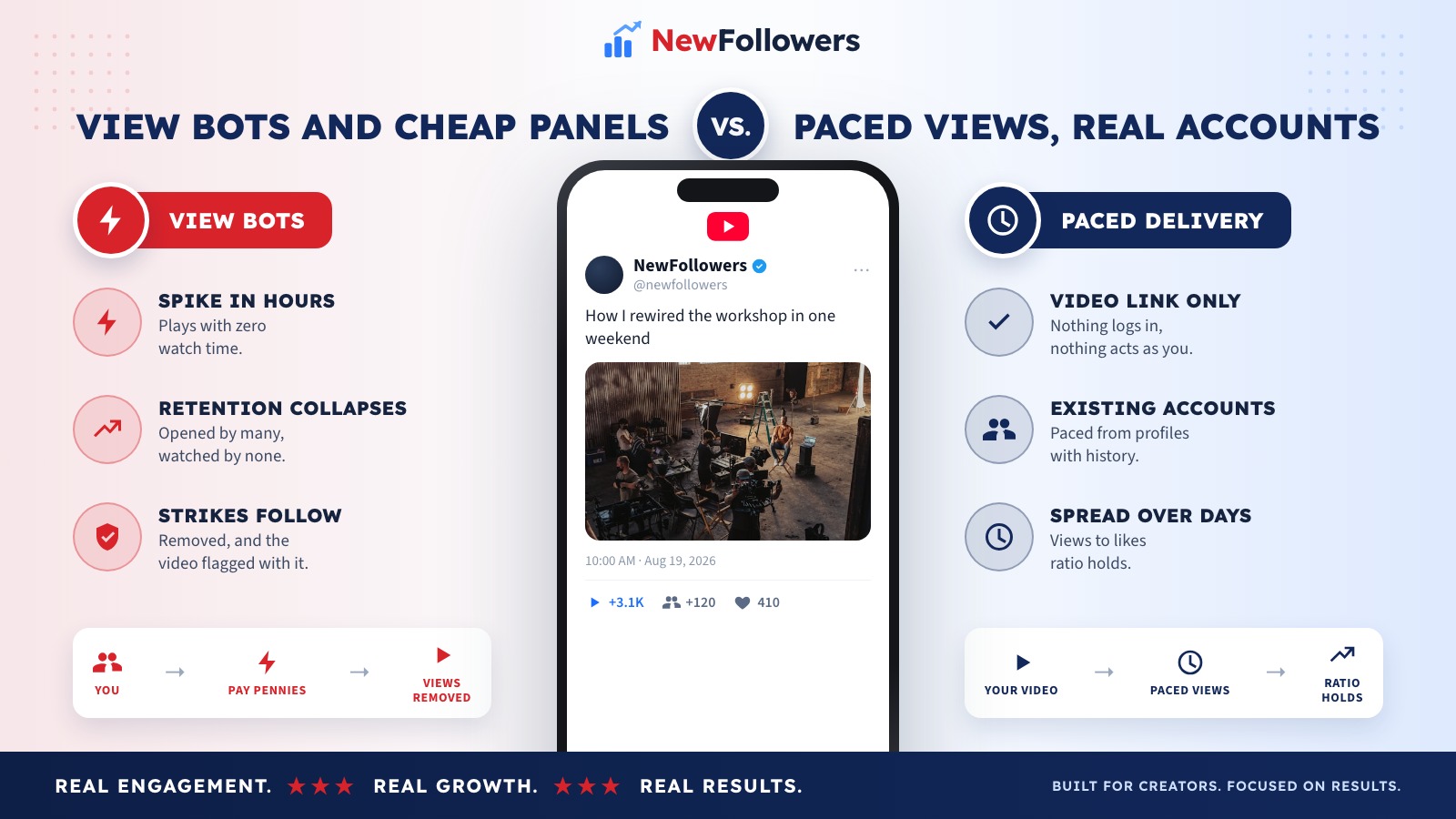
View bots and cheap panels
Paced views from a growth service
Neither column is advertising, and neither is organic reach. The right-hand column is the form of added views that does not announce itself in the retention curve and does not cost you your login; it is not exempt from YouTube's rules, and this guide does not pretend it is.
Do Promotion Services Violate YouTube's Rules?
Ads do not. Bought views do. Agencies depend on which one they are actually selling.
YouTube's fake engagement policy states that YouTube doesn't allow anything that artificially increases the number of views, likes, comments, or other metrics either by using automatic systems or serving up videos to unsuspecting viewers. It also prohibits content that links to or promotes third-party services that artificially inflate metrics like views, likes, and subscribers. Every view seller on the market, paced or not, is what that sentence describes, and mentioning one in a video or description is a second violation.
The consequences are stated on the same page: content that violates the policy is removed, and if you get 3 strikes within 90 days, your channel may be terminated. Repeated violations of the Community Guidelines or Terms of Service can also end a channel.
Google Ads campaigns are YouTube's own product and sit outside the policy, but they have a limit of their own. YouTube's Partner Program eligibility page sets the thresholds at 1,000 subscribers with 4,000 qualified watch hours in the last 12 months, or 1,000 subscribers with 10 million qualified Shorts views in the last 90 days, and lists ad campaigns among the video types whose watch hours do not count toward the thresholds. Shorts views gained through ad campaigns are excluded the same way. Ads can build an audience; they cannot buy the thresholds. The guide to Partner Program requirements covers the rest of the eligibility picture.
U.S. Businesses Should Also Understand FTC Considerations
Promotion is marketing, and the Federal Trade Commission has a rule that touches one kind of it.
The FTC's rule on consumer reviews and testimonials prohibits buying or selling fake indicators of social media influence when the buyer knows or should know they are fake and uses them to misrepresent influence for a commercial purpose. Views and subscribers are among the indicators the rule contemplates.
Ads are not fake indicators; a viewer who watched an ad watched. Bought views are, and a business that buys them and then quotes the view count to a sponsor or a customer as evidence of interest has done what the rule targets. The rule is about misrepresentation, so a business that treats added views as a change in how the video reads, and never cites the number as proof, is in a different position. The safest course for product content is to keep bought views off it entirely.
How Much Does YouTube Video Promotion Cost?
The billing model tells you what you are buying.
Google Ads bills by format. Skippable in-stream ads charge when a viewer watches 30 seconds or interacts; in-feed ads charge on the click; bumper and non-skippable ads charge on impressions. What you pay per view or click depends on your bids, your targeting and the competition for that audience, so no honest guide can quote a rate. What you can check is that every dollar appears in an account you own.
Agencies add a fee on top of ad spend, or charge a package price for placements. Ask what portion of a package is media spend and what is fee, and what the placements actually are.
Paced growth services price per package. NewFollowers, for example, lists 100 YouTube subscribers at $9.99, 500 at $39.99 and 1,000 at $74.99 on its YouTube page, with larger packages above that. View sellers at the bottom of the market are cheaper still, and the price is the signal: views that cost almost nothing are produced by methods that cost almost nothing. The guide to the best sites to buy YouTube subscribers explains how to compare providers of this kind on something other than price.
What Should You Check Before Paying for Promotion?
Five questions, in order.
Which mechanism? Ads, placements or delivered views. If the answer is "organic promotion" with no mechanism, assume delivered views and price accordingly.
Where will I see it? Ads appear in a Google Ads account you own. Placements can be listed. Delivered views appear in your analytics as traffic from sources the service should be able to name. A service that cannot tell you where to look is not running anything you can verify.
What access does it want? A video link, or an invitation to an ads account you control. Never a Google password.
How is it paced? A paced view service should describe delivery over hours or days and offer sizes that fit the video. Anything promising tens of thousands by tomorrow is describing a bot.
What is written down? Price before payment, refill or refund terms, and no promise of viral reach, guaranteed subscribers or monetization by a date.
Does Promotion Help a Video Get Recommended?
Only the kinds that bring watch time do.
YouTube's recommendation system reads what viewers do with a video: whether they click, how long they watch, whether they return to the channel. Ads bring viewers who chose to keep watching past the skip point, and their watch time is real; a well-targeted campaign can seed a video with the audience data the system needs to find more people like them, though it does not count toward the Partner Program thresholds. Organic promotion brings the same thing without the bill.
Bought views bring a number. Paced views from existing accounts leave the retention curve intact, which is the point of pacing, but they do not supply the sustained watch time that carries a video into recommendations, and this guide will not claim they do. Bot views supply the opposite: a spike of plays with no watch time, which reads to the system as a video many people opened and nobody watched. The guide to getting more YouTube views is the version of promotion that the recommendation system rewards.
Where a proportionate view count can help is at the human level. A viewer who lands on a video with plausible numbers is more inclined to press play. The effect is small and depends on the video being worth watching.
How to Promote a YouTube Video Without Paying
The free method is slow and it is the one every paid route imitates.
Earn the click with the title and thumbnail
The recommendation system cannot reward a video nobody opens. Write the title as the promise the video keeps, and make the thumbnail legible at the size it will be seen.
Hold viewers through the first thirty seconds
Lead with the payoff or the question, and cut the introduction. Retention in the opening is the number that decides whether YouTube keeps testing the video with new viewers.
Cut a Short and write a community post
A Short from the long video reaches people who do not subscribe, and a community post reaches the people who do without waiting for them to open the app to the right tab.
Post where your audience already gathers
Forums, groups, newsletters and the other platforms you use are free distribution to people who chose the topic. One good placement beats a paid embed on a site nobody visits.
Collaborate with channels your size
A guest appearance, a shared video or a shout-out swap puts your channel in front of an audience that already watches videos like yours. The guide to growing a YouTube channel from zero covers the rest of the free playbook.
Why Consider NewFollowers?
NewFollowers is a growth service of the paced-delivery kind, covering YouTube and several other platforms, and this guide has tried to describe that kind accurately, including what it does not do. It is not advertising, it is not organic reach, and it does not count toward the Partner Program.
What it offers is the version of added growth that never touches your login and never spikes. Orders are placed with a channel or video link; nothing logs in as you. Delivery comes from existing accounts on a paced schedule sized to the package. Prices are published before payment, with the subscriber packages listed above on the YouTube page. Drops are covered by a 30-day refill guarantee. The cheap subscribers page explains how low-cost delivery is paced rather than dumped.
Buying any metric is a platform-policy risk under YouTube's fake engagement policy, and NewFollowers does not pretend otherwise. Its position is that if you are going to pay a third party for a number, the kind that never asks for your password, paces delivery and states its terms is the one to choose, and a bot panel is the one to avoid. For views specifically, confirm current availability, pacing and terms on the YouTube page before ordering.
Common Mistakes to Avoid With Video Promotion
Paying an agency for ads you cannot see
If the campaign is not in a Google Ads account you can open, you have no evidence ads ran. Ask for access before paying, not after.
Handing over a Google password
No legitimate promotion mechanism needs it. A video link or an ads-account invitation is all any of them requires.
Buying the cheapest views on the market
The price is the method. Views that cost almost nothing are bots, and YouTube removes them along with, sometimes, the video.
Expecting ads to count toward monetization
They bring viewers; they do not bring qualified watch hours. Plan the Partner Program path on organic and Shorts views, not ad spend.
Citing bought views to a sponsor
For a U.S. business this is where the FTC rule becomes relevant. Treat added views as a change in how the video reads, never as a number to quote.
Promoting a video that does not hold viewers
Every paid route sends people to the video. Only the video decides whether they stay, and a promoted video with a collapsing retention curve teaches the recommendation system to stop showing it.
Final Thoughts
People search for YouTube video promotion because a video that stalls at the subscriber count never gets its chance, and the services promise to fix that. Behind the phrase are four products: Google Ads, which charges per view, click or impression and is the only paid route YouTube operates; agencies, which are ads managers for hire at best and view sellers at worst; view and subscriber sellers, from paced delivery to bots; and organic promotion, which every paid route imitates.
YouTube's fake engagement policy prohibits anything that artificially increases views, likes or subscribers and bars promoting the services that do it, with strikes and termination as the stated consequences, so bought views carry a risk ads do not. Ads carry a limit of their own: watch hours from ad campaigns do not count toward the Partner Program. U.S. businesses have the FTC to consider on top.
The strongest strategy is to earn the click, hold the opening, cut a Short, post where your audience gathers and collaborate with channels your size. If a number itself is the obstacle and a date is approaching, a paced service that never asks for your password is the least risky paid kind, and NewFollowers can be reviewed as part of that research. Confirm what is currently available for YouTube, how it is paced and what the terms are before making a decision.
Ready to explore your options? Visit NewFollowers to review the currently available YouTube growth services and choose an approach that fits your audience, your goals and your appetite for risk.
Frequently Asked Questions
What is YouTube video promotion?
Any paid or unpaid effort to put a video in front of more viewers. The phrase covers Google Ads video campaigns, which are YouTube's own paid route; agencies and services that run ads or place your video for you; view and subscriber sellers; and organic promotion through titles, thumbnails, community posts and collaborations.
How does YouTube's own video promotion work?
Through Google Ads video campaigns. Google's help page describes skippable in-stream ads where you pay when a viewer watches 30 seconds of your video or interacts with it, whichever comes first; in-feed ads where you are charged when someone clicks to watch; and bumper and non-skippable ads paid on impressions. Campaign objectives include YouTube reach, views and engagements.
Do views from ads count toward monetization?
No. YouTube's Partner Program page lists ad campaigns among the video types whose watch hours do not count toward the thresholds, and the same exclusion applies to Shorts views gained through ad campaigns. Ads can grow an audience; they do not shorten the path to the Partner Program.
Are YouTube promotion services legit?
Some run Google Ads campaigns on your behalf, which is legitimate and should be visible in a Google Ads account you control. Some sell views or subscribers, which YouTube's fake engagement policy treats as artificial inflation. Ask which one a service does before paying, because the marketing often blurs them.
Is buying YouTube views against the rules?
Yes. YouTube's fake engagement policy states that YouTube does not allow anything that artificially increases the number of views, likes, comments or other metrics, whether through automatic systems or by serving videos to unsuspecting viewers. Content that links to or promotes third-party services that inflate metrics is also prohibited.
What happens if YouTube detects bought views?
YouTube removes the fake engagement and may remove the content and issue a strike. Its policy page states that three strikes within 90 days may result in channel termination, and that repeated violations of the Community Guidelines or Terms of Service can also end a channel.
What is the difference between a view bot and paced views?
A view bot generates plays from automated sources with no watch time, in a spike, and YouTube removes them. Paced views from a growth service arrive gradually from existing accounts. Both are artificial under YouTube's policy; only one is designed to hold and to leave the video's retention curve intact.
How much does YouTube video promotion cost?
Google Ads charges per view, click or impression depending on the format, so the cost depends on your bids and targeting. Agencies charge a fee on top. Paced growth services price per package; NewFollowers, for example, lists 100 YouTube subscribers at $9.99, 500 at $39.99 and 1,000 at $74.99. Compare every quote against what it delivers and on what terms.
What is the best way to promote a YouTube video for free?
A title and thumbnail that earn the click, an opening that holds viewers, a community post and a Short cut from the video, cross-posting to places your audience already gathers, and collaborations with channels of similar size. Retention is what YouTube's recommendation system rewards, and no paid route substitutes for it.
Why consider NewFollowers?
NewFollowers is a paced-delivery growth service: orders are placed with a channel or video link, nothing logs in as you, delivery comes from existing accounts on a schedule, prices are published and drops are covered by a 30-day refill guarantee. Its core YouTube product is subscribers; for views, confirm current availability and terms on the YouTube page before ordering.
Ready to Grow Your Social Media?
Real followers, instant delivery, 30-day refill guarantee. Pick your platform: